Key takeaways
- Total output: 34W shared across all four ports
- USB-C port: up to 20W with USB Power Delivery
- Three USB-A ports at standard 5V output
- Flat, low-profile housing that hugs the wall
- Fast-charge standard: Power Delivery on USB-C, legacy 5V on USB-A
The best USB wall charger for most people in the affordable band is the INIU 30W Type-C two-port adapter: it clears the 20W Power Delivery threshold that modern phones actually use, gives you a second port for earbuds or a watch, and stays small enough to live in a bag. If you need one outlet to serve a whole nightstand of devices, the BUDI 34W four-port flat charger is the better shape. If you want the flattest possible object sitting in the wall socket, the Nekmit dual-port ultra-thin is the one. Below, twelve currently listed chargers are ranked by the things that genuinely change charging speed — port count, real wattage output, which fast-charging standard they speak, and how much wall space they occupy — plus the ownership details a spec sheet leaves out: what wears out first, and which cable quietly caps you at 12W no matter what you bought.
Top 3 Picks
Best overall: INIU USB C Charger, 30W Type C Fast Charging, 2-Port Adapter Charger Block. One USB-C Power Delivery port plus one USB-A port, 30W total, in a body small enough to disappear into a pocket. It speaks the standard that both iPhones and Android flagships use, so your phone charges at its own ceiling instead of the legacy 12W ceiling. It is the one to buy if you only want to buy once.
Best budget: LUOATIP 3-Pack 2.1A Dual Port Cube. Three identical dual-port cubes for roughly the price of a single mid-range charger. They will not fast-charge anything — 2.1A at 5V is about 10.5W per unit — but for overnight charging in three different rooms, that is genuinely all most people need. This is the value play if speed is not the point.
Best premium: MOTIVE Flat Wall Charger 35W, Dual Port. 35W split across USB-C and USB-A, in a flat body that sits nearly flush against the wall. The headroom above 20W is what lets it charge a tablet or a small laptop at full speed while still topping up a phone on the second port — something a 20W brick cannot do at the same time.
Quick Comparison
| Product | Best for | Key specs | Price tier |
|---|---|---|---|
| BUDI Flat USB C Wall Charger | Charging a whole nightstand | 34W total; 4 ports; USB-C PD up to 20W + 3× USB-A | Mid-range |
| LUOATIP 3-Pack Dual Port Cube | Cheap multi-room coverage | 3 chargers; 2.1A/5V each (≈10.5W); 2× USB-A per unit | Budget |
| Nekmit Dual Port Ultra Thin Flat | Flush-to-wall, tight outlets | 2× USB-A; Smart IC auto-detect; ultra-thin flat housing | Premium |
| FOBSUNLAND USB Wall Plug | A single low-cost spare | 5V/2A (10W); 1× USB-A; compact cube | Budget |
| VPSUN Super Thin Flat 4-Port | Maximum ports in a flat body | 4 ports; USB-C PD 20W + 3× USB-A; super-thin flat | Premium |
| MOTIVE Flat Wall Charger 35W | Tablet plus phone at once | 35W total; USB-C + USB-A; flat body | Premium |
| AILKIN 2Pack Dual Port | Two nightstands, 12W each | 2 chargers; 2.4A/5V per port (12W); USB-A only | Mid-range |
| INIU 30W Type-C 2-Port | Phone plus one accessory | 30W total; USB-C PD + USB-A; 2 ports | Premium |
| Amazon Basics 24W Dual Port USB-A | Predictable, well-documented basics | 24W total; 12W (2.4A) per port; 2× USB-A | Mid-range |
| Costyle Slim Flat 18W GaN 2-Pack | GaN efficiency on a mid budget | 2 chargers; 18W; GaN; Quick Charge 3.0; foldable prongs | Mid-range |
| OKRAY Flat & Foldable Dual USB-A | Travel | 2× USB-A; foldable prongs; flat body | Budget |
| OKRAY 5V/3A Foldable Extra-Slim | Legacy USB-A speed | 5V/3A (15W); extra-slim; foldable prongs | Budget |
How We Chose
Nothing here was tested in a lab, and no unit was bought and torn down. The ranking is built from published listing specifications, manufacturer documentation where it exists, and well-established behaviour of the USB Power Delivery and Quick Charge standards. Four criteria carried the most weight. First, real wattage against real device ceilings — a 30W charger is not better than a 20W charger if the phone it is feeding caps its own intake at 20W. Second, how power is shared when multiple ports are occupied, because a 34W four-port unit is four ports in name and roughly one fast port plus three trickle ports in practice. Third, which fast-charge standard the unit actually speaks, since Power Delivery and Quick Charge are not interchangeable and a USB-A port can never deliver Power Delivery. Fourth, physical footprint and plug behaviour — flat versus cube, fixed versus folding prongs, and whether the housing blocks the second socket of a duplex outlet. Price tier reflects the market band the product sits in rather than a fixed figure, because listings move daily. The aim is a shortlist that maps to situations rather than a single “winner”, because the right charger for a nightstand is rarely the right charger for a carry-on bag.
1. BUDI Flat USB C Wall Charger 34W 4-Port – Best for Charging a Whole Nightstand
As an Amazon Associate we earn from qualifying purchases at no extra cost to you.

This is the pick for the household where one wall outlet has to serve a phone, a tablet, a smartwatch and a set of earbuds overnight. The BUDI flat charger packs a 20W Power Delivery USB-C port alongside three USB-A ports into a low-profile body that sits close to the wall, so the second socket of a duplex outlet stays usable. It is the shape you want behind a nightstand or under a kitchen cabinet, where a cube-style brick would jut out and get knocked sideways.
Key specs
- Total output: 34W shared across all four ports
- USB-C port: up to 20W with USB Power Delivery
- Three USB-A ports at standard 5V output
- Flat, low-profile housing that hugs the wall
- Fast-charge standard: Power Delivery on USB-C, legacy 5V on USB-A
Why 34W is the number that matters
34W sounds generous until you divide it. If the USB-C port is doing 20W of Power Delivery work for a phone, roughly 14W remains for the three USB-A ports — about 4.6W each, which is trickle territory. That is perfectly adequate for a smartwatch, a set of earbuds and a fitness band, all of which sip power overnight anyway. It is not adequate for three more phones charging at full speed. This is the single most common misunderstanding about multi-port chargers: port count tells you how many cables fit, total wattage tells you how fast anything actually charges once more than one device is connected.
Used the way it is designed to be used — one demanding device on the C port, low-draw accessories on the A ports — it does the job cleanly and retires two or three old single-port bricks from the same outlet. The flat form factor also matters more than people expect. A cube charger plugged into the top socket of a duplex outlet often blocks the bottom one entirely; a flat charger with a wide, thin face generally does not.
Pros
- Four ports from a single outlet, with genuine 20W Power Delivery on the C port
- Flat body keeps the adjacent wall socket usable
- Enough ports to consolidate several older single-port chargers
- Excellent travel unit for a family, since one plug covers several devices
- Mid-range price band despite the port count
Cons
- 34W is shared; four devices at once means slow charging for three of them
- No printed guidance on which port takes priority when everything is connected
- USB-A ports are legacy 5V and will not fast-charge a modern phone
- A flat, wide body applies sideways torque to the wall socket if cables are yanked
How it compares
The nearest alternative on this list is the VPSUN Super Thin Flat four-port charger, which also pairs a 20W USB-C Power Delivery port with three USB-A ports. The difference is emphasis rather than capability: VPSUN leans harder into an extremely thin housing and sits a tier higher on price, while the BUDI unit is positioned as the mid-range workhorse. If flush mounting and minimum depth matter more to you than spend, VPSUN is the upgrade. If you want four ports without paying a premium for thinness, this is the one to take.
2. LUOATIP 3-Pack 2.1A Dual Port Cube – Best for Cheap Multi-Room Coverage

Three chargers, one purchase. The LUOATIP three-pack is the answer to a problem that is not really about speed: you have a bedroom, a kitchen and a bag, and you want a charger in each without spending mid-range money three times over. Each unit is a compact cube with two USB-A ports rated at 2.1A and 5V, which works out to roughly 10.5W per unit — legacy speed, not fast charging.
Key specs
- Pack contents: three identical dual-port chargers
- Output per unit: 2.1A at 5V (approximately 10.5W)
- Two USB-A ports per unit
- Compact cube housing, fixed prongs
- Fast-charge standard: none — standard 5V output only
What legacy speed actually costs you
Ten and a half watts is not nothing. It is roughly the same as the charger that shipped in the box with most phones a decade ago, and it will bring a modern phone from empty to full in around two hours if the phone is left alone. Where it falls down is the first thirty minutes: a 20W Power Delivery charger gets a typical phone to roughly half full in about half an hour, while a 10.5W unit gets it to perhaps a quarter. If you charge overnight, that difference never shows up. If you charge in twenty-minute windows between meetings, it shows up constantly.
The three-pack model is genuinely smart for a different reason: it removes the friction of moving one charger between rooms, which is the most common reason people end up buying a fourth and fifth charger anyway. Buying three at once in the budget band usually costs less than buying two separately later.
Pros
- Three chargers for roughly the price of one mid-range unit
- Two ports each, so a phone and a watch can share one outlet
- Compact cubes fit easily into a bag pocket or a desk drawer
- Overnight charging performance is identical to a fast charger in practice
Cons
- No Power Delivery or Quick Charge — modern phones will charge slowly
- 10.5W is shared across two ports when both are occupied
- Fixed prongs take up more space in a bag than a foldable design
- No fast-charge headroom for tablets, which will charge very slowly
How it compares
The closest alternative is the AILKIN two-pack, which is also a multi-unit USB-A bundle but steps up to 2.4A per port — about 12W per port, or roughly 14% more current. That extra half an amp is the difference between a phone reporting “charging” and occasionally reporting “fast charging” on older Android handsets. AILKIN gives you two chargers at higher output; LUOATIP gives you three at lower output. If you need to cover three rooms, take the three-pack. If you need two rooms and slightly better speed, take the AILKIN.
3. Nekmit Dual Port Ultra Thin Flat USB Wall Charger – Best for Flush-to-Wall, Tight-Outlet Installs
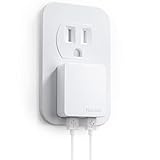
Some outlets are simply hostile to chargers: behind a sofa, under a floating shelf, in a hotel room where the socket is recessed into a headboard, or on a power strip where a cube-shaped brick would eat two slots. The Nekmit ultra-thin flat charger exists for those places. It is a two-port USB-A unit in a white housing designed to sit almost flush against the wall, with a Smart IC that auto-detects what is plugged in and allocates output accordingly.
Key specs
- Two USB-A ports
- Smart IC auto-detect and output allocation
- Ultra-thin flat housing, white finish
- Fast-charge standard: none — standard 5V USB-A output
- Positioned in the premium price band on build and form factor rather than wattage
What you are actually paying for
This is the clearest example on the list of a charger whose price is not explained by its wattage. You are paying for depth — or the lack of it. A flat charger that sits under half an inch proud of the wall solves problems that no amount of extra wattage can solve: it fits behind furniture, it survives being brushed by a suitcase in a hallway, and it does not lever itself out of a loose socket the way a heavy cube does.
“Smart IC” is worth understanding rather than dismissing. It is not a fast-charging standard and it does not negotiate Power Delivery — USB-A ports physically cannot. What it does is sense the current draw of whatever is connected and adjust output to match, rather than dumping a fixed current and letting the device clamp it. In practice this means slightly cooler running and slightly better efficiency on low-draw devices like earbuds and watches, plus protection against over-current if a cable shorts.
Pros
- Extremely low profile — the flattest practical option for recessed or obstructed outlets
- Will not block the second socket of a duplex outlet or a power strip slot
- Smart IC allocation runs cooler with small accessories
- Clean white housing suits visible locations like kitchens and hallways
Cons
- No Power Delivery, so no fast charging for modern phones
- Premium price for legacy 5V output
- Two ports only, both USB-A
- Thin housings generally have less thermal mass, so sustained high load warms them more
How it compares
The obvious alternative is the OKRAY flat and foldable dual USB-A charger, which also targets a low-profile footprint but does it at a budget price with folding prongs for travel. Nekmit wins on finish, depth and the Smart IC behaviour; OKRAY wins on price and packability. If the charger is going to live permanently in a visible wall socket, the Nekmit’s build justifies the tier. If it is going into a travel bag and getting scratched, the OKRAY makes more sense.
4. FOBSUNLAND USB Wall Plug 5V 2A – Best for a Single Low-Cost Spare

Not every purchase needs a strategy. Sometimes you need one more charger, cheaply, for a guest room, a garage bench, an office drawer or a spare cable that has been homeless for months. The FOBSUNLAND USB wall plug is exactly that: a single-port USB-A adapter rated at 5V and 2A, which is 10W. It is the simplest object on this list, and there is a case for that.
Key specs
- One USB-A port
- Output: 5V at 2A (10W)
- Compact cube housing, fixed prongs
- Compatibility listed broadly across phones, tablets and accessories
- Fast-charge standard: none
Where a single-port 10W charger still makes sense
There are three situations where 10W and one port is the correct answer rather than a compromise. The first is overnight charging of a single device, where speed is irrelevant because you are asleep for eight hours. The second is low-draw hardware — security cameras, smart speakers, e-readers, Bluetooth receivers, LED strips — which never asks for more than 5W and will not benefit from a 30W charger. The third is a location where the charger may be forgotten, borrowed or lost, and where spending premium money is simply wasteful.
What it will not do is keep up with a modern phone during the day, and it will not charge a tablet in any reasonable time. A large tablet drawing from a 10W source can take five hours or more from empty, and if the screen is on during that time the charge may barely move at all. That is a physics limit, not a fault of this specific unit.
Pros
- Lowest spend on the list for a working single-port charger
- Small enough to leave plugged in permanently without being noticed
- Fine for overnight phone charging and all low-draw accessories
- Simple, with nothing to configure or misunderstand
Cons
- One port only — no sharing, no second device
- 10W will charge a modern phone slowly and a tablet very slowly
- No fast-charge standard of any kind
- Fixed prongs make it bulkier in a bag than a folding design
How it compares
Against the LUOATIP three-pack, the maths is straightforward: for a modest step up in price you get three dual-port chargers instead of one single-port charger. The FOBSUNLAND unit only wins if you genuinely need exactly one, or if you want the absolute minimum spend. If there is any chance you will want a second charging location within a year, the three-pack is the better decision.
5. VPSUN USB C Wall Charger, Super Thin Flat 4-Port – Best for Maximum Ports in a Flat Body

The VPSUN charger is the answer to a specific frustration: you want four ports, but you also want the charger to disappear into the wall rather than stick out like a suitcase. It combines a 20W USB-C Power Delivery port with three USB-A ports in an unusually thin flat housing. It sits at the premium end of the market, and the premium is mostly about depth and finish rather than raw wattage.
Key specs
- Four ports total: one USB-C, three USB-A
- USB-C port: 20W with USB Power Delivery
- Super-thin flat housing
- Fast-charge standard: Power Delivery on USB-C, legacy 5V on USB-A
- Premium price tier
The engineering trade-off behind “super thin”
Flat chargers are harder to build than cubes, and it is worth knowing why. A cube has volume in every direction, which gives the internal components room to spread out and heat to dissipate across a larger surface area. A flat charger compresses the same electronics into a shallow slab, so the designer has to be more careful about thermal paths and about component placement near the wall-facing side.
That is also why thin chargers tend to be rated more conservatively relative to their physical size, and why you should not expect a flat four-port unit to run cool while simultaneously pushing 20W into a phone and 5W into three accessories for hours. Warm to the touch is normal and expected. Hot enough that you would not hold it is not, and that applies to every charger on this list, not just this one.
Pros
- Four ports in a body thin enough for recessed or obstructed outlets
- Genuine 20W Power Delivery on the USB-C port
- Best combination of port count and low profile on this list
- Premium housing finish and build quality
Cons
- Premium price for 34W-class shared output
- Four ports share the total, so simultaneous heavy use is not possible
- Thin housings have less thermal mass and warm up faster under sustained load
- USB-A ports do not fast-charge modern phones
How it compares
This is the direct premium counterpart to the BUDI four-port flat charger, and the two are close enough that the decision comes down to one question: how much does depth matter? If the outlet is behind furniture, in a recessed box, or on a strip where space is tight, the VPSUN’s thinner body is worth the premium. If the outlet is out in the open and nobody will ever brush past it, the BUDI delivers the same port layout for less, and the extra depth costs you nothing.
6. MOTIVE Flat Wall Charger 35W, Dual Port – Best for Tablet Plus Phone

Thirty-five watts across two ports is the point where a wall charger stops being a phone accessory and starts being a small power station. The MOTIVE flat charger pairs a USB-C port capable of USB Power Delivery fast charging with a USB-A port for legacy devices, in a flat body designed to sit close to the wall. It is the pick for anyone whose nightly routine involves a phone and a tablet, or a phone and a small laptop.
Key specs
- Total output: 35W shared across two ports
- USB-C port: USB Power Delivery fast charging
- USB-A port: legacy 5V output
- Flat housing, low profile against the wall
- Premium price tier
Why 35W is a meaningful step above 20W
A phone will not charge much faster on 35W than on 20W — most phones cap their own intake well below that, and the charge controller inside the phone decides the rate regardless of what the charger offers. The value of 35W is not phone speed; it is simultaneous speed. If a tablet needs 30W to charge at its full rate and a phone needs 20W, a 20W charger can only serve one of them properly. A 35W charger with two ports can allocate meaningfully to both, even if neither gets its theoretical maximum at the same moment.
That is the practical argument for paying the premium tier here. You are buying the ability to run two medium-demand devices at once without one of them crawling. If you only ever charge one device at a time, the same money buys you nothing over a good 20W unit.
Pros
- 35W is enough to charge a tablet or small laptop properly
- Two ports, so a phone and a second device can run at once
- Flat body stays out of the way and keeps the adjacent socket clear
- Power Delivery on USB-C covers iPhone and Android fast charging alike
Cons
- Premium price for two ports
- 35W is shared, so both ports at full demand will not both be satisfied
- No USB-A fast-charge standard for older Quick Charge handsets
- Overkill if your only device is a phone
How it compares
The nearest alternative is the INIU 30W two-port charger. INIU offers 30W in a compact, travel-friendly cube; MOTIVE offers 35W in a flat body. That 5W gap matters if you are charging a tablet, and the flat shape matters if the outlet is awkward. If you travel constantly and want the smallest possible two-port charger, INIU is the better call. If the charger lives permanently in a wall and has to handle a tablet, MOTIVE is worth the extra tier.
7. AILKIN 2Pack USB Wall Charger Plug, 2.4A Dual Port – Best for Two-Nightstand Setups
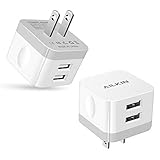
Two chargers, two rooms, done. The AILKIN two-pack targets the most common real-world configuration there is: one charger on each side of a bed, or one at home and one at the office. Each unit has two USB-A ports rated at 2.4A, which is 12W per port — the top of the legacy USB-A range and meaningfully quicker than the 2.1A units that dominate the budget tier.
Key specs
- Pack contents: two identical dual-port chargers
- Output: 2.4A at 5V per port (12W)
- Two USB-A ports per unit
- Compact cube housing
- Fast-charge standard: none, but at the ceiling of legacy USB-A output
What 2.4A buys you over 2.1A
It sounds like a rounding error, but 2.4A sits at a meaningful threshold. Twelve watts is the maximum that standard USB-A charging can deliver without a proprietary fast-charge protocol, and it is also the rate that several generations of tablets and phones were designed around. Devices from that era will often display a fast-charge indicator at 2.4A and a plain charging indicator at 2.1A or below, because the device is checking whether the source can meet its expected current.
On a modern phone, 2.4A will still be slower than Power Delivery — roughly two hours to full versus about eighty minutes — but it will not be the painfully slow trickle that a 1A port produces. For overnight charging, which is how most people actually use a bedside charger, the difference between 12W and 20W is invisible. You plug in at eleven and unplug at seven either way.
Pros
- Two chargers in one purchase, ideal for matched bedside or home-office setups
- 12W per port is the fastest legacy USB-A output available
- Two ports per unit, so a phone and a watch can share one outlet
- Better speed-per-unit than the cheaper 2.1A three-packs
Cons
- No Power Delivery, so no modern fast charging
- 12W is shared between two ports when both are occupied
- Cube shape can block the second socket of a duplex outlet
- Fixed prongs are less travel-friendly than folding designs
How it compares
Against the LUOATIP three-pack, this is a straight trade of quantity for quality: two chargers at 12W per port, or three chargers at roughly 10.5W per unit. If you need three locations covered, LUOATIP wins on coverage. If you need two locations and want the fastest legacy speed available, AILKIN is the better buy, and the difference is noticeable on older tablets that draw hard on a USB-A port.
8. INIU USB C Charger, 30W Type C Fast Charging, 2-Port – Best Overall for Phone Plus Accessory

If you want one charger that handles the widest range of everyday situations with the fewest compromises, this is it. The INIU 30W two-port adapter combines a USB-C port with USB Power Delivery and a USB-A port for legacy gear, in a compact body that is genuinely portable. Thirty watts is the point where a single charger covers a phone at full speed, a second small device, and — with the right cable — a tablet or a thin laptop at a usable rate.