Key takeaways
- Drive: all-terrain tracks, low center of gravity
- Stated slope capability: 45-degree climbing
- Power: gas-electric hybrid, high-output
- Control: remote operation, operator stands clear of the slope
- Cut width: narrower than a 42–54 in. tractor deck (the main productivity cost)
- Best ground: steep banks, soft soil, wet or loose surfaces
The best riding mower for rough terrain overall is the Husqvarna TS 120 (42 in.) 19 HP Briggs lawn tractor. It pairs a 19 HP Briggs & Stratton engine and a hydrostatic transmission with the steering-wheel control, larger front tires and lower seating position that keep a machine predictable when the ground is uneven or sloped, and its 42 in. deck clears most gate openings and tree gaps without a second pass. It suits homeowners with roughly half an acre to two acres of mixed lawn — bumps, surface roots, a ditch bank, a couple of grades — who want to finish in one go. If your ground is genuinely steep, above roughly 20 degrees, no conventional rider is the right answer: the INFRONT remote-control tracked mower is rated to 45 degrees with the operator standing safely off the slope. If your terrain is wide and mostly flat but littered with obstacles, the Husqvarna Z254F 54 in. zero-turn is much faster. And if your “rough terrain” is really a small, level yard you push across, the budget pick is the American Lawn Mower 1304-14GC.
Top 3 Picks
Best overall: Husqvarna TS 120 (42 in.) 19 HP Briggs Lawn Tractor
The most balanced choice for uneven residential ground. Hydrostatic foot control gives you fine speed modulation over bumps, the 42 in. two-blade deck fits through standard gates, and the steering-wheel layout is far more stable on side slopes than lever-steered zero-turns of similar price. It is the machine to buy if you have one mower and several kinds of ground.
Best budget: American Lawn Mower 1304-14GC 14 in. 5-Blade Reel Mower with Grass Catcher
A five-blade reel with a catcher for a fraction of the cost of anything powered, and the cleanest cut on this list. It suits small, level, well-kept lawns where the “rough terrain” is a couple of tree roots rather than a hillside. It is also the only mower here you can hang on a wall.
Best premium for extreme terrain: INFRONT Remote Control Lawn Mower
Tracked, hybrid-powered and rated for 45-degree climbing, this is the answer when a slope is too steep or too soft for a ride-on. You operate it from level ground with a remote, which removes the single biggest cause of mower accidents on banks. Expect a narrower cut and a higher price than any conventional rider.
Best for wide, obstacle-heavy acreage: Husqvarna Z254F 54 in. 23 HP Kawasaki Zero Turn
A 54 in. deck and a 23 HP Kawasaki engine put this in a different productivity class — roughly 2.5 acres per hour of real cutting. Dual-lever steering lets you pivot around trees and beds instead of making three-point turns. It is the fastest way to mow a large, mostly open property, provided the slopes stay gentle.
Quick Comparison
| Product | Best for | Key specs | Price tier |
|---|---|---|---|
| INFRONT Remote Control Lawn Mower | Steep banks, soft ground, unsafe slopes | Tracked drive; rated to 45° climb; gas-electric hybrid; remote operation | Premium |
| Husqvarna TS 120 (42 in.) 19 HP Briggs Lawn Tractor | Mixed residential terrain, 0.5–2 acres | 42 in. deck; 19 HP Briggs & Stratton; hydrostatic transmission; ~1.3 acres/hr realistic | Premium |
| Husqvarna Z254F 54 in. 23 HP Kawasaki Zero Turn | Wide, mostly flat acreage with obstacles | 54 in. deck; 23 HP Kawasaki; dual hydrostatic levers; ~2.5 acres/hr realistic | Premium |
| VEVOR Heavy Duty ATV Tow Behind Dump Cart | Hauling heavy debris and soil | 17 cu. ft. capacity; 600 lb load rating; steel bed; tow-behind | Premium |
| American Lawn Mower 1204-14 Push Reel | Small level lawns, lowest cost | 14 in. cut; 4-blade reel; manual push; no fuel or cord | Budget |
| LawnMaster MEB1114K Corded Electric | Small yards within reach of an outlet | 15 in. cut; 11 amp motor; corded; ~100 ft practical cord reach | Mid-range |
| American Lawn Mower 1304-14GC Reel with Catcher | Small lawns with clipping collection | 14 in. cut; 5-blade reel; grass catcher included | Budget |
| Litheli Cordless Electric Mower | Cord-free small yards | 13 in. cut; rated 1,300 sq. ft. per charge; battery powered | Mid-range |
| AR-PRO 11×4.00-5 Flat Free Front Tire and Wheel | Ending front-tire flats on riders and ZTRs | 11 in. OD; 4.00 in. width; 5 in. rim; solid flat-free; turf profile | Budget |
| AUTOSAVER88 500 lb Tow Behind Dump Cart | Everyday hauling on a budget | 500 lb load rating; removable sides; steel bed; tow-behind | Mid-range |
| QEL 20×8.00-8 Rear Tire and Wheel Assembly (2 Pack) | Restoring rear traction, pair replacement | 20 in. OD; 8.00 in. width; 8 in. rim; 4-ply tubeless; two wheels | Mid-range |
| Marastar 20808-TO 20×8.00-8 Tire Only | Cheapest rear tire refresh | 20 in. OD; 8.00 in. width; 8 in. rim; tubeless; turf tread; tire only | Budget |
How We Chose
This roundup covers two things that belong together on rough ground: the machines that do the mowing, and the traction and hauling hardware that decides whether a machine survives a season of it. Selection was based on published manufacturer specifications, standard tire-sizing conventions, deck construction and transmission class, and the operating limits manufacturers state in their own manuals — not on trial runs. We compared spec classes rather than anecdotes: deck width and material, engine displacement and horsepower class, transmission type, tire dimensions, load ratings and stated slope capability.
Category fit came next. A tracked remote mower, a 54 in. zero-turn and a 14 in. reel mower solve completely different problems, so each entry is judged against the terrain it was built for rather than against the others. Use case drove the shortlist: slope angle, ground clearance, obstacle density, distance from an outlet, and whether the yard needs debris hauled off it. Finally, upgrade path: replacement tires, blades, belts and spindles are consumables, and a machine only makes sense if those parts are standard sizes you can buy again in three years. Items that lock you into a proprietary size or an unusual rim diameter were marked down.
1. INFRONT Remote Control Lawn Mower – Best for Steep Banks and Slopes
As an Amazon Associate we earn from qualifying purchases at no extra cost to you.

The INFRONT is the entry on this list that changes what is physically possible on a property. A conventional riding mower is limited to roughly 15 degrees of slope before traction and tip-over risk make it unsafe; this machine is rated for 45-degree climbing, which is close to 100 percent grade — a slope so steep that standing on it is difficult. It achieves that with tracks instead of wheels and a gas-electric hybrid drivetrain that keeps torque available at low ground speed. It suits homeowners with a bank, a pond edge, a drainage ditch or a hillside that has been going unmowed for years.
The most important feature is not the climbing rating, it is the remote. On a slope steep enough to matter, the operator is the least stable part of the system — a ride-on mower on a 25-degree bank is a rollover waiting for one bad tire bite. Standing on level ground with a controller removes that risk entirely and also puts you out of the path of thrown debris. Tracked drive spreads weight over a long, wide contact patch, which is why the machine holds on soft, wet or loose ground that would spin a pneumatic turf tire immediately.
The trade-offs are real. Tracked mowers cut narrower than a tractor deck, so a large open lawn takes considerably longer than it would with a 42 in. or 54 in. machine. Tracks are also harder on turf than turf tires when you turn — they scuff more on damp, established lawns. And the hybrid powertrain adds a second system to maintain: fuel, oil and filters on one side, batteries and charge cycles on the other. That is the price of the capability.
- Drive: all-terrain tracks, low center of gravity
- Stated slope capability: 45-degree climbing
- Power: gas-electric hybrid, high-output
- Control: remote operation, operator stands clear of the slope
- Cut width: narrower than a 42–54 in. tractor deck (the main productivity cost)
- Best ground: steep banks, soft soil, wet or loose surfaces
Pros
- Handles slopes that no wheeled residential mower can safely attempt
- Keeps the operator off the bank entirely, which is the biggest safety gain available
- Tracked footprint holds traction on soft, wet and loose ground
- Hybrid drivetrain delivers torque at very low ground speed
Cons
- Premium tier — the highest-cost item in this roundup by a wide margin
- Narrower cut means much slower coverage on large open lawns
- Tracks can scuff damp turf more than turf-tread tires
- Two power systems to maintain, and more components to fail
Compared with the Husqvarna TS 120 — the other machine here that is genuinely competent on slopes — the choice comes down to angle. Up to about 15 degrees, dry, the TS 120 is faster, cheaper to run and more comfortable, and it also cuts a 42 in. swath. Past 20 degrees, the TS 120 is the wrong tool regardless of how careful you are, and the INFRONT is the only sensible option on this list.
2. Husqvarna TS 120 (42 in.) 19 HP Briggs Lawn Tractor – Best for Mixed Residential Terrain
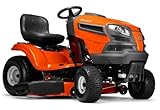
The TS 120 is the default answer for a suburban or rural-residential lot with a bit of everything: a front lawn that is mostly flat, a back section that slopes toward a fence, a few surface roots and a strip along the driveway that collects gravel. The 19 HP Briggs & Stratton engine and hydrostatic transmission are the two specs that matter most here, because on uneven ground you want torque at low speed rather than top-end speed you cannot use.
Hydrostatic drive is the key feature for rough terrain. Instead of selecting a gear and living with it, you modulate speed continuously with a pedal, which means you can crawl over a root zone, speed up across open grass, and slow down before a ditch without stopping. Combined with a steering wheel and a low seating position, it makes the machine predictable — the front wheels track where you point them, and the operator’s weight sits well inside the wheelbase rather than perched over the rear axle as it is on a zero-turn.
The 42 in. deck is a deliberate compromise and generally the right one for rough ground. It fits through a standard 48 in. gate, it leaves room to maneuver between trees, and its two blades are cheaper and faster to sharpen or replace than a three-blade 54 in. assembly. The narrower deck also reduces the machine’s overall width, which matters on side slopes where you want to keep the uphill wheels on solid ground.
Realistic productivity is around 1.3 acres per hour. That figure comes from deck width times ground speed: 42 in. is 3.5 ft, and at 4 mph you cover 352 ft per minute, or about 1,232 sq. ft. per minute in ideal conditions — roughly 1.7 acres per hour theoretical, and about 1.3 acres per hour once you allow for turns, overlap and slowing down on the rough sections. For a one- to two-acre property with obstacles, that is a comfortable single-session job.
- Deck: 42 in., two-blade
- Engine: 19 HP Briggs & Stratton
- Transmission: hydrostatic, foot-controlled
- Steering: wheel, front-axle steer
- Realistic coverage: ~1.3 acres per hour
- Practical slope ceiling: ~15 degrees, dry
- Gate clearance: fits a standard 48 in. opening
Pros
- Hydrostatic control gives fine speed modulation over bumps and roots
- Wheel steering and low seating make side slopes far less nerve-racking than a zero-turn
- 42 in. deck fits gates and threads between obstacles
- Standard tire and blade sizes — replacements are easy to source for years
Cons
- Slower than a zero-turn on open ground with few obstacles
- No suspension — rough ground transfers directly to the operator
- Premium tier for a lawn tractor; the deck is stamped steel, not fabricated
- Ground clearance is modest; deep ruts and stumps are still off-limits
Against the Z254F, the TS 120 trades speed for stability and control. If your property is wide and open with gentle grades, the zero-turn will finish in about half the time. If it is broken up by beds, trees, fences and a slope or two, the tractor is the calmer machine to live with, and it is the one that will not leave you white-knuckled on a cross-slope.
3. Husqvarna Z254F 54 in. 23 HP Kawasaki Zero Turn – Best for Wide Acreage With Obstacles
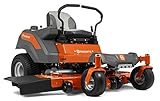
The Z254F is a productivity machine. A 54 in. deck and a 23 HP Kawasaki engine put it in a different class from any lawn tractor here, and dual hydrostatic levers let you pivot on the spot rather than swinging a wide arc around every tree. It suits owners of one to four acres of mostly open, mostly even ground with a scattering of obstacles — fruit trees, fence lines, a shed, a couple of beds — where the limiting factor is time rather than terrain severity.
The numbers explain why. A 54 in. deck is 4.5 ft wide. At 6 mph you cover 528 ft per minute, which is 2,376 sq. ft. per minute — about 3.3 acres per hour theoretical, and roughly 2.5 acres per hour in practice after overlap, turns and slowing for obstacles. That is close to double the TS 120’s real-world rate. On a three-acre property, that difference is the gap between a two-hour job and a one-hour job, every single week of the season.
Where a zero-turn struggles is exactly where rough terrain gets serious. With no suspension and the operator seated over the rear axle, bumps arrive with more leverage. Zero-turns are also less stable on side slopes than tractors of similar size, and most manufacturers advise keeping them off slopes that a lawn tractor would handle without drama — particularly when the grass is wet. The 54 in. deck also raises the machine’s overall width, so a 48 in. gate becomes a barrier.
Traction comes down to tires, and this is where the aftermarket entries in this roundup earn their place. Rear tires in the 20×8.00-8 class are the standard fitment on machines like this, and a 4-ply tubeless turf tire at correct pressure is what keeps the rear end planted when you are turning on a slight grade. Letting rear pressure drift low is one of the most common causes of turf scuffing and poor grip on a zero-turn, and it is free to fix.
- Deck: 54 in.
- Engine: 23 HP Kawasaki
- Transmission: dual hydrostatic, lever-controlled
- Steering: zero-turn radius — pivots in place
- Realistic coverage: ~2.5 acres per hour
- Practical slope ceiling: lower than a tractor; avoid wet cross-slopes
- Tire class: 20×8.00-8 rear fitment, turf tread
Pros
- Roughly double the cutting rate of a 42 in. lawn tractor
- Zero-turn radius means far less trimming and fewer three-point turns
- 23 HP Kawasaki engine holds power in tall or thick grass
- Wide deck reduces total passes on large open areas
Cons
- Unstable on side slopes compared with a steering-wheel tractor
- No suspension; rough ground is punishing over a long session
- 54 in. deck will not fit through a standard gate
- Premium tier, and higher ongoing costs for blades and belts
The nearest alternative in this list is the TS 120, and the decision is a straightforward trade. Choose the Z254F if your land is open and your slopes are gentle — the time savings are substantial. Choose the TS 120 if your land is chopped up by obstacles or includes banks you have to cross sideways, because that is the situation where a zero-turn stops being fun.
4. VEVOR Heavy Duty ATV Tow Behind Dump Cart – Best for Hauling Heavy Debris

Rough terrain does not only slow mowing down — it also means you cannot wheel a barrow across the yard. The VEVOR dump cart is a 17 cu. ft. steel-bed tow-behind rated for 600 lb, which puts it in the top capacity class of residential yard carts. It suits anyone clearing brush, moving topsoil, hauling gravel to a drainage problem, or dragging fallen limbs out of a back section that a wheelbarrow cannot reach.
To put 17 cu. ft. in perspective: that is roughly two and a half standard wheelbarrow loads in a single trip, and at 600 lb it will carry a full load of damp topsoil without complaint. The dump function is the second half of the value — you tow it to the drop point, release the bed and tip, rather than shoveling out of a stationary box. On a property where the drop point is 200 ft from the source, that saves a genuinely large amount of labor over a season.
For rough ground specifically, a tow-behind cart has an advantage over a powered utility vehicle: it has no engine, no drivetrain and no steering to go wrong, and it follows your mower or ATV over ground you already know is passable. The limitations are equally clear. It relies on the towing machine for traction and braking, so it should not be loaded to 600 lb behind a small tractor on a downhill slope — a loaded cart can push the tow vehicle. Keep loads moderate on grades and tow with something that has real brakes.
This is the premium-tier option among the carts here, and the extra cost buys capacity and steel construction. If your hauling is occasional and light, the AUTOSAVER88 cart below covers most of it for less. If you are moving soil and gravel regularly, the capacity difference pays for itself quickly.
- Capacity: 17 cu. ft.
- Load rating: 600 lb
- Bed: heavy-duty steel, dump/tilt function
- Hitch: tow-behind, ATV and mower compatible
- Best use: soil, gravel, brush, storm debris
Pros
- 17 cu. ft. and 600 lb — among the largest residential capacities
- Dump function removes most of the shoveling
- No engine or drivetrain to maintain
- Steel bed stands up to rock and log loads
Cons
- Premium tier — more than most homeowners need
- A fully loaded cart can push a light tow vehicle downhill
- Steel bed will rust if left loaded and wet
- Takes up real storage space
Compared with the AUTOSAVER88 cart, the VEVOR is the higher-capacity, higher-cost choice. The 600 lb rating and 17 cu. ft. box make it the right call if you are moving bulk material; the AUTOSAVER88’s 500 lb rating and removable sides make it the smarter call for lighter, more varied loads where you want to slide long items in from the side.
5. American Lawn Mower 1204-14 Push Reel Mower – Best for Small Lawns on a Tight Budget

The 1204-14 is a 14 in., four-blade push reel mower — no engine, no cord, no battery. It suits a specific reader: someone with a small, level, reasonably maintained lawn who wants the lowest possible cost of ownership and does not mind the physical effort. It is also the only mower here that produces no emissions, no noise and no fuel storage problem, which matters on smaller suburban lots.
A reel mower cuts differently from a rotary. Instead of a single blade whipping past at high speed, four helical blades scissor against a bed knife, which is why a reel produces the cleanest cut available — it slices grass like scissors rather than tearing it. A clean cut surface loses less moisture and is less prone to disease, so a reel-mowed lawn often looks noticeably better at the same mowing height. That is a genuine quality argument, not a budget compromise.
The honest limitations start with the terrain. A reel mower needs a flat bed knife running against a flat surface, so bumps, roots and ruts cause scalping and a racket, and the reel will ride over tall or wet grass rather than cutting it. Fourteen inches is a narrow swath: on a 2,000 sq. ft. lawn that is roughly 1,400 linear feet of walking with overlap, and on anything above about a quarter acre the effort stops being reasonable. It is also unforgiving of infrequent mowing — a reel is a weekly tool, not a monthly one.
Maintenance is simple but not zero. The blades need annual sharpening or lapping and the bed knife needs adjustment, which most owners can do with a lapping kit. Keep the reel dry and oiled and it will outlast several gas mowers. Realistically, a four-blade reel gives a slightly less refined cut than a five-blade, and that is the single biggest difference between this mower and the 1304-14GC below.
- Cut width: 14 in.
- Reel: 4-blade
- Power: manual push
- Best lawn size: up to roughly 2,000–3,000 sq. ft.
- Maintenance: annual blade sharpening or lapping, bed knife adjustment
- Storage: hangs on a wall
Pros
- Lowest purchase and running cost of anything here
- Cleanest cut type — slices rather than tears grass
- No fuel, cord, battery or engine maintenance
- Light enough to lift, hang and carry through a gate
Cons
- Requires physical effort and a flat lawn
- Scalps and stalls on roots, ruts and bumps
- Needs mowing weekly; will not handle long grass
- Narrow 14 in. swath means many passes
The nearest alternative is the 1304-14GC, its five-blade sibling. The fifth blade gives a finer cut and the included catcher saves raking, at a modest cost increase. If you are choosing between the two, pick the 1304-14GC unless budget is the single deciding factor — for a small lawn, the catcher alone is worth it.
6. LawnMaster MEB1114K Electric Corded Lawn Mower – Best for Small Yards Near an Outlet

The MEB1114K is a 15 in., 11 amp corded electric mower. It suits a homeowner with a small to mid-sized lawn — call it up to about a quarter acre — where the mowing area is within practical reach of an outdoor outlet, and where the appeal of instant starting, no fuel and no battery charging outweighs dragging a cord.
An 11 amp motor on a 15 in. deck is a reasonable match: enough power for regular residential grass at a normal mowing height, with a lighter overall machine than a comparable gas mower. Electric motors also deliver their torque immediately, so there is no pull-start ritual, no choke, no oil changes and no carburetor to clog — the maintenance list shrinks to blades and the occasional cord inspection. For anyone who has spent twenty minutes trying to start a cold gas engine, that is a real quality-of-life improvement.
The cord is the defining constraint. Practical reach is around 100 ft with a heavy-gauge outdoor extension cord, and every foot of that must run from the outlet to the far corner of the lawn without crossing where you have already mowed, which is more difficult than it sounds. You also need a cord rated for the motor’s draw; an undersized cord causes voltage drop, and the mower will bog down in thick grass. The cord itself is a consumable — expect to replace it eventually, and never run one that has been cut or taped.
On rough terrain, this mower is a level-ground tool. Its wheels are small and it has no suspension, so it does not like ruts or roots, and it should never be used on a wet slope with a cord trailing behind it. If your “rough terrain” is a couple of uneven patches, it will cope. If it is a bank, it will not.
- Cut width: 15 in.
- Motor: 11 amp electric, corded
- Power source: 120 V outlet with outdoor-rated extension cord
- Practical reach: ~100 ft of cord
- Best lawn size: up to roughly a quarter acre
- Maintenance: blades only; no oil, fuel or filters
Pros
- Instant start with no fuel, oil or carburetor maintenance
- Lighter than a comparable gas mower
- Consistent motor torque in normal residential grass
- Mid-range tier and cheap to run
Cons
- Cord limits range and adds a trip hazard
- Not suitable for slopes, especially wet ones
- Small wheels handle ruts and roots poorly
- Requires a properly rated extension cord or it bogs down
The nearest alternative is the Litheli cordless mower. The corded unit has unlimited runtime and more cutting power for the money; the cordless one removes the cord but caps you at a rated 1,300 sq. ft. per charge. If your lawn is small and you hate cords, go cordless. If it is slightly larger and the outlet is well placed, the corded mower is the better value.
7. American Lawn Mower 1304-14GC 14 in. 5-Blade Reel Mower with Grass Catcher – Best for Small Lawns With Clipping Collection

The 1304-14GC is the same 14 in. platform as the 1204-14 but with a five-blade reel and an included grass catcher. The fifth blade is the meaningful upgrade: more blades per revolution means more cuts per inch of forward travel, which produces a finer finish and handles slightly taller grass than a four-blade reel. The catcher means you are not raking afterwards.
This is the budget pick for the whole roundup, and it is the one to choose if your property is small, level and you care about how the lawn looks. A five-blade reel on a well-maintained lawn produces a finish that no rotary mower in this price bracket can match, and it does it with no fuel, no cord and no battery. Push effort on a 14 in. reel is modest on level ground — it is when the ground tilts or the grass gets long that a reel becomes hard work.
The catcher changes the routine in a way worth understanding. Bagging removes clippings, which reduces thatch buildup and keeps the surface clean for the next cut, but it also removes nutrients and moisture, so a bagged lawn typically needs more feeding than a mulched one. On a small lawn, the practical answer is to bag when the grass is long or wet and to let clippings drop when it is dry and short — the catcher is a tool you use selectively, not every week.
Ground clearance is the constraint to plan around. A reel mower sits low because the bed knife has to meet the turf at a consistent height, so a lawn with roots, ruts or a bumpy transition at the driveway edge will scalp and jolt. This is a mower for a lawn that has been leveled and maintained, not one that has been left to develop its own topography.
- Cut width: 14 in.
- Reel: 5-blade (finer cut than 4-blade)
- Power: manual push
- Collection: grass catcher included
- Best lawn size: up to roughly 3,000 sq. ft., level
- Maintenance: annual lapping or sharpening, bed knife adjustment
Pros
- Five-blade reel delivers a noticeably finer cut than four-blade reels
- Grass catcher included — no raking and less thatch
- Lowest-cost option here with the lowest running cost
- No engine, fuel, cord or battery to manage
Cons
- Still physically demanding on any slope or in long grass
- 14 in. cut means many passes on larger lawns
- Bagging removes nutrients, so the lawn needs more feeding
- Low deck height means roots and ruts cause scalping
Against the 1204-14, this model is the better buy for almost everyone. The fifth blade and the catcher together justify the small step up in cost, and both share the same simple maintenance routine and the same wall-storage footprint. Only choose the four-blade version if the price difference is the deciding factor.
8. Litheli Cordless Electric Lawn Mower – Best for Cord-Free Small Yards

The Litheli is a 13 in. cordless battery mower rated for 1,300 sq. ft. per charge. It suits the smallest category of lawn here — courtyard, townhouse patch, a front strip — where a cord is genuinely awkward and a gas mower is overkill. It is the only fully cordless walk-behind in this roundup, and that is its entire reason for existing.
Put 1,300 sq. ft. in perspective, because the number matters more than it looks. That is roughly a 36 ft. by 36 ft. square. With a 13 in. cut — just over a foot wide — and typical overlap, you are looking at somewhere around 1,300 to 1,600 linear feet of walking per full charge, or roughly 10 to 20 minutes of actual cutting depending on pace and grass condition. If your lawn is 2,600 sq. ft., you are looking at two sessions or a second battery, and that is the honest planning figure to use.
The upside is the absence of everything annoying. No fuel to buy or store, no oil changes, no cord to drag, no pull start. You pick it up, press a button and go, and it stores on a shelf or in a closet. Battery mowers are also quiet enough to run early in the morning without annoying neighbors, which is a real practical benefit on small lots where houses are close together.
The limits are capacity and terrain. A 13 in. deck is the narrowest here, so coverage per pass is low; a battery will fade in long or wet grass, and cold weather reduces usable runtime. Small wheels and light weight mean it is a flat-lawn tool — it will not cope with a bank, and on rough ground you will feel every bump through the handlebar. If your ground is genuinely uneven, this is the wrong category entirely.
- Cut width: 13 in.
- Power: cordless battery
- Rated coverage: 1,300 sq. ft. per charge (roughly 36 ft. × 36 ft.)
- Practical session: ~10–20 minutes of cutting per charge
- Best lawn size: under roughly 1,500 sq. ft. per charge
- Maintenance: blade sharpening and battery care
Pros
- No cord, no fuel, no oil — the simplest routine on this list
- Quiet enough for early-morning use on small lots
- Light and easy to store
- Mid-range tier with very low running cost
Cons
- 1,300 sq. ft. per charge is a hard ceiling on lawn size
- 13 in. cut is the narrowest here — many passes
- Runtime drops in long, wet or cold conditions
- Not suitable for slopes or genuinely rough ground
The nearest alternative is the LawnMaster corded mower, which cuts 2 in. wider and runs indefinitely as long as the cord reaches. Choose the Litheli if a cord is impractical or unsafe on your lot; choose the LawnMaster if your lawn is a bit bigger and the outlet is well placed.
9. AR-PRO 11×4.00-5 Flat Free Front Tire and Wheel – Best for Ending Front-Tire Flats on Riders

The AR-PRO is a flat-free front tire and wheel assembly in the 11×4.00-5 size, which is one of the most common front fitments on riding mowers and zero-turn mowers. It suits anyone whose rough terrain has already produced a puncture — thorny ground, gravel drives, construction debris — or anyone who is tired of topping up front tire pressure every few weeks.
Reading the size is worth doing once, because it prevents an expensive mistake. In 11×4.00-5, the 11 is the overall outside diameter in inches, the 4.00 is the section width in inches, and the 5 is the rim diameter in inches. Outside diameter is the number that matters most for fit: swapping an 11 in. tire for a 10 in. one drops the front of the deck by half an inch and changes the machine’s stance. Always match the original outside diameter and rim diameter.
Flat-free construction replaces the air chamber with a solid, dense compound, so the tire cannot go flat and cannot lose pressure. On rough ground that is a genuine advantage — a front tire that goes down mid-job can drop the deck into the turf and gouge the lawn, and on a slope it affects steering response at exactly the wrong moment. The trade-off is ride quality: a solid tire transmits more shock to the deck and the operator than a pneumatic one, and it is heavier.
The turf-friendly profile is the other feature to note. A rounded, ribbed front tire rolls over grass without digging in on turns, which is what you want on a mower that steers with its front wheels. Aggressive tread on a front mower tire tears turf on every turn — flat-free or not, match the tread style to turf, not to mud.
- Size: 11×4.00-5 (11 in. OD, 4.00 in. width, 5 in. rim)
- Construction: flat-free solid, no air chamber
- Tread: turf-friendly profile
- Fitment: common front position on riders and zero-turns
- Maintenance: none — no pressure checks, no punctures
Pros
- Cannot go flat or lose pressure — no mid-job downtime
- Turf-friendly tread avoids tearing grass on turns
- Budget tier, and sold as a complete wheel assembly
- Eliminates the most common cause of uneven deck height
Cons
- Firmer ride than pneumatic; more shock reaches the deck
- Heavier than an equivalent air-filled tire
- No pressure adjustment to fine-tune flotation on soft ground
- Must match original outside diameter exactly or the deck height changes
The nearest alternative is a pneumatic tire in the same size, such as the Marastar or QEL entries here in their respective sizes. Pneumatic tires give a softer ride and can be tuned by pressure; flat-free eliminates the failure mode entirely. If your rough terrain includes thorns or gravel, flat-free front tires are the single most cost-effective upgrade on this list.
10. AUTOSAVER88 500 lb Tow Behind Dump Cart – Best Value Hauling Cart

The AUTOSAVER88 is a heavy-duty tow-behind dump cart rated for 500 lb, with removable sides. It suits the homeowner who hauls regularly but not in bulk — brush, bagged leaves, garden waste, tools, a few loads of mulch — and who wants the flexibility of a cart that converts from a box to a flatbed when the load is long or awkward.
The removable sides are the feature that separates it from a fixed-bed cart. With the panels in place you have a box for loose material; with them off you have a flat platform for fence posts, lumber, a mower deck, or anything that will not fit in a box. That flexibility is worth more than an extra 100 lb of capacity for most residential users, because the awkward loads are the ones that actually require a cart.
At 500 lb, this is a mid-range capacity — enough for a full load of mulch, a decent volume of topsoil, or a season’s worth of brush. As with any tow-behind, the load rating assumes reasonable conditions: on slopes, reduce the load and tow with a machine that has proper braking, because a loaded cart on a downhill grade pushes the tow vehicle rather than following it. Keeping loads to roughly two-thirds of the rating on grades is a sensible habit.
Steel beds need care to last. Empty the cart after every use, particularly after hauling soil or manure, and store it tipped or covered so water does not sit in the bed. Surface rust on a steel cart is normal and cosmetic; rust that reaches the seams is what ends its life. A few minutes with a brush and touch-up paint at the end of each season roughly doubles the service life of a cart in this class.
- Load rating: 500 lb
- Bed: heavy-duty steel with removable sides
- Function: dump/tilt; converts to flatbed
- Hitch: tow-behind, ATV and mower compatible
- Best use: brush, leaves
Affiliate disclosure. As an Amazon Associate we earn from qualifying purchases at no extra cost to you. Prices accurate as of the date shown.Best Riding Lawn Mowers for Rough TerrainCheck price on Amazon