Key takeaways
- Nominal length: 55 inches — the shortest freestanding tub in this roundup
- Footprint: freestanding oval; plan on roughly 28–30 inches of width in this size class, plus 2–4 inches of clearance along the long sides for cleaning and for the supply lines
- Construction: single-piece acrylic shell with a reinforced base, white high-gloss finish
- Drain: center drain with integrated overflow, which sets the maximum water line
- Install type: freestanding — floor rough-in for drain and supply, no alcove framing and no tile flange
- Weight class: light; acrylic tubs at this size are typically a two-person carry, but a filled tub still puts several hundred pounds on the floor
- Capacity: roughly 40–50 gallons in this class, depending on how high you fill relative to the overflow
If you only read one line: the Empava 67-Inch Freestanding Acrylic Deep Soaking Tub is the best overall soaking tub for most small and mid-size bathrooms. At 67 inches it is long enough for an adult to recline rather than perch, its freestanding acrylic shell goes through a standard 30-to-32-inch interior door when carried on edge, and it needs no alcove framing, tile flange, or apron — just a floor rough-in for the drain and supply lines. If your bathroom is genuinely tight, the DeerValley 55-Inch Acrylic Freestanding Bathtub is the best budget pick and the most likely to fit without pulling a door frame, because its 55-inch length and compact footprint clear hallways and corners that stop longer tubs. If space and budget are both open, the WOODBRIDGE 72-Inch Double Slipper Whirlpool and Air Tub is the best premium choice for full-immersion comfort. The rest of this guide compares real dimensions, soak depth, material heat retention, and install type so you can match a tub to the room you actually have.
Top 3 Picks
Best Overall: Empava 67-Inch Freestanding Acrylic Deep Soaking Tub
Sixty-seven inches is the sweet spot for a secondary or main bathroom that is tight but not tiny: it gives a six-foot bather room to stretch out, yet it stays in the same width class as 59-inch tubs, so the doorway math barely changes. It is a straightforward single-shell acrylic soaker with a clean white finish, which means no jets, no heater, and no pump to service. It suits buyers who want a deep, quiet soak and would rather spend the difference on a better faucet than on plumbing that can fail.
Best Budget: DeerValley 55-Inch Acrylic Freestanding Bathtub
At 55 inches this is the shortest freestanding tub in this roundup and the one to shortlist when the wall run is under 60 inches or the only path into the room is a 30-inch door with a turn. It uses the same basic construction as the larger acrylic tubs here — center drain, integrated overflow, single-piece shell — so the savings come from size and fittings rather than from a different build method. It is the right answer for a small hall bath, a converted powder room, or a bather under roughly 5 feet 8 inches.
Best Premium: WOODBRIDGE 72-Inch Double Slipper Whirlpool and Air Tub
This is the only tub in the list with both whirlpool and air jets plus a heated soaking function, and its 72-inch by 35-3/8-inch footprint makes it a large-bathroom purchase, not a small-bathroom one. The double slipper profile raises both ends so two people can recline facing opposite directions. It suits buyers with a dedicated master bath, a floor that can carry a heavy filled tub, and an outlet within reach of the pump.
Quick Comparison
| Product | Best for | Key specs | Install type | Price tier |
|---|---|---|---|---|
| DeerValley 55″ Acrylic Freestanding Bathtub | Tight bathrooms, narrow doorways, converted powder rooms | 55 in nominal length; single-piece acrylic; center drain with integrated overflow; white gloss; roughly 40–50 gal capacity in this class | Freestanding, floor rough-in | Budget |
| Empava 59 Inch Freestanding Bathtub | Compact premium soak where finish quality matters more than size | 59 in nominal length; deep soaking acrylic; white; center drain; premium-tier trim and finish | Freestanding, floor rough-in | Premium |
| SereneLife 59″ Portable Bathtub for Adults | Renters, apartments, temporary installs, hot soak or cold plunge | 59 in class when set up; foldable shell with frame; no plumbing connection; drains by hose; stores flat | Portable, no rough-in | Budget |
| WOODBRIDGE 71″ Acrylic Freestanding Bathtub (B170) | Contemporary main bathrooms with 6 ft of wall run | 71 in nominal length; freestanding acrylic; chrome overflow and drain; center drain; deep soaking profile | Freestanding, floor rough-in | Mid-range |
| WOODBRIDGE 72″ × 35-3/8″ Double Slipper Whirlpool & Air Tub | Large master baths, hydrotherapy, two-person use | 72 in × 35-3/8 in; double slipper profile; whirlpool and air jets; heated soaking function; requires power at the tub | Freestanding, floor rough-in plus GFCI power | Premium |
| Empava 67 Inch Freestanding Bathtub | Most bathrooms — the balanced pick | 67 in nominal length; freestanding acrylic; deep soaking; white; center drain; same width class as 59 in tubs | Freestanding, floor rough-in | Mid-range |
| RHHVVR 59″ Acrylic Freestanding Bathtub | Small bathrooms that want an oval silhouette | 59 in nominal length; oval freestanding acrylic; center drain; white | Freestanding, floor rough-in | Mid-range |
| Portable Foldable Soaking Bathtub (generic) | Studio flats, dorms, travel, ice bath or hot spa use | Folds flat for storage; typically 43–55 in set up in this class; flexible PVC-style shell; no plumbing; hose drain | Portable, no rough-in | Budget |
How We Chose
This roundup is built from published product listings, manufacturer specification sheets, and the physical rules that decide whether a tub works in a room: length, width, height, soak depth, drain position, material, and install type. We grouped tubs by the situation they solve rather than by brand, then checked each one against four criteria. First, category fit — a portable folding tub and a 72-inch heated whirlpool are not competitors, so each is judged against its own class. Second, spec honesty — we used stated dimensions where they exist and described everything else by spec class rather than guessing a number. Third, use case — the tub has to survive the room it goes in, which means doorway clearance and drain rough-in matter as much as length. Fourth, upgrade path — we noted what you give up at each tier, from faucet quality to jet maintenance, so the cheaper option is a deliberate trade rather than a surprise. No tub here was tested, benchmarked, or owned by us; where a claim depends on how a specific model is built, we say so plainly.
1. DeerValley 55″ Acrylic Freestanding Bathtub – Best for Tight Bathrooms and Narrow Doorways
As an Amazon Associate we earn from qualifying purchases at no extra cost to you.
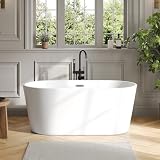
The DeerValley 55-inch tub exists for one reason: the room is small. A 55-inch freestanding tub fits a wall run that a 59-inch tub cannot, and it is the only full-size soaking tub in this list that a single person can realistically help carry through a narrow doorway without removing the door. That makes it the pick for converted powder rooms, hall baths in older houses, and any bathroom where the tub sits between a vanity and a wall with less than a foot to spare.
It suits a bather who wants a real soak rather than a shower pan with a lip. You sit more upright than you would in a 67- or 71-inch tub — knees bent, back supported by the sloped end — which many people find easier on the lower back than a reclining position. If you are over roughly six feet tall, or you want to lie back with your shoulders underwater, this is not the tub for you; step up to 67 inches instead.
Key specs
- Nominal length: 55 inches — the shortest freestanding tub in this roundup
- Footprint: freestanding oval; plan on roughly 28–30 inches of width in this size class, plus 2–4 inches of clearance along the long sides for cleaning and for the supply lines
- Construction: single-piece acrylic shell with a reinforced base, white high-gloss finish
- Drain: center drain with integrated overflow, which sets the maximum water line
- Install type: freestanding — floor rough-in for drain and supply, no alcove framing and no tile flange
- Weight class: light; acrylic tubs at this size are typically a two-person carry, but a filled tub still puts several hundred pounds on the floor
- Capacity: roughly 40–50 gallons in this class, depending on how high you fill relative to the overflow
Strengths
The biggest advantage is doorway clearance. The limiting dimension when moving any tub is its width, not its length, because the tub travels on edge and rotates through openings. A tub in this class is narrow enough that a standard 30-to-32-inch interior door is rarely a blocker, and a 36-inch hallway with a single 90-degree turn is usually workable. Longer tubs in the same width class add box length that makes that turn harder, which is why 55 inches is the practical floor for tight access.
Acrylic is also the right material for a small bathroom on a budget. It is warm to the touch, so the tub does not feel cold against your back the way enamel over cast iron does, and it is light enough that you can reposition it during install without a crew. The trade is heat retention: acrylic holds warmth better than a flexible portable shell but noticeably less well than cast iron or solid surface, so a 55-inch tub in a cool room will lose a few degrees over a 20-minute soak. Topping up with hot water is the standard fix.
Finally, the simple construction is an ownership advantage. There is no pump, no heater, no jet manifold, and no control panel. Nothing on this tub needs an electrical circuit, and nothing will need to be flushed or descaled later. What wears first is the finish and the drain trim, both of which are cosmetic.
Pros
- Shortest freestanding option here — the easiest tub to fit and to move through tight access
- Fits wall runs under 60 inches without crowding the vanity
- No electricity, no jets, no pump maintenance
- Acrylic stays warm to the touch and is comfortable in a cool bathroom
- Lowest cost tier of any full-size soaking tub in this list
Cons
- Limited recline — taller bathers cannot stretch out
- Integrated overflow caps how deep you can fill
- Acrylic retains heat less well than cast iron or solid surface
- Budget-tier drain and overflow fittings; upgrading them later is awkward once the tub is set
- The shell can flex if the floor is not flat and the base is not fully supported
How it compares
The nearest alternative in this list is the RHHVVR 59-inch oval tub. Four inches of length does not sound like much, but it changes two things: the 59-inch tub gives a taller bather enough room to lean back, and it needs a wall run of roughly 64–66 inches once you allow clearance at each end. If your wall measures 58 inches, the DeerValley is the only one of the two that fits. If it measures 66 inches or more, the RHHVVR buys you noticeably more comfort for a modest step up in price tier.
2. Empava 59 Inch Freestanding Bathtub – Best for a Compact Premium Soak

Most 59-inch tubs sit in the budget or mid-range tier. This one sits in the premium tier despite the compact length, which tells you where the money went: shell thickness, finish consistency, drain and overflow hardware, and the base support underneath. It is the pick for a buyer who has a small bathroom but does not want the small-bathroom compromise — the tub that looks and feels like a master-bath fixture even though it is only five feet long.
Who it suits: someone renovating a hall bath or a guest bath to a high standard, or someone replacing a built-in alcove tub in a room that cannot take anything longer. It also suits a bather who prefers a deeper, more upright soak to a long recline. If your priority is maximum stretch-out room, the Empava 67-inch and the WOODBRIDGE 71-inch are better uses of the same money.
Key specs
- Nominal length: 59 inches — fits wall runs of roughly 64–66 inches once clearances are counted
- Footprint: freestanding oval; expect the usual 28–30 inch width class plus side clearance
- Construction: deep soaking acrylic, single shell, white finish, premium-tier hardware and trim
- Drain: center drain with overflow
- Install type: freestanding — floor rough-in only, no framing, no apron, no tile flange
- Electrical: none; no pump or heater
- Capacity: roughly 45–55 gallons in this class depending on fill level
Strengths
The most tangible premium upgrade is shell rigidity. Budget acrylic tubs flex slightly under a full load, and that flex is what eventually shows up as hairline crazing near the drain or a squeak when you step in. A heavier, better-braced shell in the same 59-inch footprint reduces that movement, which matters more in a small bathroom because the tub is often used by everyone in the house, several times a day.
Finish quality is the second upgrade. On a premium acrylic tub you are paying for a more uniform gloss, fewer visible mold seams, and hardware that is less likely to pit. In a small bathroom where the tub occupies a large share of the visual field, that difference is more noticeable than it would be in a large room with other features competing for attention.
The third advantage is that premium positioning here does not come with complexity. There is still no pump, no heater, and no electrical connection, so the long-term ownership cost stays close to a budget tub’s. You are buying build quality, not features — and build quality is the thing that does not break.
Pros
- Premium build in a compact 59-inch footprint
- No electricity, jets, or heater to service
- Better shell rigidity and finish consistency than budget acrylic
- Fits most small bathrooms without removing a door frame
- Deep soaking profile suits upright soakers
Cons
- You pay a premium for the same length as much cheaper tubs
- Still not enough recline for very tall bathers
- No heated soak, so water cools over a long bath
- Center drain requires the rough-in to be centered on the footprint
- Premium finish means you will notice scratches and want to be careful with abrasive cleaners
How it compares
The closest comparison is the Empava 67-inch tub further down this list. Same brand, same general construction, eight inches of extra length, and a lower price tier — which is unusual and worth understanding. The 67-inch is a value play on size; the 59-inch is a premium play on build. If your room allows 67 inches, you get more bathing room for less money. If it does not, this is the best-built tub that will still fit.
3. SereneLife 59″ Portable Bathtub for Adults – Best for Renters and Temporary Installs
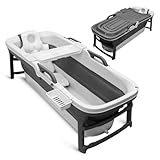
This is the tub for people who cannot cut into a floor. It sets up freestanding, fills from a hose or a shower wand, and drains by hose, which means no drain rough-in, no supply lines, no permit, and no permanent change to the room. For renters, for anyone in a short-term lease, and for anyone who wants a soak now and a renovation later, that is the whole value proposition.
It is also the only product in this list built for both hot soaking and cold plunge use. That dual purpose makes it popular in small apartments and in homes with no tub at all. General information only: if you are considering cold-water immersion, keep sessions short, never do it alone, and check with a medical professional first if you have a heart condition, circulation problems, or any condition that makes sudden temperature change risky.
Key specs
- Set-up length: 59-inch class when fully assembled
- Construction: foldable shell over a frame, designed to collapse for storage
- Plumbing: none — fills from an external source and drains by hose
- Install type: portable; no rough-in, no framing, no floor modification
- Storage: folds down flat enough for a closet or under a bed in most cases
- Heat retention: low compared with any hard-shell tub; plan on topping up or using it quickly
Strengths
The obvious strength is reversibility. Nothing about the installation is permanent, so it works in a rental, a studio, a dorm, or a house where the bathroom renovation is three years away. It also solves the doorway problem entirely: because it arrives folded, it fits through openings that no rigid tub can pass.
The second strength is versatility. A foldable tub that holds hot water also holds cold water, and the same product covers both. That is unusual in this category — a rigid acrylic soaking tub is a hot-water appliance, full stop. If you want one vessel for a warm soak in winter and a cold plunge in summer, this is the format that does it.
The third strength is cost and speed. There is no plumber, no tile work, and no demolition. You can have a working soak the day it arrives, and you can take it with you when you move. For anyone comparing the cost of a portable tub against the cost of a bathroom renovation, the math is not close.
Pros
- No plumbing, no permit, no permanent modification
- Folds for storage and passes through any doorway
- Works for both hot soaking and cold plunge
- Lowest total installed cost of anything in this roundup
- Portable between rooms and between homes
Cons
- Poor heat retention — water cools faster than in any hard-shell tub
- Softer walls flex and are less comfortable to lean against
- Filling and draining take more manual effort than a plumbed tub
- No overflow protection built into the plumbing; you manage the water level yourself
- Not a substitute for a permanent tub at resale
How it compares
The nearest alternative is the generic foldable portable tub later in this list. Both are plumbing-free and both fold, but they target different buyers. The SereneLife is the larger, more structured option, better suited to regular adult soaking at home. The generic foldable tub is the smaller, cheaper, more storage-friendly option for occasional use and very tight spaces. If you plan to soak several times a week, the extra structure is worth it; if you need something that lives in a closet and comes out twice a month, it is not.
4. WOODBRIDGE 71″ Acrylic Freestanding Bathtub (B170) – Best for a Contemporary Main Bathroom
Seventy-one inches is a full-size tub. This is the pick for a main bathroom or a master bath with a clear wall run of about 76 inches or more, where the goal is a clean contemporary freestanding look without the cost and complexity of jets. The chrome overflow and drain are the only visual accents, which keeps the tub reading as furniture rather than as a plumbing fixture.
It suits a household where at least one bather is tall, and where the tub is used for long, hot soaks rather than quick rinses. It does not suit a tight bathroom, a narrow hallway with a corner, or an upstairs floor that has not been checked for load. Measure the access path before you order — 71 inches of tub is a lot of box to turn.
Key specs
- Nominal length: 71 inches — plan on a wall run of roughly 76 inches with end clearance
- Footprint: freestanding; expect the standard 29–32 inch width class in this size
- Construction: freestanding acrylic soaking shell, white finish
- Drain and overflow: chrome-finished overflow and drain, center drain configuration
- Install type: freestanding — floor rough-in for drain and supply, no framing, no tile flange
- Electrical: none
- Capacity: roughly 60–75 gallons in this class depending on fill level
Strengths
Length is the point. At 71 inches, an adult over six feet can recline with shoulders and knees both underwater, which is the difference between a soaking tub and a tub you sit in. The deep profile and long interior also mean the water stays deeper over your torso at any given fill level, so the soak feels warmer for longer even though the material is acrylic.
The contemporary shape is the second strength. A long, low, gently curved freestanding tub takes up floor space but not visual space, and the chrome drain and overflow read as deliberate rather than decorative. In a bathroom with a simple palette — large-format tile, one wood tone, matte black or chrome fixtures — this is the shape that ties the room together.
Third, there is nothing to service. No pump, no heater, no jets, no control panel, no electrical circuit. Compared with the 72-inch double slipper further down, the long-term ownership picture is dramatically simpler: the things that wear are the finish and the drain trim, both cosmetic and both replaceable without pulling the tub.
Pros
- Full 71-inch interior — genuine stretch-out room for tall bathers
- Clean contemporary silhouette that suits modern bathrooms
- Chrome overflow and drain included as a matched set
- No pump, heater, or electrical work
- Deep water column over the torso at normal fill levels
Cons
- Requires a wall run of roughly 76 inches — it will not fit a small bathroom
- Long box is hard to turn through hallways and 90-degree corners
- Filled weight is substantial; upper floors should be checked
- Acrylic cools faster than cast iron or solid surface
- Center drain means the rough-in must be centered, which can force a floor change
How it compares
The nearest alternative is the Empava 67-inch tub. Four inches and a tier separate them. The Empava is cheaper, fits a slightly shorter wall run, and is easier to maneuver into a room; the WOODBRIDGE gives a noticeably longer interior and a more contemporary profile with a chrome fitting set rather than white. If your wall measures 68–74 inches, the Empava is the only one of the two that fits. At 76 inches or more, the WOODBRIDGE is the better long-term tub.
5. WOODBRIDGE 72″ × 35-3/8″ Double Slipper Whirlpool & Air, Heated Soaking Bathtub – Best for Full-Immersion Comfort and Hydrotherapy

This is the most capable tub in the roundup and the least suited to a small bathroom. At 72 inches long and 35-3/8 inches wide it needs a genuinely large footprint — think a master bath with a dedicated tub area rather than a wall slot between a vanity and a shower. In exchange it offers whirlpool jets, air jets, and a heated soaking function, plus a double slipper profile that raises both ends so two people can recline facing opposite directions.
It suits buyers who use the tub as a destination rather than a utility: a weekly long soak, a two-person bath, or hydrotherapy-style use. General information only — jet bathing is a comfort feature, not a treatment, and anyone with a skin condition, circulatory issue, or pregnancy should check with a medical professional before using warm jet bathing regularly.
Key specs
| Spec | Detail |
|---|---|
| Nominal length | 72 inches — plan on a wall run of roughly 78 inches or more |
| Nominal width | 35-3/8 inches — wider than the standard 29–32 inch freestanding class, so measure side clearance carefully |
| Profile | Double slipper — both ends raised for two-person reclining |
| Systems | Whirlpool jets plus air jets; heated soaking function |
| Install type | Freestanding, floor rough-in for drain and supply, plus a dedicated GFCI electrical circuit |
| Access requirement | Pump and heater access is needed for service; plan an access panel or a clear side |
| Capacity | Substantially higher than a standard soaking tub in this class; confirm the water heater can keep up |
Strengths
The heated soaking function is the standout. Standard acrylic tubs lose heat steadily, which is why long baths usually end with a hot-water top-up. A heated tub holds the water temperature where you set it, so a 45-minute soak stays a 45-minute soak. That single feature changes how the tub gets used — it becomes something you plan an evening around rather than something you rush.
The combination of whirlpool and air jets covers two different sensations. Whirlpool jets move a directed stream of water for a massaging effect; air jets push warm air through the water for a lighter, more effervescent feel. Having both means you can choose, and it means the tub is not a one-trick purchase.
The double slipper profile is the third advantage, and it is a practical one as much as an aesthetic one. Raised ends give both bathers a backrest, and the deeper center section keeps the water column high over the torso. Combined with the 72-inch length and 35-3/8-inch width, this is the only tub here that comfortably fits two adults.
Pros
- Heated soak holds water temperature for long baths
- Both whirlpool and air jets in one tub
- Double slipper profile suits two-person use
- Largest footprint and water capacity in this roundup
- Premium-tier build and finish
Cons
- Needs a large bathroom and a wide access path
- Requires a dedicated GFCI circuit and a plumber-electrician install
- Jets, pump, and heater all need periodic cleaning and eventual service
- Jet plumbing retains residual water and needs flushing to stay hygienic
- Highest price tier and the highest long-term ownership cost
How it compares
The nearest alternative is the WOODBRIDGE 71-inch B170. Same brand, nearly the same length, and a very different proposition: the B170 is a plain acrylic soaker with no electricity, no jets, and no service schedule, and it fits a narrower space because it is in the standard width class rather than at 35-3/8 inches. Choose the B170 if you want a long, quiet, low-maintenance soak. Choose this one if you specifically want heat retention and jet therapy and you have the room, the circuit, and the willingness to maintain it.
6. Empava 67 Inch Freestanding Bathtub – Best Overall for Most Bathrooms
Sixty-seven inches is where a soaking tub stops being a compromise. It is long enough that a six-foot bather can lean back without their knees riding up, and short enough that it still fits the kind of bathroom most people actually have. It stays in the standard width class, so the doorway math is the same as for a 59-inch tub — the extra eight inches only affects the wall run, not the access path. That combination is why this is the best overall pick.
It suits a household that wants one good tub in a secondary or primary bathroom, used for real soaks rather than decoration. It also suits a remodel where the existing alcove tub is being removed and replaced with something that reads as furniture. It does not suit a bathroom with less than about 72 inches of usable wall, and it does not suit anyone who needs jet therapy or a heated soak — that is the 72-inch double slipper’s job.
Key specs
- Nominal length: 67 inches — plan on roughly 72 inches of wall run with clearance at each end
- Footprint: freestanding; standard 29–31 inch width class, so no wider than a 59-inch tub to move
- Construction: freestanding acrylic soaking shell, white finish, deep soaking profile
- Drain: center drain with overflow
- Install type: freestanding — floor rough-in for drain and supply only
- Electrical: none
- Capacity: roughly 55–65 gallons in this class depending on fill level
Strengths
The dimensional balance is the main strength, and it is worth spelling out. Eight inches of extra length over a 59-inch tub adds meaningful recline and legroom; it does not add width, so it does not complicate the doorway, and it does not add the kind of box length that makes a 71- or 72-inch tub difficult to turn through a hallway corner. For most houses, 67 inches is the largest tub you can buy without the install becoming a project.
The second strength is simplicity. No pump, no heater, no jets, no control panel, no GFCI circuit, no access panel, no flushing schedule. The maintenance list is: wipe the shell, keep abrasive cleaners away, and check the drain seal once a year. That is the entire ownership story, and it is why a plain soaker is often the better long-term purchase than a feature-heavy tub in the same price band.
Third, acrylic is the right material for this size. A 67-inch cast iron tub would weigh several hundred pounds empty and would need floor reinforcement in many houses; the acrylic version goes in with two people and a level. You give up some heat retention, which you can offset by starting with hotter water and by keeping the bathroom door closed during a soak.
Pros
- Best length-to-fit ratio in this roundup
- Standard width class, so doorway clearance is manageable
- Mid-range price tier for a full-length soaking tub
- No electrical work and no mechanical maintenance
- Enough interior length for tall bathers to recline
Cons
- Still needs roughly 72 inches of clear wall
- No heated soak, so water cools over a long bath
- Acrylic shell can flex if the floor is not flat
- Center drain may require relocating the existing rough-in
- White gloss finish shows water spots and soap film quickly
How it compares
The nearest alternative is the Empava 59-inch premium tub. Same brand, same construction family, and a genuine trade: the 59-inch is built to a higher standard in a smaller package, while the 67-inch gives you four more inches of length and eight more inches of overall interior for less money. If your wall run is 64–66 inches, the 59-inch is your tub. At 72 inches or more, the 67-inch is the better buy for almost everyone, because bathing comfort scales with length far more than it scales with trim quality.
7. RHHVVR 59″ Acrylic Freestanding Bathtub – Best for Small Bathrooms That Want an Oval Profile

This is a 59-inch freestanding oval tub with a center drain — the classic small-bathroom soaking tub shape. It suits a bathroom with roughly 64–66 inches of usable wall, where a 55-inch tub would feel cramped but a 67-inch tub simply will not fit. The oval profile is the appeal: it reads softer than a rectangular freestanding tub and usually looks better in a room with curved or traditional fixtures.
It suits a single regular bather who wants a proper soak, and it works well as the only tub in a one-bathroom home. It does not suit tall bathers who want to fully recline, and it does not suit anyone who needs jets, heat, or two-person capacity.
Key specs
- Nominal length: 59 inches — plan on roughly 64–66 inches of wall run with end clearance
- Footprint: oval, freestanding; standard 28–30 inch width class
- Construction: single-piece acrylic shell, white finish
- Drain: center drain with overflow
- Install type: freestanding — floor rough-in for drain and supply, no framing
- Electrical: none
- Capacity: roughly 45–55 gallons in this class depending on fill level
Strengths
The oval shape is more than cosmetic. An oval tub has no hard corners to catch a hip or a knee, and the curved walls mean the interior feels wider at shoulder level than the exterior footprint suggests. In a small bathroom, where you are often stepping into the tub from an awkward angle, that rounded geometry is genuinely easier to use.
The 59-inch length is the practical middle ground. It is long enough for most adults under about six feet to sit with legs extended and knees slightly bent, which is a real soak, and short enough to fit a wall run that cannot take a 67-inch tub. It also keeps the box to a size that most two-person crews can maneuver through a normal hallway.
The center drain is worth noting because it affects your plumbing plan. A center-drain freestanding tub needs the rough-in centered on the footprint, which in a remodel usually means opening the floor. That is a real cost, but it also means the tub can sit anywhere along the wall — you are not locked into the drain position that the old alcove tub used.
Pros
- Oval profile is comfortable and space-efficient
- Fits wall runs of roughly 64–66 inches
- Mid-range price tier with no electrical or mechanical systems
- Rounded interior is easy to step into and to clean
- Freestanding placement is flexible within the room
Cons
- Center drain rough-in often requires opening the floor
- Not enough length for very tall bathers to fully recline
- Acrylic heat retention is average at best
- No heated soak or jet options
- Oval footprint can leave awkward gaps against straight walls
How it compares
The nearest alternative is the DeerValley 55-inch tub. Four inches of length is the whole difference in fit terms — but it is also the difference between sitting upright and leaning back. The DeerValley wins on tight access and on price; the RHHVVR wins on bathing comfort and on the softer oval profile. If your wall measures under 60 inches, buy the DeerValley. At 64 inches or more, the RHHVVR is worth the step up.
8. Portable Foldable Soaking Bathtub (Generic) – Best for the Smallest Spaces and Ice Baths

This is the compact end of the portable category: a foldable soaking tub for adults that collapses small enough to live in a closet, sets up without tools, fills from a hose or shower, and drains by hose. It suits studio apartments, dorm rooms, small rentals, and anyone who wants occasional hot soaks or cold plunges without any permanent installation. It is not a replacement for a plumbed tub and it is not meant to be.
Because it holds both hot and cold water, it is one of the few products in this list that covers both uses. General information only: cold-water immersion carries real risks, including cold shock. Keep sessions brief, never immerse alone, and consult a medical professional before starting if you have a heart condition, high blood pressure, circulation problems, or are pregnant.
Key specs
- Set-up size: typically 43–55 inches in this class when assembled — smaller than any rigid tub here
- Construction: flexible foldable shell, collapsible for storage
- Plumbing: none; fills externally and drains by hose
- Install type: fully portable, no rough-in, no framing, no floor work
- Storage: folds flat for a closet, under a bed, or behind a door
- Heat retention: lowest in this roundup; expect to top up with hot water or use it promptly
Strengths
The first strength is that it fits where nothing else does. A rigid tub needs a wall run, a doorway path, and a drain rough-in. A foldable tub needs a flat patch of floor and a hot tap. In a studio flat with a shower-only bathroom, that is the difference between having a soaking option and not having one.
The second strength is cost and commitment. There is no plumber, no electrician, no tile work, no permit, and no resale consideration. If you move, it moves with you. If you decide you want a real tub later, nothing has to be undone.
The third strength is dual use. The same tub handles a hot soak in winter and a cold plunge in summer, which makes it unusually versatile for the money. That is a genuine advantage over an acrylic soaker, which is effectively a hot-water-only appliance.
Pros
- Smallest storage footprint of anything in this roundup
- No plumbing, no electricity, no installation
- Works for hot soaking and cold plunge
- Cheapest entry point into soaking at home
- Portable between rooms and between homes
Cons
- Water cools quickly; long soaks need topping up
- Soft walls offer little back support
- Filling and draining are manual chores
- Smaller interior than a 59-inch rigid tub
- Not durable enough to be a permanent fixture
How it compares
The nearest alternative is the SereneLife 59-inch portable tub. Both fold, both need no plumbing, and both handle hot and cold water. The SereneLife is larger and more structured, which makes it better for frequent adult soaking; this generic foldable tub is smaller, cheaper, and stores in less space, which makes it better for occasional use and genuinely tiny rooms. Choose on how often you will use it, not on price alone — a tub that is awkward to set up stops getting used.
How to Choose
Ignore the marketing copy and measure three things before you look at any tub: the wall run, the doorway clear path, and the drain rough-in position. Almost every disappointing tub purchase traces back to one of those three numbers, and all three are easy to check with a tape measure in ten minutes.
1. Wall run: length plus clearance
A freestanding tub needs its nominal length plus clearance at both ends. Two to four inches on each end is the practical minimum for cleaning, for the supply lines, and for the tub not to look wedged in. That means:
- A 55-inch tub wants a wall run of about 60 inches
- A 59-inch tub wants about 64–66 inches
- A 67-inch tub wants about 72 inches
- A 71–72 inch tub wants about 76–78 inches, and the 72-inch double slipper needs more side clearance because it is 35-3/8 inches wide rather than the usual 29–32 inches
If your wall run is 58 inches, you are choosing between the 55-inch DeerValley and a portable tub. If it is 65 inches, the 59-inch options open up. If it is 73 inches, the 67-inch Empava becomes the best value in this guide.
2. Doorway and hallway clearance
This is the measurement people forget, and it is the one that turns a delivery into a return. A rigid tub travels on edge, so the limiting dimension is the tub’s width in most cases, not its length. Standard interior doors are 30–32 inches wide and 80 inches tall; a tub in the standard 28–32 inch width class usually clears a 30-inch door on edge, though you should plan on removing the door slab and any stop trim to gain two inches.
The harder problem is a corner. A long box cannot pivot through a 90-degree hallway turn if the hallway is narrow, because the box has to sweep a diagonal. As a practical rule, a hallway turn gets difficult when the box length exceeds roughly three times the hallway width. A 59-inch tub box in a 36-inch hallway is a tight but usually work