Key takeaways
- Geared tuners, not friction pegs: Die-cast chrome geared tuners with a 14:1 or 18:1 ratio let you tune precisely. Friction pegs found on ultra-cheap vintage-style sopranos slip more easily and frustrate beginners.
- Fluorocarbon strings: Many Kala, Enya, and Flight models now ship with Aquila Super Nylgut or fluorocarbon. Fluorocarbon settles faster (2-4 days vs. 5-7 for basic nylon) and holds tuning better with temperature changes.
- Proper nut slots: A well-cut nut keeps strings from binding and pinging sharp. If tuning jumps in small increments, the nut slots are too tight – a common issue on ukuleles under $50.
- Wound vs. unwound low G: For standard high-G tuning, all four strings should be smooth non-wound. Avoid wound C-strings on sub-$100 models as they wear frets faster and feel inconsistent.
What's inside
- Soprano vs. Concert: Which Size Should You Start With?
- Solid Wood vs. Laminate: Durability Matters More Than Tone at the Start
- Tuning Stability: Why Beginners Go Out of Tune and How to Fix It
- Decision Matrix: Which Beginner Ukulele Fits Your Situation?
- Specific Starter Picks That Stay in Tune (by Budget)
- Durability and Ownership Realities Most Listings Skip
- Cost Per Use: Why a $120 Ukulele Is Cheaper Than a $50 One
- Frequently Asked Questions
The best ukulele for beginners in 2026 is a concert-size laminate ukulele with geared tuners like the Kala KA-C or Enya Nova U Concert, because it offers more fret room and tuning stability than a traditional soprano while staying durable and affordable for new players.
- Soprano vs. Concert: Which Size Should You Start With?
- Solid Wood vs. Laminate: Durability Matters More Than Tone at the Start
- Tuning Stability: Why Beginners Go Out of Tune and How to Fix It
- Decision Matrix: Which Beginner Ukulele Fits Your Situation?
- Specific Starter Picks That Stay in Tune (by Budget)
- Durability and Ownership Realities Most Listings Skip
- Cost Per Use: Why a $120 Ukulele Is Cheaper Than a $50 One
- Frequently Asked Questions
If you want the classic bright, plinky island sound and a smaller body, a soprano like the Kala KA-S is still a great budget starter. If you want easier fretting, more volume, and a neck that feels less cramped for adult hands, a concert is the safer first buy. Both keep costs low, but laminate construction is what keeps most beginners playing longer without fighting tuning or humidity issues.
As an Amazon Associate we earn from qualifying purchases at no extra cost to you.
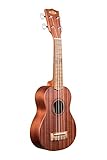

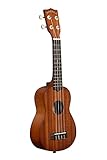

Soprano vs. Concert: Which Size Should You Start With?
Soprano and concert are the two most common beginner sizes. They use the same standard G-C-E-A tuning, but the physical dimensions change how they feel and sound.
| Spec | Soprano Ukulele | Concert Ukulele |
|---|---|---|
| Overall Length | 20-21 inches (51-53 cm) | 23 inches (58 cm) |
| Scale Length | 13-13.5 inches (33-34 cm) | 14.5-15 inches (37-38 cm) |
| Body Length x Width | ~9.5 x 7 inches | ~11 x 8.2 inches |
| Typical Weight | 0.85-1.0 lb (385-450g) | 1.0-1.25 lb (450-570g) |
| Number of Frets (to body) | 12-13 | 14-16 |
| String Tension (nylon/fluorocarbon) | Lower, looser feel | ~10-15% higher, more resistance |
| Volume & Sustain | Bright, quiet, quick decay | Louder, fuller mids, longer sustain |
| Best For | Kids, travel, classic uke tone | Adults, guitar converts, fingerpicking |
Why concert is usually easier for adult beginners
The extra 1.5 inches of scale length on a concert doesn’t sound like much, but it adds about 0.15 inches (4mm) between frets in the first position. That makes clean C, G, and F chords easier when you have larger fingertips. The slightly larger body also moves your strumming arm into a more natural position and gives you two extra frets clear of the body, which helps when you start playing up the neck in week three or four.
When soprano is the better pick
Choose soprano if you specifically want that traditional, treble-forward Hawaiian sound, you have smaller hands, you are buying for a child under 12, or portability is the priority. Sopranos fit in backpacks and carry-on luggage more easily and cost slightly less on average. The trade-off is less low-end and a tighter fretboard that can feel cramped for chord transitions.
Solid Wood vs. Laminate: Durability Matters More Than Tone at the Start
Beginner guides obsess over tonewood, but for a first ukulele, stability and durability decide whether the instrument stays in tune and survives a dry winter or a humid summer in a dorm room.
Laminate (plywood with veneer)
Laminate ukuleles use thin layers of wood pressed together with a decorative veneer on top like mahogany, sapele, or acacia. They are significantly more resistant to cracking and warping from humidity swings, which is the number one killer of cheap solid-top ukuleles. They also need less careful storage and handle temperature changes in cars and classrooms better. Tonally they are less resonant and complex than solid wood, but the difference is subtle at the $60-$150 starter price point where build quality matters more than wood species.
General market range: $59-$149 for reputable laminate soprano and concert models from brands like Kala, Enya, Donner, and Flight.
Solid top or all-solid wood
A solid mahogany or solid acacia top vibrates more freely, giving you more volume and warmth after a few months as the wood opens up. However, solid wood is sensitive to relative humidity. It wants to live at 45-55% humidity. Below 35% for weeks, tops can shrink, fret ends can become sharp, and seams can open. Above 65% for extended periods, tops can swell and action rises. If you live in a climate-controlled home and will store it in a case with a small humidifier, solid wood is fine. If you plan to leave it on a stand year-round, laminate is the lower-risk ownership choice.
General market range: $129-$249 for entry-level solid-top concerts from Cordoba, Kala, and Ohana.
Other materials to know
HPL (high-pressure laminate) and carbon fiber polycarbonate models like the Enya Nova U are nearly indestructible for humidity and temperature. They are slightly heavier and sound brighter and more plastic-y to purists, but they never need humidification and are ideal for kids, camping, and classrooms.
Tuning Stability: Why Beginners Go Out of Tune and How to Fix It
New players often blame themselves for tuning issues, but new nylon and fluorocarbon strings are the real culprit. They stretch for 3-7 days before holding pitch.
What to look for
- Geared tuners, not friction pegs: Die-cast chrome geared tuners with a 14:1 or 18:1 ratio let you tune precisely. Friction pegs found on ultra-cheap vintage-style sopranos slip more easily and frustrate beginners.
- Fluorocarbon strings: Many Kala, Enya, and Flight models now ship with Aquila Super Nylgut or fluorocarbon. Fluorocarbon settles faster (2-4 days vs. 5-7 for basic nylon) and holds tuning better with temperature changes.
- Proper nut slots: A well-cut nut keeps strings from binding and pinging sharp. If tuning jumps in small increments, the nut slots are too tight – a common issue on ukuleles under $50.
- Wound vs. unwound low G: For standard high-G tuning, all four strings should be smooth non-wound. Avoid wound C-strings on sub-$100 models as they wear frets faster and feel inconsistent.
Step-by-step string break-in (with reasons)
Do this for the first week and you will cut tuning frustration in half:
- 1. Tune up to pitch, then gently stretch: After tuning to G-C-E-A, lightly pull each string 1 inch up at the 12th fret. This pre-stretches the elastic portion. Re-tune immediately.
- 2. Retune every 10-15 minutes of playing: Strings flatten as they stretch. Constant retuning trains them to hold pitch rather than letting them sit flat and settle in the wrong tension.
- 3. Keep it at pitch overnight: Don’t loosen strings after practice during break-in. Constant tension helps strings stabilize.
- 4. Check tuning before you put it away: A quick tune before casing keeps neck tension consistent, which reduces the next-day sag.
Decision Matrix: Which Beginner Ukulele Fits Your Situation?
| Your Situation | Recommended Pick | Why |
|---|---|---|
| Adult with larger hands / guitar background | Concert laminate, geared tuners | More fret spacing, familiar neck tension, louder projection |
| Child age 7-11 or very small frame | Soprano laminate | Lighter weight, shorter reach, less hand fatigue |
| Dorm, dry climate, or no case storage | Concert laminate or carbon fiber | Humidity-resistant, crack-proof, no humidifier needed |
| You want the warmest tone and will humidify | Concert solid mahogany top | Richer midrange after break-in, better sustain |
| Travel, beach, camping, classroom | Soprano or concert HPL / polycarbonate | Withstands heat, bumps, and moisture |
| Tightest budget, trying it for 3 months | Soprano laminate under $80 | Lowest cost to learn fundamentals before upgrading |
Specific Starter Picks That Stay in Tune (by Budget)
Best overall for most beginners: Kala KA-C Concert
The Kala KA-C is a laminate mahogany concert with a 23-inch body and geared tuners that has been in production for years for a reason. It has a 14.9-inch scale, smooth fret edges, and Aquila strings out of the box. It sits in the $99-$149 range and balances warmth, volume, and durability. Its concert size avoids the cramped feel that makes beginners mute strings on a soprano.
Most durable low-maintenance: Enya Nova U Concert
The polycarbonate Nova U is impervious to humidity, weighs about 1.1 lb, and includes a rounded body that is comfortable on the forearm. It stays in tune well thanks to sealed gears and fluorocarbon strings, and it tolerates being left on a stand or taken outdoors. General range $79-$129. The tone is brighter and less woody than laminate mahogany, which some players love for pop strumming and some find too modern.
Best classic soprano on a budget: Kala KA-S Soprano
If you want the traditional sound and smallest footprint, the KA-S laminate mahogany soprano at $69-$99 offers the same stable tuners and build consistency as its concert sibling. It is ideal for kids and for players who want that quick, percussive strum for traditional songs.
Step-up warm tone: Cordoba 15CM Concert (solid acacia top) or Ohana CK-10 Concert
Both sit in the $149-$219 range with solid tops and laminate back/sides. They need a simple case humidifier in winter but reward you with more dynamic range and sustain as they play in. Choose these only if you are comfortable storing the ukulele in its case at 45-55% humidity.
Durability and Ownership Realities Most Listings Skip
- What wears first: Strings, not the body. Expect to replace strings every 3-6 months with daily practice. Fluorocarbon lasts longer than basic nylon. Frets on budget ukuleles are soft nickel and can show grooves after 12-18 months of heavy use.
- Common mistake: over-tightening: Beginners turning the wrong peg sharp until the string breaks. Always pluck and watch a clip-on tuner. If the needle jumps sharp, you are on the wrong string.
- Cleaning: Wipe strings and body with a dry microfiber cloth after playing. Oils from hands dull strings and cloud laminate. Avoid guitar polish with silicone – it builds up on thin ukulele finishes. A damp cloth is enough.
- Storage: Never leave it in a hot car. Glue softens above 120F and laminate layers can separate. In winter, keep it away from heaters and radiators that drop local humidity below 30%.
- Action creep: If strings feel higher after a humid summer, the top has swelled slightly. Keep it cased with desiccant for a week; if action stays high, a shop can lower the saddle for $15-$30.
Cost Per Use: Why a $120 Ukulele Is Cheaper Than a $50 One
A $55 ukulele with friction pegs and poor intonation often leads to early quitting. A $120 laminate concert that stays in tune gets played.
Conservative math: Play 20 minutes, 4 times a week, for 12 months = 208 sessions or about 69 hours. At $120, that is $0.58 per session or $1.74 per hour. If a cheaper instrument goes unused after a month (16 sessions), its true cost is $3.44 per session with no progress. Paying for geared tuners and a decent setup saves money if it keeps you practicing.
Frequently Asked Questions
Do I need a concert or soprano if I have never played anything?
Start concert if you are an adult of average height. The larger fretboard makes your first 30 days of chord changes cleaner, and you keep the same G-C-E-A tuning and chord shapes as a soprano.
Are low-G and high-G different ukuleles?
No, it is just a string swap. Almost all beginners should learn high-G (the classic bright tuning) first. You can switch the thick G-string to a low-G later for more bass without buying a new instrument.
How often will I really need to tune?
For the first week, tune every time you pick it up and several times during practice. After strings settle, once at the start of a session and a quick check midway is normal. If you need to retune every few minutes after two weeks, the strings are old or the tuners are slipping.
Do I need to humidify a laminate ukulele?
No. Laminate and polycarbonate models are stable without humidification. Only solid wood tops benefit from a small soundhole or case humidifier in winter when indoor humidity drops below 40%.