Key takeaways
- Wheels: Grit and abrasion eventually flatten the tread or damage bearings. Wipe them after trips and remove hair or thread before it winds around the axle.
- Telescoping handles: Dirt in the channels can cause sticking. Extend and retract the handle while cleaning, but do not force it or lubricate it with a heavy oil that attracts dust.
- Zippers: Overpacking puts continuous stress on the teeth and slider. Close the case while pressing contents down evenly rather than pulling the slider across a bulging shell.
- Fabric panels: Softside luggage can be cleaned with mild soap and a damp cloth. Let it dry completely before storage to reduce odor and mildew.
- Shells and corners: Polycarbonate can flex and absorb impacts; polypropylene is often lighter and more flexible; ABS is generally less expensive but can be more brittle in cold conditions.
Best Spinner Luggage for Effortless Maneuvering
The best spinner luggage for most travelers is a four-wheel carry-on with recessed 360-degree wheels, a rigid shell or reinforced softside frame, and an empty weight below about 8 pounds; choose a two-wheel model instead if you regularly use rough pavement, deep carpet, or uneven sidewalks.
Four wheels versus two: which handles better?
Four-wheel spinner luggage excels in airports, hotels, train platforms, and other smooth indoor spaces. Each wheel swivels independently, so you can push the case beside you, pull it behind you, or move it sideways through a narrow aisle. That reduces the twisting force placed on your wrist and makes a fully packed case easier to position beside a seat.
Our top picks

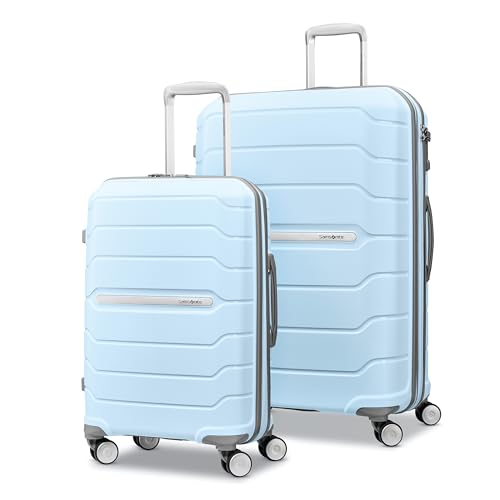


As an Amazon Associate we earn from qualifying purchases at no extra cost to you. Ratings are shown as listed on Amazon.
The trade-off is vulnerability. Spinner wheels sit near the case corners and need clearance to rotate. A wheel can catch on a curb, expansion joint, cobblestone, or thick carpet. Because the case stands upright on four small contact points, it may also roll away on a slope unless the handle is held.
Two-wheel luggage, sometimes called an inline-roller, uses larger wheels recessed farther into the case. It is pulled at an angle, like a small suitcase cart. This design usually tracks more predictably across rough pavement and gives better clearance over shallow obstacles. It is less convenient in tight spaces and places more leverage on the telescoping handle when the bag is heavily loaded.
| Feature | Four-wheel spinner | Two-wheel roller |
|---|---|---|
| Smooth airport floors | Excellent; rolls in any direction | Very good; best when pulled behind you |
| Carpet | Fair to good, depending on wheel size | Usually better with larger wheels |
| Rough pavement | Fair; exposed wheels can catch | Good to very good; recessed wheels clear more debris |
| Stability when parked | Good on level ground, weaker on slopes | Good when tilted against its wheel set |
| Sideways movement | Excellent | Not practical |
| Typical wheel clearance | About 1–2 cm below the case | About 2–4 cm below the case |
What makes a spinner easy to maneuver?
Wheel design and clearance
Look beyond the phrase “360-degree wheels.” Wheel diameter, wheel housing, bearings, and clearance matter more than the marketing label. Wheels around 50–60 mm are common on compact carry-ons, while larger wheels of roughly 60–70 mm generally perform better on carpet and uneven surfaces. A recessed wheel is protected by the case body, but the recess can reduce usable interior width.
Check whether the wheels are single or double. Double wheels can improve balance and keep the case upright, but they add weight and may collect grit between the wheel halves. Replaceable wheel assemblies are valuable because wheels are often the first moving parts to wear. A wheel that wobbles, squeaks, or no longer spins freely is a warning sign even when the shell still looks new.
Handle geometry
A good telescoping handle should lock at more than one height and have minimal side-to-side play. A short handle can force taller travelers to stoop, while excessive extension makes the bag feel unstable. For a carry-on, a handle height of roughly 40–42 inches from the ground suits many adults, but the right measurement depends on your height and walking style.
When possible, push the case with the handle only lightly extended. More exposed tubing creates more leverage and makes the case wobble. On rough ground, pull a two-wheel case with the handle angled modestly rather than dragging it at a sharp angle.
Case stability
Four wheels do not automatically make a suitcase stable. A narrow, tall case with a heavy laptop or shoes at the top can tip when turned. Wider wheel spacing, a low center of gravity, and a firm base improve stability. Compression panels and internal straps also help prevent the contents from shifting and changing the balance during transit.
Best spinner luggage by travel situation
| Your situation | Best choice | Why |
|---|---|---|
| Frequent airport and hotel travel | Four-wheel carry-on, 20–22 inches | Fastest sideways movement and easiest narrow-aisle handling |
| Older buildings, cobblestones, or city sidewalks | Two-wheel roller with 60 mm or larger wheels | More clearance and less wheel exposure |
| Lowest practical weight | Softside spinner, about 6–8 lb empty | Leaves more of the airline weight allowance for belongings |
| Maximum impact and weather resistance | Polycarbonate spinner with reinforced corners | Rigid structure and better resistance to rain than most fabric cases |
| Long-term ownership and repairability | Premium softside or repairable hard-shell design | Parts and service can matter more than initial appearance |
Carry-on sizing: measure the whole case
Airline carry-on limits vary, but a common international reference is approximately 55 × 40 × 20 cm, while many North American domestic limits are around 22 × 14 × 9 inches. Those measurements usually include wheels, corner guards, handles, and external pockets. A suitcase advertised as 20 or 21 inches may exceed the limit once its wheels are included.
For the safest general-purpose choice, look for an overall height of about 21–22 inches, width near 14 inches, and depth no greater than 9 inches when packed. A softside case with an expansion zipper can exceed the permitted depth quickly. Expansion is useful for a return journey, but it should be treated as extra capacity rather than guaranteed carry-on space.
Capacity figures are not perfectly standardized, but a compact carry-on commonly holds about 35–45 liters. A 22–24-inch case may provide roughly 50–65 liters, while a medium checked case often reaches 65–85 liters. More capacity is not always better: an overfilled case becomes harder to roll, stresses the zipper, and may exceed airline weight limits.
Interior layout: packing access versus usable space
Hard-shell spinners often split into two halves with a central divider. This keeps clothing contained when the case is opened, but the center frame and divider can consume space. One deep compartment is more efficient for bulky items, especially when paired with packing cubes.
Softside designs commonly provide one main compartment, a zippered lid, and external pockets. The front pocket is convenient for documents or a tablet, but it can reduce interior depth and shift weight toward the handle side. A padded laptop sleeve is useful only if it does not force the computer into an awkward top-heavy position.
For easy organization, prioritize full-width compression straps, a broad divider panel, and a pocket that remains accessible without opening the entire case. Avoid filling every small pocket: concentrated weight near the top or front can make a spinner unstable.
Real-world ownership: what wears first
- Wheels: Grit and abrasion eventually flatten the tread or damage bearings. Wipe them after trips and remove hair or thread before it winds around the axle.
- Telescoping handles: Dirt in the channels can cause sticking. Extend and retract the handle while cleaning, but do not force it or lubricate it with a heavy oil that attracts dust.
- Zippers: Overpacking puts continuous stress on the teeth and slider. Close the case while pressing contents down evenly rather than pulling the slider across a bulging shell.
- Fabric panels: Softside luggage can be cleaned with mild soap and a damp cloth. Let it dry completely before storage to reduce odor and mildew.
- Shells and corners: Polycarbonate can flex and absorb impacts; polypropylene is often lighter and more flexible; ABS is generally less expensive but can be more brittle in cold conditions.
Recognizable options worth comparing
Travelpro Platinum Elite is a softside option known for an organized interior and external access, making it appealing to business travelers who accept some fabric exposure. Samsonite Freeform is a lightweight hard-shell spinner line aimed at travelers who want a relatively light case and simple divided packing. Away The Carry-On emphasizes a clean hard-shell layout and compression system, while Briggs & Riley Baseline is a premium softside choice for travelers who value expandable packing and long-term service.
These products suit different priorities rather than representing one universal winner. Compare their total dimensions, empty weight, wheel housing, handle play, warranty terms, and replacement-part availability. A lighter case with fragile wheels may be less useful than a slightly heavier model with stronger wheel assemblies.
Bottom line
Choose four-wheel spinner luggage for smooth indoor travel, frequent direction changes, and effortless sideways movement. Choose a two-wheel case when rough pavement, thick carpet, curbs, or exposed outdoor walking are routine. Whichever style you select, prioritize large or well-recessed wheels, a stable base, a low empty weight, and dimensions measured with every external component included. Those details determine maneuvering comfort far more reliably than a large capacity number or a glossy shell finish.