Key takeaways
- Keep the packed weight below the airline limit instead of aiming to use every permitted pound.
- Place shoes and dense objects in the middle of the case, not beside wheels or corners.
- Use packing cubes to stop contents from shifting and stressing the zipper.
- Cover or remove loose straps before checking the bag; they can catch on conveyor equipment.
- Do not overfill the expansion section. A strained zipper is one of the first failures on a heavily used suitcase.
- Wipe down wheels and wheel housings after dusty or wet trips, then remove hair and thread from the axles.
- Dry a damp fabric suitcase completely before storing it, with the zippers partly open to improve ventilation.
- Photograph the suitcase and its contents before checking it, and report damage promptly after arrival.
Best Checked Luggage for Frequent Travelers
The best checked luggage for frequent travelers is the Travelpro Platinum Elite 29-Inch Expandable Spinner for a practical balance of capacity, organization, wheel performance, and repair support; choose a Briggs & Riley Baseline Large Expandable Spinner if long-term durability matters more than price, or a lightweight polycarbonate suitcase if lifting weight is your main concern.
Quick Picks by Travel Situation
| Traveler or priority | Best luggage type or pick | Why it fits | Typical market price |
|---|---|---|---|
| Frequent business and international travel | Travelpro Platinum Elite 29-Inch Spinner | Durable fabric, useful organization, replaceable-style components, and strong maneuverability | $350–$450 |
| Maximum long-term ownership value | Briggs & Riley Baseline Large Spinner | Expandable compression system, premium construction, and a comprehensive lifetime repair policy | $700–$900 |
| Light packer or strict weight limit | Lightweight polycarbonate spinner | Often about 9–11 pounds empty in the 27–29-inch class | $150–$350 |
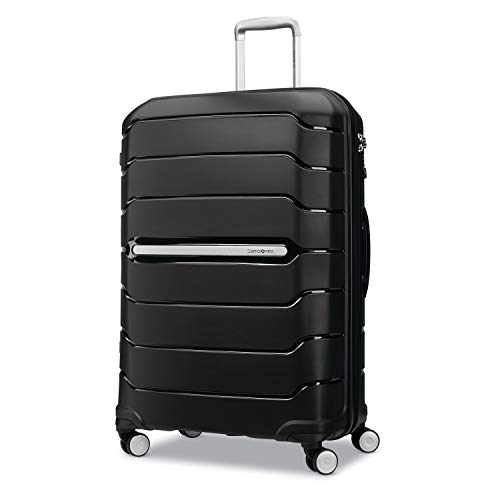
| Hard-shell protection at a moderate price | Samsonite Freeform Large Spinner | Lightweight polypropylene construction and a spacious interior | $150–$250 |
| Premium minimalist design | Away The Large | Polycarbonate shell, compression system, and restrained interior layout | $375–$425 |
Prices vary by size, seasonal promotions, and whether a model is sold as part of a set. Treat the figures as market ranges rather than fixed prices.
Our top picks


As an Amazon Associate we earn from qualifying purchases at no extra cost to you. Ratings are shown as listed on Amazon.
What Makes Checked Luggage Good for Frequent Travel?
Capacity without dangerous overpacking
A large checked suitcase normally offers approximately 95–125 liters of usable space. The airline size limit is usually expressed as linear dimensions: length plus width plus height. A common maximum is 62 linear inches, although each airline and fare may differ. A suitcase measuring 30 by 20 by 12 inches totals 62 linear inches.
Expansion zippers can add several liters, but they may also push a bag beyond the airline limit or make it easy to exceed the weight allowance. For most travelers, a 27- to 29-inch suitcase is a better everyday compromise than an oversized 32-inch case. It provides enough room for roughly one to two weeks of clothing without encouraging a load that is difficult to lift.
Empty weight is part of usable capacity
A suitcase with a 125-liter interior is less useful if it weighs 15 pounds before packing. With a 50-pound checked-bag limit, that leaves 35 pounds for clothing, shoes, toiletries, and souvenirs. A 10-pound case leaves 40 pounds—an effective 14% increase in allowable payload.
As a practical target, look for an empty weight below 11 pounds for a large checked spinner. Premium fabric cases may weigh more because of frames and built-in organizers, while inexpensive hard-shell cases can be light but may sacrifice wheel or handle quality.
Head-to-Head: Fabric, Polycarbonate, and Polypropylene
| Construction | Typical strengths | Typical weaknesses | Best for |
|---|---|---|---|
| Ballistic nylon or polyester fabric | Flexible packing, exterior pockets, easier fitting into tight spaces, often repairable | Can absorb moisture; fabric and zippers may abrade; contents have less impact protection | Business travelers and people who value organization |
| Polycarbonate | Good impact resistance, rigid protection, smooth surfaces that are easy to wipe clean | Can scratch, crack at stressed corners, and offer limited exterior storage | Travelers checking fragile or structured items |
| Polypropylene | Usually light, flexible under impact, and often less expensive | Can flex permanently or develop hinge and latch problems; interiors may be basic | Weight-conscious travelers on a moderate budget |
| ABS or ABS blends | Low cost and light weight | Generally less impact-resistant than quality polycarbonate or polypropylene | Occasional travelers who prioritize price |
No shell is immune to baggage-handler damage. Hard luggage is not automatically stronger: a rigid corner can crack when dropped, while a fabric case may show scuffs but remain functional. Examine corner guards, seam quality, zipper tracks, wheel housings, and the handle attachment—not only the shell material printed on the label.
Recommended Models and Their Trade-Offs
Travelpro Platinum Elite 29-Inch Expandable Spinner
This is the most balanced choice for frequent travelers who want a fabric suitcase. Its ballistic nylon exterior, zippered expansion, built-in garment organization, and multiple interior compartments favor people who move between business trips and longer vacations. The spinner wheel system is particularly useful in airports, where rolling beside you is easier than dragging a two-wheel case behind.
The compromises are weight and a fabric exterior that can collect dirt or moisture. It is also not the best choice for unprotected glassware or other fragile objects. Pack those items in the rigid center of the case, surrounded by clothing, rather than against the outer panels.
Briggs & Riley Baseline Large Spinner
The Baseline is a premium option for travelers who expect to keep one suitcase for many years. Its CX expansion system increases packing space and then compresses the contents, which is more useful than a simple gusset when returning with souvenirs. The fabric construction provides flexibility, and the company’s lifetime repair policy is a meaningful ownership advantage for high-frequency users.
It is expensive and typically heavier than a minimalist hard-shell case. The value becomes easier to justify when spread across repeated trips. For example, a $800 suitcase used on 80 trips costs $10 per trip before repairs. A $250 suitcase used on 10 trips costs $25 per trip. The calculation is only useful if the premium case actually suits your packing habits and remains serviceable.
Samsonite Freeform Large Spinner
The Freeform is a sensible moderate-budget hard-shell choice. Its polypropylene shell keeps weight relatively low, while the structured interior is adequate for folded clothing and packing cubes. It works well for travelers who check luggage a few times per year and prefer a wipe-clean exterior.
Expect fewer premium touches than on higher-priced luggage: lighter-duty interior materials, less sophisticated organization, and potentially less robust long-term hardware. Avoid sitting on the case or overfilling it, since excessive pressure stresses the zipper and wheel mounts.
Away The Large
Away’s large polycarbonate suitcase suits travelers who prefer a clean interior, compression panel, and organized packing layout. The shell offers useful impact protection and the case is easy to clean after a rough trip. Its design is particularly convenient for travelers who pack with cubes and want one side of the suitcase separated from the other.
The rigid shell can develop visible scuffs, and the fixed interior system is less adaptable than an open fabric compartment. Measure the packed case carefully when expanded; a large hard-shell suitcase can exceed airline limits more easily than expected.
Wheel and Handle Performance Matter More Than They Look
Four-wheel spinners are convenient on smooth terminal floors, but their small exposed wheels are vulnerable to curbs, potholes, and rough sidewalks. Larger wheels with reinforced housings generally cope better with hotel entrances and uneven pavement. A two-wheel roller has more ground clearance and may be tougher on rough surfaces, but it places more strain on your arm and wrist.
Check that the telescoping handle has minimal side-to-side movement when fully extended. A loose handle transfers impact into its mounting points. Lift the suitcase by its top and side handles as well: these handles are frequently used when loading a car or lifting a bag onto a scale.
Security Features: Useful, but Limited
A TSA-recognized combination lock can let authorized airport security personnel open the bag without cutting the lock. It does not make the suitcase theft-proof, and it does not protect an unzipped pocket or a damaged zipper. A lock is most useful when paired with a robust zipper track and sensible packing.
For valuable items, use a small pouch placed inside the suitcase rather than an exterior pocket. Do not check passports, medication, cash, irreplaceable documents, or electronics unless the airline’s rules and your own risk tolerance clearly allow it. Built-in tracking features can help locate a delayed bag, but they do not prevent mishandling and may require charging or battery replacement.
How to Reduce Damage and Extend Suitcase Life
- Keep the packed weight below the airline limit instead of aiming to use every permitted pound.
- Place shoes and dense objects in the middle of the case, not beside wheels or corners.
- Use packing cubes to stop contents from shifting and stressing the zipper.
- Cover or remove loose straps before checking the bag; they can catch on conveyor equipment.
- Do not overfill the expansion section. A strained zipper is one of the first failures on a heavily used suitcase.
- Wipe down wheels and wheel housings after dusty or wet trips, then remove hair and thread from the axles.
- Dry a damp fabric suitcase completely before storing it, with the zippers partly open to improve ventilation.
- Photograph the suitcase and its contents before checking it, and report damage promptly after arrival.
Final Recommendation
Choose the Travelpro Platinum Elite if you want the strongest all-around balance for frequent trips. Choose the Briggs & Riley Baseline when repairability and long ownership are worth a premium. Choose a lightweight polycarbonate or polypropylene case when your main problem is a strict weight allowance, and choose a fabric model when exterior pockets, flexible capacity, and easy organization matter most. Whichever style you select, prioritize wheel housings, handle stability, usable weight, and a realistic 62-linear-inch measurement over appearance alone.