Key takeaways
- Pro: Proven track record with extensive community support and replacement parts availability
- Pro: Seven functions eliminate the need for multiple countertop appliances
- Con: Six-quart minimum liquid ratio makes it impractical for single servings
A pressure cooker promises to cut cooking time in half, but the market makes it hard to know which one actually delivers. Buyers compare dozens of listings, each claiming different wattages, safety features, and pot capacities, without clear guidance on what matters for their kitchen size or cooking habits. The wrong choice wastes money and counter space; the right one becomes the most-used appliance in the house within weeks.
What separates a worthwhile model from a disappointing one comes down to capacity matching your household, the quality of the sealing mechanism, and how intuitive the control panel feels for the meals you actually cook. This roundup compares eight pressure cookers across electric and stovetop categories, using published specifications, current prices, and aggregated owner feedback to help you narrow the field before committing.
Our top picks




As an Amazon Associate we earn from qualifying purchases at no extra cost to you.
Quick Picks
| Product | Best for | Price |
|---|---|---|
| Instant Pot Duo 6 Qt | Larger families needing an all-around electric cooker | $107.30 |
| Instant Pot Duo 3 Qt | Singles and couples with limited counter space | $89.99 |
| Cosori 6 Qt | Home cooks who prefer non-stick ceramic over stainless | $80.99 |
| Hawkins 4L Classic | Stovetop purists wanting a durable Indian-style cooker | $38.45 |
| Instant Pot Pro 8 Qt | Enthusiasts upgrading to premium capacity and features | $149.99 |
| IMUSA 7 Qt Stovetop | High-volume stovetop cooking on a budget | $47.99 |
| OLIXIS 3 Qt | Small kitchens wanting the lowest electric price | $39.93 |
| Hawkins 2L Classic | Individual portions and camping-style stovetop use | $32.41 |
How We Picked
We evaluated each model on four criteria: usable capacity relative to household size, build quality as reflected in long-term owner reviews, the number and reliability of safety mechanisms, and price-to-feature ratio. A cooker earns a spot here when its strengths clearly align with a specific buyer profile rather than trying to please everyone. We also considered whether replacement parts and community recipe support are readily available, since those factors determine whether a purchase remains useful beyond the first year.
The 8 Best Pressure Cooker Options in 2026
Instant Pot Duo 6 Qt
This remains the default recommendation for households of three to five people. The seven cooking modes cover pressure cooking, slow cooking, sautéing, steaming, and more, all controlled through a straightforward button panel. Owners consistently praise its reliability and the enormous library of compatible recipes available online. The stainless steel inner pot handles high-heat searing before pressure cooking without warping. Some buyers note the lid requires careful alignment to seat properly, and the unit is bulky for small counters. Skip this if you cook for one or two, since the minimum liquid requirement makes small batches awkward to manage.
- Pro: Proven track record with extensive community support and replacement parts availability
- Pro: Seven functions eliminate the need for multiple countertop appliances
- Con: Six-quart minimum liquid ratio makes it impractical for single servings
Instant Pot Duo 3 Qt
Designed for couples and individuals who still want the Instant Pot ecosystem in a footprint barely larger than a rice cooker. The three-quart capacity handles a whole chicken, a batch of soup, or a pot of rice for two without wasting liquid. The included app with over 1,900 recipes scales portions for smaller batches. Owners appreciate the compact size but note the inner pot is thinner than the six-quart version, making it more prone to hot spots during sautéing. Skip this if you regularly cook for three or more, since you will hit the fill line often.
- Pro: Fits under standard overhead cabinets and suits tight counter layouts
- Pro: Free recipe app with small-batch adaptations reduces guesswork
- Con: Thinner pot base increases sticking risk during sear or sauté modes
Cosori 6 Qt
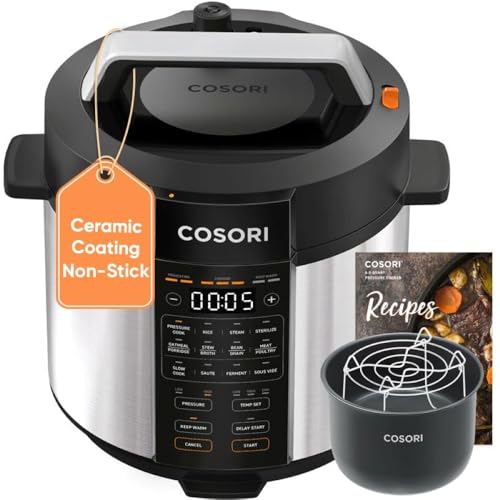
The standout feature here is the ceramic-coating inner pot, which releases food more easily than bare stainless steel and suits cooks who dislike scrubbing stuck-on residue after sautéing. With nine functions and twelve safety features listed, it competes directly with the Instant Pot Duo at a lower price point. Owner feedback highlights the quiet sealing process and intuitive interface. The ceramic coating does require gentler utensils, as metal spatulas will damage the surface over time. Skip this if you prefer the flexibility of switching between a stainless steel pot for searing and a non-stick for eggs, since this model ships with one pot only.
- Pro: Ceramic coating simplifies cleanup and reduces oil needed for sautéing
- Pro: Twelve safety features provide peace of mind for first-time users
- Con: Coating longevity depends on careful utensil selection and no abrasive scrubbing
Hawkins 4L Classic
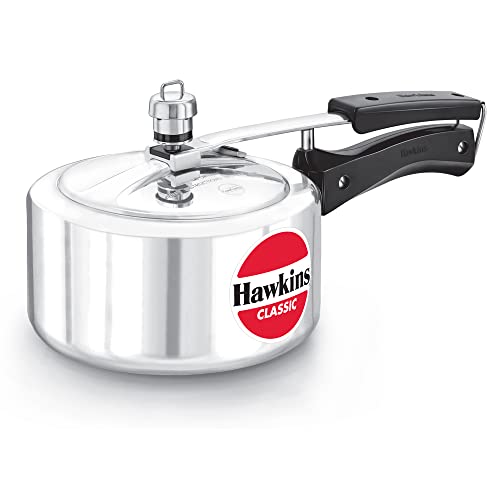
A workhorse stovetop pressure cooker popular in South Asian kitchens for good reason. The inner lid design means fewer parts to disassemble, making cleaning faster than gasket-heavy alternatives. At 4 liters, it handles dal, rice, and vegetable dishes for a family of four. Owners report decades of use from a single unit. The trade-off is that stovetop models demand active heat management during cooking, and the weight of the cooker plus the burner’s thermal output means it will not suit glass-top ranges without caution. Skip this if you want set-and-forget cooking with no monitoring required.
- Pro: Inner lid mechanism makes cleanup nearly effortless compared to external-gasket designs
- Pro: Exceptional longevity at a fraction of electric-cooker prices
- Con: Requires manual heat adjustment throughout cooking to maintain pressure
Instant Pot Pro 8 Qt
The eight-quart capacity serves as the upgrade path for families that have outgrown the Duo or for cooks who routinely make large batches of beans, broth, or pulled meat. Ten functions, including a dedicated sous vide mode and adjustable pressure levels, give it more granularity than lower-tier models. Owners praise the carry-lid handles on both sides, a small but meaningful ergonomic improvement. The price is the primary barrier; casual cooks will not use enough of the advanced features to justify the premium. Skip this if you cook for fewer than four people, since the minimum liquid volume at eight quarts forces oversized recipes.
- Pro: Adjustable pressure settings allow precision for delicate dishes like fish or custards
- Pro: Side-handled lid design solves the wrist-strain issue of older Instant Pot lids
- Con: Premium price is hard to justify when the Duo already covers most cooking tasks
IMUSA 7 Qt Stovetop
For cooks who want maximum stovetop capacity at the lowest price, this aluminum model delivers. Seven quarts handle whole chickens, large pots of beans, or batch canning prep. The safety valve and pressure regulator are simple mechanical components, easy to replace when needed. Owner feedback notes the aluminum construction conducts heat efficiently but can pit or discolor over years of use with acidic ingredients. It is noticeably heavier when full than stainless steel alternatives. Skip this if you cook tomato-heavy or citrus dishes regularly, since aluminum reacts with strong acids over time.
- Pro: Large capacity at under fifty dollars offers the best volume-per-dollar in this group
- Pro: Simple mechanical valves are cheap and easy to source as replacements
- Con: Aluminum body discolors and can impart metallic taste with prolonged acidic cooking
OLIXIS 3 Qt
At just under forty dollars, this is the lowest-priced electric option in the roundup. The ceramic inner pot and ten presets cover basic pressure cooking, slow cooking, and steaming for one or two people. Owner reviews praise the quiet operation and compact design. The build quality reflects the price; the exterior feels plasticky, and the control panel font is small enough to be difficult in poor lighting. Skip this if you value longevity or plan to use it daily for years, as long-term durability data is thinner than for the Instant Pot models.
- Pro: Ceramic pot at a sub-$40 price point is rare and reduces cleanup friction
- Pro: Slow cook function in a compact body replaces two single-purpose appliances
- Con: Limited long-term owner feedback makes durability harder to confirm
Hawkins 2L Classic
The smallest option here serves a specific niche: cooking perfect rice, dal, or a single portion of vegetables on a stovetop without heating a large appliance. The two-liter capacity means it fills and seals quickly, and the inner lid design still makes cleanup straightforward. At under thirty-five dollars, it is the cheapest pressure cooker in this guide. The obvious limitation is volume; you cannot cook anything beyond one or two servings. Skip this if you ever want to make broth, beans in bulk, or anything requiring more than a cup of dry ingredients.
- Pro: Achieves full pressure in minutes due to small volume, ideal for quick side dishes
- Pro: Lowest entry price in the entire roundup at $32.41
- Con: Two-liter capacity restricts meal prep to single portions or small sides
Buying Guide
Matching Capacity to Your Household
Pressure cookers require a minimum liquid volume to build steam, typically one to two cups. A six-quart electric cooker cannot safely make rice for one person without exceeding fill-line ratios on a small batch. If you cook for one or two, a three-quart model like the Instant Pot Duo Mini or OLIXIS avoids this trap. Families of four or five benefit from six to eight quarts. Stovetop users should size up slightly since there is no minimum-liquid rule tied to an electric element; the Hawkins 4L handles family portions that a three-quart electric unit struggles with.
Electric Versus Stovetop Tradeoffs
Electric pressure cookers regulate heat automatically, maintain consistent pressure, and offer timed cooking modes that let you walk away. Stovetop models are cheaper, last longer mechanically, and work on any heat source including camp stoves. The choice comes down to whether you value convenience or simplicity. Electric units add digital complexity that can fail; stovetop units add a manual heat-management step that requires attention during cooking. For most urban households, electric wins on daily usability. For campers, off-grid cooks, or those with unreliable electricity, stovetop remains the better fit.
Safety Mechanisms and Maintenance
Modern electric pressure cookers list between eight and twelve safety features, including overpressure release, lid-lock sensors, and automatic shut-off. Stovetop models rely on mechanical pressure regulators and fusible backup plugs. Regardless of type, gaskets and valves require periodic replacement, typically every twelve to eighteen months of regular use. Before purchasing, confirm that replacement parts are available from the manufacturer or major retailers. The Instant Pot ecosystem has the widest third-party parts availability, while Hawkins inner lids are inexpensive and universally stocked in South Asian grocery stores. The Cosori and OLIXIS have smaller aftermarket communities, so budget for manufacturer-sourced replacements.
Our Verdict
The Instant Pot Duo 6 Qt remains the top pick for most households, combining proven reliability, extensive recipe support, and a price under $110 that undercuts the competition on features-per-dollar. For the budget-conscious stovetop buyer, the Hawkins 4L Classic offers unmatched durability at $38.45. That said, if your priority is effortless cleanup and you cook tomato-based or sticky dishes frequently, the Cosori 6 Qt ceramic model wins on usability despite slightly fewer community recipes.
FAQ
Can a pressure cooker replace a slow cooker?
Most electric pressure cookers include a slow cook function, but results differ from a dedicated slow cooker because the sealed environment traps moisture differently and cooking temperatures are lower on slow settings. You can adapt recipes, but expect to reduce liquid amounts and adjust timing.
Are stovetop pressure cookers safe on induction ranges?
Aluminum models like the IMUSA 7 Qt are not induction-compatible without a transition disk. Stainless steel stovetop cookers with magnetic bases work directly. Always verify your specific model is rated for induction before attempting to use it on that burner type.
How long does a pressure cooker gasket last?
With daily use, expect twelve to eighteen months before the silicone gasket loses elasticity and begins leaking steam. Replacement gaskets cost a few dollars and are a simple DIY swap on virtually all electric models. Stovetop models use metal regulators that last longer but still benefit from periodic inspection.
Is a ceramic inner pot better than stainless steel?
Ceramic coatings release food more easily and require less oil for sautéing, but they degrade faster under metal utensils and high heat. Stainless steel pots tolerate any utensil and will not flake, though food sticks more readily. If convenience matters most, ceramic wins; if longevity and dishwasher safety matter most, stainless steel remains the stronger choice.