Key takeaways
- Weekend or short business trip: A carry-on trunk can work if you pack light and the full exterior dimensions meet your airline’s cabin rules. A trunk-shaped interior may be convenient for folded clothes, but check whether its depth makes it hard to lift into an overhead bin.
- One to two weeks: A medium checked trunk is the practical middle ground for most mixed packing. It has room for shoes and a packing cube or two without encouraging the excess that often makes a large case heavy.
- Long trip or bulky gear: A large trunk suits winter layers, family items, or equipment that does not compress well. Before buying, make sure you can lift it into your car and store it at home. More volume is useful only if you can stay within your baggage weight allowance.
- Frequent transfers or uneven pavements: Prioritize wheel construction, a sturdy handle, and a manageable loaded weight over maximum capacity. Four spinner wheels are easy to maneuver on smooth floors; larger two-wheel designs can be steadier over rougher ground, but must be tilted to roll.
- Closet or under-bed storage is tight: Compare the trunk’s actual height and depth with your available space. Some trunks are tall and narrow, while others are broad and low. A soft-sided model may compress slightly when empty, but do not assume it will fit a particular storage slot without measuring.
Best Travel Trunks for Organized, Durable Packing
The best travel trunks for most travelers are medium-sized, hard-sided spinner trunks with compression straps and replaceable wheels; choose a larger checked trunk for long trips or bulky gear, and a soft-sided trunk when low weight and flexible storage matter more than impact protection.
A trunk’s advertised capacity is only part of the decision. Its outer dimensions determine whether it fits airline limits or your home storage space, while its weight affects how much you can pack before reaching a baggage allowance. The comparisons below use representative size ranges and typical empty-weight ranges for each trunk type; exact specifications vary by model.
Our top picks
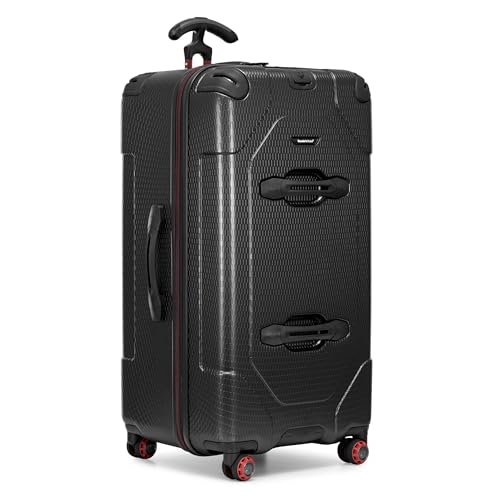


As an Amazon Associate we earn from qualifying purchases at no extra cost to you. Ratings are shown as listed on Amazon.
Compare trunk styles before you buy
| Trunk type | Typical dimensions (H × W × D) | Typical capacity | Empty weight | Best for | Trade-off |
|---|---|---|---|---|---|
| Carry-on hard-sided trunk | 22 × 14 × 9 in | 35–45 L | 6–8 lb | Short trips and travelers who want to keep belongings close | Limited room for bulky items; airline limits vary |
| Medium checked spinner trunk | 26 × 17 × 12 in | 65–80 L | 8–11 lb | About one to two weeks of mixed clothing | May need careful packing for strict weight limits |
| Large checked trunk | 30 × 20 × 13 in | 95–120 L | 10–14 lb | Long trips, family packing, or bulky equipment | Heavy when full and awkward on stairs or in small cars |
| Soft-sided wheeled trunk | 26–30 × 16–20 × 11–14 in | 70–110 L | 7–12 lb | Travelers who value exterior pockets and a little packing flexibility | Fabric can scuff, absorb moisture, or offer less impact protection |
Dimensions in the table are illustrative, not airline guarantees. Measure the case including wheels and handles, then check the rules for your airline and route. Capacity figures are also estimates: brands may measure internal volume differently, and a trunk’s shape affects what fits.
Choose by trip length, load, and storage space
- Weekend or short business trip: A carry-on trunk can work if you pack light and the full exterior dimensions meet your airline’s cabin rules. A trunk-shaped interior may be convenient for folded clothes, but check whether its depth makes it hard to lift into an overhead bin.
- One to two weeks: A medium checked trunk is the practical middle ground for most mixed packing. It has room for shoes and a packing cube or two without encouraging the excess that often makes a large case heavy.
- Long trip or bulky gear: A large trunk suits winter layers, family items, or equipment that does not compress well. Before buying, make sure you can lift it into your car and store it at home. More volume is useful only if you can stay within your baggage weight allowance.
- Frequent transfers or uneven pavements: Prioritize wheel construction, a sturdy handle, and a manageable loaded weight over maximum capacity. Four spinner wheels are easy to maneuver on smooth floors; larger two-wheel designs can be steadier over rougher ground, but must be tilted to roll.
- Closet or under-bed storage is tight: Compare the trunk’s actual height and depth with your available space. Some trunks are tall and narrow, while others are broad and low. A soft-sided model may compress slightly when empty, but do not assume it will fit a particular storage slot without measuring.
Materials and organization: what matters in daily use
Shells: polycarbonate, polypropylene, and ABS
Hard-sided trunks commonly use polycarbonate, polypropylene, or ABS plastic. Polycarbonate is valued for a combination of flexibility and impact resistance, though shell thickness and construction differ by model. Polypropylene is often relatively light and can flex under pressure. ABS is generally a lower-cost option, but can be less forgiving of repeated hard impacts. Material names alone do not prove durability: inspect corner protection, seams, locks, and warranty terms too.
A hard shell helps protect the contents from compression and light rain, but it is not automatically waterproof. Water can enter around zippers, seams, or closures. A soft-sided trunk made from nylon or polyester often provides useful exterior pockets and can accommodate awkward loads; look for reinforced stitching and a fabric treatment if exposure to moisture is a concern.
Wheels, handles, and closures
Wheels and handles are common wear points because they take repeated knocks and load-bearing stress. Check whether the wheels are screwed on or otherwise replaceable, and whether the manufacturer offers repair parts. Spinner wheels offer easy movement across airport floors, but can catch on rough paving and take direct impacts. Two-wheel trunks usually have fewer exposed wheels and can handle rougher surfaces more steadily when tilted, at the cost of easier maneuvering in tight spaces.
Extend and retract the handle several times in the shop or at home. Look for wobble, sticking, or a grip that feels uncomfortable. A zipper closure is convenient, but a damaged zipper can be difficult to repair; frame-style closures avoid a zipper but can add weight. A built-in lock can secure zipper pulls, but it does not make a case theft-proof. For international travel, check whether the lock is approved for the airports on your itinerary.
Organization that earns its space
Compression straps keep clothing from shifting, while a divider panel can separate clean items from laundry or accessories. Removable laundry bags and packing cubes make it easier to unpack and repack without turning the trunk into a jumble. Interior pockets are useful for small items, but too many fixed compartments can reduce space for bulky clothing. If you already use packing cubes, prioritize a clear main compartment and reliable straps rather than paying extra for duplicate organizers.
How to size a trunk without overbuying
Start with the bulkiest items you actually travel with, not a theoretical number of outfits. Then check the airline’s current size and weight rules for the route. For a quick weight check, add the trunk’s empty weight to the estimated weight of your packed items. For example, a 9 lb medium trunk plus 36 lb of belongings weighs 45 lb before any extras. If your checked allowance is 50 lb, that leaves only 5 lb of margin for souvenirs or a scale difference. A lighter case or a tighter packing list may be a better choice than a larger trunk.
Check exterior dimensions against your car trunk, closet, and any storage shelf as well as baggage rules. Manufacturers’ listed measurements may exclude handles or wheels, so confirm what is included. When comparing two models, use the same measurement method and leave a little clearance rather than choosing a case that fits exactly.
Ownership costs and care
Purchase price varies widely with size, material, hardware, and brand. As a general market guide, basic wheeled trunks often cost around $80–$180, midrange cases about $180–$350, and premium models $350 or more. These are broad ranges rather than quotes; sales and regional availability can change them. A cost-per-trip estimate can put the price in perspective: a $240 trunk used for 60 trips costs $4 per trip before repairs. If it is used only twice a year for five years, the same purchase works out to $24 per trip.
- Wipe a hard shell with a soft cloth and mild soapy water; avoid abrasive cleaners that can dull or scratch its finish.
- Vacuum fabric interiors and clean spills promptly. Let the trunk dry fully before storing it to reduce the chance of musty odors.
- Clear hair, thread, and grit from wheel housings. Small debris can make wheels harder to roll and accelerate wear.
- Do not overload the handle or use an extended trolley handle to lift the case. Lift by the carry handles instead.
- Keep the receipt, model details, and warranty information. Confirm whether coverage includes wheel and handle repairs, and whether it excludes airline damage.
A well-sized trunk with serviceable wheels and a packing layout you will actually use is usually a better buy than the largest or most feature-heavy option. For many travelers, that means a medium checked trunk; choose a carry-on for compact trips, a large trunk for genuinely bulky loads, or a soft-sided design when flexible storage and pockets take priority.