Key takeaways
- Best for weekend travelers: A compact two-tier Caboodles-style case with a lift-out tray, elastic brush loops, and a washable interior.
- Best for a growing collection: A Relavel-style professional train case with removable dividers, several brush pockets, and a shoulder strap.
- Best for frequent artists: A ZÜCA-style rolling artist case with modular storage, provided its larger dimensions fit your airline and vehicle needs.
- Best budget option: A soft-sided fabric train case with adjustable dividers rather than a rigid case with fixed compartments you may quickly outgrow.
- Best for hotel rooms with poor lighting: A hard-sided case with an integrated LED mirror, preferably with brightness adjustment and USB power.
The best makeup train cases depend on how much you carry: choose a compact two-tier case for occasional trips, a customizable professional case for a full kit, or a hard-sided, lighted case when protection and quick access matter more than weight.
Our top picks
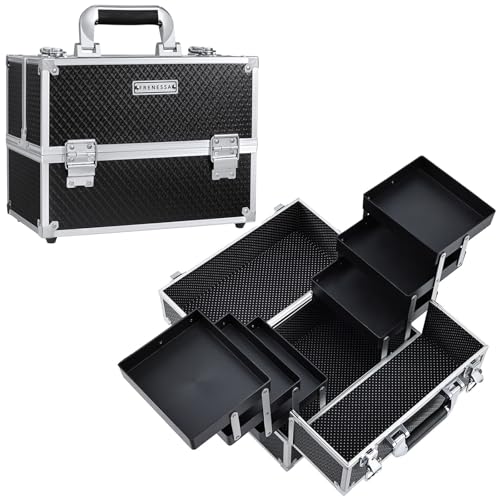


As an Amazon Associate we earn from qualifying purchases at no extra cost to you. Ratings are shown as listed on Amazon.
Quick picks by travel situation
- Best for weekend travelers: A compact two-tier Caboodles-style case with a lift-out tray, elastic brush loops, and a washable interior.
- Best for a growing collection: A Relavel-style professional train case with removable dividers, several brush pockets, and a shoulder strap.
- Best for frequent artists: A ZÜCA-style rolling artist case with modular storage, provided its larger dimensions fit your airline and vehicle needs.
- Best budget option: A soft-sided fabric train case with adjustable dividers rather than a rigid case with fixed compartments you may quickly outgrow.
- Best for hotel rooms with poor lighting: A hard-sided case with an integrated LED mirror, preferably with brightness adjustment and USB power.
Best makeup train cases compared
The most useful comparison is not simply “small versus large.” It is how efficiently each case turns available space into organized, protected storage. The figures below are typical targets for the main case types; exact dimensions vary by model and configuration.
| Case type | Typical external size | Typical weight | Useful capacity | Best for | Main compromise |
|---|---|---|---|---|---|
| Compact two-tier | 9 × 7 × 4.5 in | 1.5–2.5 lb | 1–2 lb of products | Weekend trips and minimal routines | Limited room for tall bottles and palettes |
| Medium adjustable-divider case | 12 × 9 × 5.5 in | 2.5–4 lb | 3–5 lb of products | Regular travelers and makeup enthusiasts | Dividers can consume space |
| Professional train case | 15 × 11 × 7 in | 4–7 lb | 6–10 lb of products | Artists and large personal kits | Bulky when packed for flights |
| Rolling artist case | 18–22 × 14–16 × 9–12 in | 8–15 lb empty | 10–20 lb of products | Frequent work travel and complete kits | Often unsuitable as a compact carry-on |
| Lighted hard case | 13–16 × 10–12 × 6–8 in | 5–9 lb | 4–8 lb of products | Hotel use and controlled application lighting | Extra weight and charging requirements |
Compartment layouts: what actually helps
Fixed compartments look tidy in product photographs, but they work only when your collection matches their dimensions. They are useful for short trips because they prevent small items from shifting. However, fixed slots often waste space around irregular palettes, hair tools, and skincare bottles.
Adjustable hook-and-loop dividers are more versatile. Look for dividers that are at least 1.5 inches wide, with several attachment points rather than one long strip. This lets you create narrow lanes for lip products, medium sections for compacts, and one larger bay for a palette. Soft padded dividers are preferable to thin plastic because they reduce scratching and cushion pressed powder.
A practical layout is to put fragile powder products in the center, liquids upright along the perimeter, and frequently used items in the top tray. Keep the heaviest bottles low so the case does not tip when open.
Brush storage and spill resistance
Brush storage is one of the clearest differences between a cosmetic organizer and a genuinely travel-ready train case. Elastic loops hold brushes in place, but exposed bristles can touch the case lid or collect lint. A brush flap with a washable cover is better, especially when the case will be opened on hotel surfaces.
Check the maximum brush length before buying. Many compact cases accommodate brushes up to 5 inches, while larger professional designs may allow 7-inch tools. If you use long-handled brushes, measure your longest brush rather than relying on the number of brush slots.
No soft makeup case is completely leakproof. “Spill-resistant” usually means a coated lining, raised seams, and a wipe-clean base—not an airtight seal. For liquid foundation, cleansing oil, or fragrance, place each container in a small leakproof pouch and tighten the cap before packing. A silicone bottle sleeve adds more protection than simply adding another fabric divider.
Mirror and lighting: useful upgrade or unnecessary weight?
An attached mirror is valuable when counter space is limited, but mirror quality varies. A rigid acrylic mirror is lighter and less likely to shatter than glass, though it can scratch and may show mild distortion. A glass mirror usually gives a clearer image but adds weight and needs better cushioning.
LED lighting helps in dim hotel rooms, but it does not replace good daylight. Prefer adjustable brightness, a neutral-white setting near 4,000–5,000 Kelvin, and a rechargeable battery rather than disposable button cells. A useful lighted case should provide roughly 4–8 hours of runtime per charge. USB-C charging is convenient, but confirm whether the case can operate while plugged in.
Lighting also takes up lid space. If you normally apply makeup at a well-lit vanity, spend the extra weight budget on stronger dividers and a better zipper instead.
Airline-friendly portability
Measure the packed case, not the empty case. A soft case can bulge by 1–2 inches when full, and a rigid case has no flexibility at all. Before flying, compare the packed dimensions with your airline’s current personal-item or carry-on allowance; limits differ by carrier and fare.
For most travelers, a case around 12 inches wide or less is easier to place inside a larger carry-on. A shoulder strap is useful for transfers, while a top handle is better for short movement through security or a hotel. Wheels are helpful only when the case will be moved over smooth floors; they add weight and reduce usable interior volume.
Keep liquids subject to the applicable airport liquid rules in a separate, accessible pouch. A well-organized train case cannot override security restrictions, and a large case filled with bottles may be more practical in checked luggage if permitted.
Decision matrix: choose by routine
| Your situation | Recommended format | Prioritize | Avoid |
|---|---|---|---|
| One or two trips per year | Compact two-tier case | Low empty weight, wipe-clean lining | Bulky rolling systems |
| Weekly personal use | Medium divider case | Removable dividers, brush flap, strong zipper | Decorative fixed slots |
| Beginner building a collection | Expandable medium case | Reconfigurable layout and one tall compartment | Very small molded compartments |
| Professional or frequent paid work | Large modular or rolling case | Replaceable inserts, reinforced corners, load-bearing handle | Thin fabric walls and overloaded zippers |
| Very limited hotel lighting | Lighted hard case | Adjustable LED brightness and rechargeable power | Non-replaceable batteries without runtime information |
Durability and ownership costs
The zipper, handle attachment, divider fasteners, and case corners usually wear before the main fabric. Overloading is the most common cause: if the zipper teeth strain when the lid closes, remove products rather than forcing it. A case rated for a certain volume is not necessarily rated for heavy glass bottles.
Clean the interior after each trip with a barely damp cloth and mild soap, then leave every compartment open until fully dry. Do not saturate padded dividers, because trapped moisture can create odors and weaken adhesive. Replace cracked powder products and wipe bottle necks before storage; residue around a cap is more likely to cause a leak than ordinary movement.
To estimate value, divide the price by realistic uses. For example, a $30 case used twice a year for four years costs about $3.75 per trip. A $100 professional case used twice a month for four years costs about $1.04 per use, before replacement inserts or batteries. The more frequently you travel, the more sense it makes to pay for stronger hardware rather than extra decoration.
Final buying checklist
- Measure your longest brush, tallest bottle, and largest palette.
- Check packed dimensions against your airline’s current baggage rules.
- Choose adjustable dividers if your collection changes regularly.
- Look for a washable, coated lining and reinforced zipper ends.
- Use a covered brush compartment rather than exposed elastic loops alone.
- For lighted models, verify brightness adjustment, charging port, and expected runtime.
- Leave roughly 15% of the interior empty so the case closes without pressure.
For most people, the best makeup train cases are medium adjustable-divider cases: they offer enough room for a complete personal routine without the weight and bulk of a professional roller. Choose a compact two-tier model for occasional minimalist travel, and move to a hard or rolling case only when your products, work frequency, or lighting needs justify the extra size.