
Key takeaways
- Wi-Fi standard: Wi-Fi 6 is enough for nearly everyone; Wi-Fi 7 helps if your devices support it and your upstream is fast.
- VPN support: Look for WireGuard and OpenVPN client support. Throughput figures are the maker’s lab numbers and real results are lower.
- Ports: At least one WAN port for hotel Ethernet and one LAN port for a wired laptop or streaming box.
- USB tethering: Useful if you want to share a phone’s mobile data with your other devices.
- Power: USB-C power from a power bank is practical for trains, cars and campsites.
- Repeater mode: Connects to hotel Wi-Fi when there is no Ethernet port. Speeds are shared between the upstream and downstream hops.
- Captive portal handling: Most models let you reach the hotel login page through the router’s interface or a connected device.
For most travelers the GL.iNet Beryl AX is the sensible all-round travel router, the Beryl 7 suits people who need faster VPN speeds, the Slate 7 suits those who want a touchscreen and Wi-Fi 7, and the Opal is the cheapest way to turn a hotel Ethernet port or a shaky captive-portal network into your own private Wi-Fi. This guide compares those models and a few alternatives so you can match a router to the way you travel.
Our top picks



As an Amazon Associate we earn from qualifying purchases at no extra cost to you.
Travel Routers at a Glance
| Model | Best for | Stated or reported specs | Limits |
|---|---|---|---|
| GL.iNet Beryl 7 (GL-MT3600BE) | Fast VPN and Wi-Fi 7 users | Announced at CES 2026; the maker rates WireGuard throughput near 1,100 Mbps | Newer; accessories and community guides still growing |
| GL.iNet Beryl AX (GL-MT3000) | Best value for most travelers | Wi-Fi 6; reviewers report about 300 Mbps over VPN | No touchscreen |
| GL.iNet Slate 7 (GL-BE3600) | Touchscreen control and Wi-Fi 7 | Reviewers report about 900 Mbps over VPN; about 295 g | Reviewers note it does not mesh with other GL.iNet routers |
| GL.iNet Slate AX (GL-AXT1800) | Wi-Fi 6 with gigabit ports | Built-in WireGuard and OpenVPN clients | Older design |
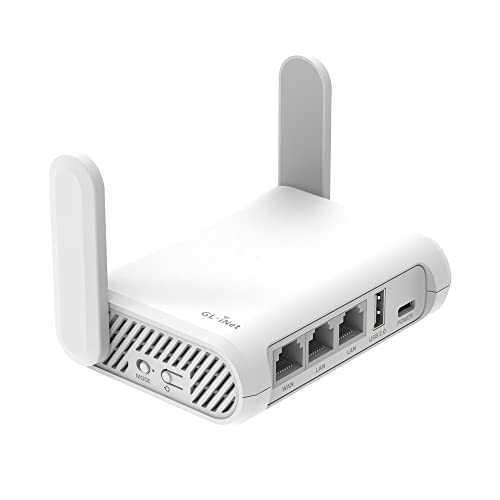
| GL.iNet Opal (GL-SFT1200) | Budget and light packing | About 145 g; dual-band Wi-Fi 5; one WAN and two LAN gigabit ports | VPN speed reported between roughly 65 and 100 Mbps |
| TP-Link Roam 6 (and similar) | Simple setup | Compact; uses TP-Link’s own app | Fewer advanced options |
What a Travel Router Actually Does
A travel router sits between the hotel, airport or rental network and your own devices. You connect the router to the network once, through Ethernet, Wi-Fi repeater mode or a USB tethered phone, and every phone, laptop, tablet and streaming stick then joins your router’s private network. The benefits are practical: you sign in to a captive portal once instead of on every device, your smart TV or e-reader that cannot handle web login pages works, and you can run a VPN for the whole group of devices.
It is not a magic speed booster. The router can only pass on what the underlying connection delivers. Reviewers frequently point out that hotel connections often deliver less than the router’s VPN limit, which is why a modest router can feel as fast as an expensive one.
GL.iNet Beryl AX: The Value Default
The Beryl AX is the model that reviewers most often call the best for the majority of travelers. It supports Wi-Fi 6, has multiple gigabit ports and includes VPN client support in its admin panel. Reviewers report roughly 300 Mbps over VPN, which exceeds most hotel and rental connections. It is small enough for a day bag and is powered by a USB-C supply, so a power bank can keep it running.
Choose it if: you want solid performance, simple VPN setup and a reasonable price tier without paying for the newest Wi-Fi standard.
GL.iNet Beryl 7: Faster VPN and Newer Wi-Fi
The Beryl 7 was announced at CES 2026 and is described by reviewers as the fastest VPN performer in the Beryl range, with GL.iNet rating roughly 1,100 Mbps for WireGuard. That only matters if your upstream connection is quick. Think of fiber in a rental apartment, a coworking space or a long-stay serviced apartment, where the router could become the bottleneck on a cheaper model.
Choose it if: you work remotely over a VPN from fast connections, or you plan to use the router at home as well.
GL.iNet Slate 7: Touchscreen Convenience
The Slate 7 adds a small touchscreen, which reviewers like because it lets you switch VPN, connect to Wi-Fi or check status without opening a phone or laptop. One review called it a brilliant travel router with a few strategic flaws, and another notes that it does not mesh with other GL.iNet routers. It supports Wi-Fi 7 and reviewers report around 900 Mbps over VPN. It is a little heavier than the Opal, at about 295 g.
Choose it if: you often reconfigure the router on the go, such as moving between hotels, trains and cafes.
GL.iNet Slate AX: Older but Capable
The Slate AX remains in many 2026 lists. It offers Wi-Fi 6, gigabit ports and both WireGuard and OpenVPN clients. It is a reasonable choice if you find it on sale, but the newer Slate 7 and Beryl AX cover most of its use cases.
GL.iNet Opal: The Budget Pocket Option
The Opal is the cheapest and lightest of the group, around 145 g. It has dual-band Wi-Fi 5 and gigabit WAN and LAN ports. Reviewers disagree slightly on VPN speed, with figures between about 65 and 100 Mbps, but most agree that is enough for hotel Wi-Fi, streaming and video calls. It is a good backup router or a first travel router.
Choose it if: weight and cost matter more than future-proofing.
TP-Link and Other Simpler Alternatives
If you do not want to learn GL.iNet’s admin interface, a router such as the TP-Link Roam 6 uses a manufacturer app and a simpler setup process. It offers fewer advanced options, such as flexible VPN client settings, but is easier for non-technical travelers. Check the maker’s product page for current model names, because travel router lines get renamed.
Features That Matter
- Wi-Fi standard: Wi-Fi 6 is enough for nearly everyone; Wi-Fi 7 helps if your devices support it and your upstream is fast.
- VPN support: Look for WireGuard and OpenVPN client support. Throughput figures are the maker’s lab numbers and real results are lower.
- Ports: At least one WAN port for hotel Ethernet and one LAN port for a wired laptop or streaming box.
- USB tethering: Useful if you want to share a phone’s mobile data with your other devices.
- Power: USB-C power from a power bank is practical for trains, cars and campsites.
- Repeater mode: Connects to hotel Wi-Fi when there is no Ethernet port. Speeds are shared between the upstream and downstream hops.
- Captive portal handling: Most models let you reach the hotel login page through the router’s interface or a connected device.
Budget Tiers
- Budget: Opal and TP-Link Roam-style routers. Good for streaming, calls and basic VPN use.
- Mid-range: Beryl AX, Slate AX. Best balance of speed, features and size.
- Premium: Beryl 7 and Slate 7. For Wi-Fi 7 and high VPN speeds.
Security and Etiquette Notes
- Change the router’s default admin password and Wi-Fi passphrase before your first trip.
- Keep firmware updated before leaving, since hotel networks are not the place to download large updates.
- A VPN encrypts traffic between your router and the VPN provider; it does not make an unsafe site safe.
- Some hotels, cruise ships and offices restrict extra routers or VPNs. Read the venue’s network policy.
- Use the correct power adapter for your destination; the router itself usually accepts standard USB power but plug shapes differ by country.
Pick X If …
| If you … | Pick |
|---|---|
| Want the best all-round travel router | GL.iNet Beryl AX |
| Need very fast VPN throughput | GL.iNet Beryl 7 |
| Want a touchscreen and Wi-Fi 7 | GL.iNet Slate 7 |
| Want the cheapest and lightest option | GL.iNet Opal |
| Want the simplest app setup | TP-Link Roam series |
Alternatives Worth Considering
- Phone hotspot: Free if your plan allows it and fine for one or two devices.
- Portable cellular hotspot or eSIM router: Better when the lodging has no reliable network at all.
- Wi-Fi extender or repeater: Helps with weak signal, but does not give you a private network or VPN.
Frequently Asked Questions
Do I need a travel router if I have a phone hotspot?
Not always. A hotspot is enough for one or two devices and short stays. A travel router helps when you have several devices, need the hotel’s wired connection, or want one VPN for everything.
Will a travel router make hotel Wi-Fi faster?
No. It cannot exceed the speed of the hotel’s connection. It can improve stability and avoid repeated logins, and a wired Ethernet connection to the router is often more reliable than weak hotel Wi-Fi.
Is a VPN on a travel router worth it?
It is convenient because all your devices are covered by one connection. VPN speed depends on your provider and the router’s processor, so a faster router only helps when your upstream connection is fast too.
Can I use a travel router on a plane or train?
Only if the vehicle offers a network that you can join. Some trains and aircraft have Wi-Fi portals that work in repeater mode. Airlines may restrict personal transmitters, so follow crew instructions.
How do I connect to a hotel login page through the router?
Join the router’s own Wi-Fi, connect the router to the hotel network, then open a browser to trigger the login page. Most GL.iNet models also have a portal or repeater page in the admin panel to help with this.
Do travel routers need special power adapters?
Most run from standard USB-C power, so a regular phone charger or power bank works. Check the maker’s input rating and bring a plug adapter for the country you are visiting.




