Key takeaways
- Steel pop-up frames: Usually the lowest-cost route to a large canopy and often stable when properly weighted, but heavy and prone to rust if stored wet.
- Aluminum frames: Lighter and resistant to corrosion, with a higher purchase price. A good choice when the tent is moved frequently.
- Commercial powder-coated steel: A practical compromise for repeated backyard use. Inspect the joints and roof hubs, not just the tube thickness.
- Center-pole tents: Attractive and efficient for large open areas, but require stakes, guy lines, and planning around interior poles.
- Frame tents: More flexible around tables and entrances and often better on patios or driveways, but heavier and slower to assemble.
The best party tents are chosen by footprint first, peak height second, and weather protection and frame design third: for most backyard gatherings, a 10 × 20-foot straight-leg canopy is the most versatile starting point, while larger events usually need a modular pole tent or multiple commercial-grade frames.
Our top picks


As an Amazon Associate we earn from qualifying purchases at no extra cost to you. Ratings are shown as listed on Amazon.
Quick picks by situation
| Situation | Recommended tent type | Useful size | Why it fits |
|---|---|---|---|
| Small patio meal for 6–12 people | Pop-up canopy with straight legs | 10 × 10 ft | Fast setup and roughly 100 sq. ft. of shade |
| Backyard party for 15–30 people | Commercial-grade pop-up canopy | 10 × 20 ft | Good space for seating, food, and a walkway |
| Buffet or cocktail event for 25–45 people | Two 10 × 20 ft frames or a larger pole tent | 20 × 20 ft or more | Allows separate dining and service zones |
| Formal event with high visual impact | High-peak or tension pole tent | 20 × 20 to 40 × 60 ft | Taller central peak and better open-floor appearance |
| Frequent rentals or repeated annual use | Commercial frame tent with replaceable parts | 10 × 20 ft modules | More durable and easier to expand or repair |
How much space do you actually need?
Advertised capacity can be optimistic because it often assumes tightly packed standing guests. For a comfortable seated meal, allow about 10 to 12 square feet per person under the canopy. For standing cocktails, 6 to 8 square feet per person is more realistic. Add space for a buffet, bar, DJ table, gifts, or children’s activities rather than treating those items as free space.
For example, a 10 × 20-foot tent provides 200 square feet. A seated dinner for 16 people at 12 square feet each uses approximately 192 square feet before allowing room for serving access. That is technically possible but cramped. A more comfortable plan is 12 to 14 seated guests, or around 25 standing guests without bulky furniture.
Tables also change the calculation. A standard 6-foot rectangular table is approximately 6 × 2.5 feet, but chairs and walking clearance can more than double its footprint. For a meal, two 6-foot tables placed end-to-end do not simply require 30 square feet; allow roughly 100 to 120 square feet once chairs and movement are included.
Best party tents by footprint and height
10 × 10 feet: compact and quick
A 10 × 10 canopy is suitable for a small food station, a drinks area, or a casual gathering of about 6 to 12 people. It is often the easiest size for one or two people to assemble. Straight-leg models generally provide more usable headroom at the edges than slant-leg designs, which lose floor area as the legs angle inward.
Choose this size when your yard is tight or the tent will be used mainly for shade. It is not ideal for a full seated dinner, and it offers limited protection when wind-driven rain is coming from the side.
10 × 20 feet: the all-purpose choice
A 10 × 20 frame is usually the best balance for backyard birthdays, graduation parties, reunions, and outdoor buffet service. It provides 200 square feet and can accommodate approximately 16 to 24 seated guests depending on the table arrangement, or around 25 to 35 standing guests.
Look for a peak height of at least 9 feet and adjustable eave heights around 6.5 to 7.5 feet. A higher peak improves ventilation and makes the interior feel less crowded, but it also increases wind exposure. A tent with removable sidewalls is more flexible than a permanently enclosed design: use the walls for rain protection, then remove them when airflow matters.
20 × 20 feet and larger: plan the layout, not just the guest count
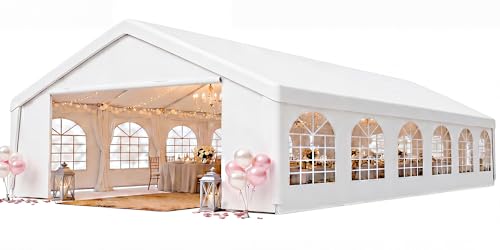
Large tents are often modular. Two 10 × 20-foot commercial canopies may be easier to transport and repair than one 20 × 40-foot structure. Pole tents can create attractive high peaks, but they require guy lines and center poles, which affect where tables, dance floors, and walkways can go. Frame tents have a more usable perimeter and can often be placed on hard surfaces, although they are heavier and more expensive.
Waterproofing: what the ratings mean
“Waterproof” on a canopy listing is not a complete weather specification. The fabric, seams, roof slope, sidewalls, and anchoring all affect performance. A roof may resist steady rain while water still enters through stitched seams or blows underneath the walls.
| Specification or feature | What to look for | Practical implication |
|---|---|---|
| Fabric | Coated polyester, commonly 300D–600D for portable canopies | Heavier fabric generally resists abrasion better, though coating quality matters too |
| Waterproof rating | A published hydrostatic-head figure, ideally around 1,500 mm or higher for rain protection | Useful for comparison, but does not predict wind-driven leakage by itself |
| Seams | Taped, sealed, or double-stitched seams | Reduces leakage at the most common failure points |
| Roof pitch | Sloped panels with no pooling areas | Helps water drain instead of stretching the fabric and loading the frame |
| Sidewalls | Zip-on or hook-and-loop walls with secure lower attachment | Improves rain protection but increases wind load |
If a manufacturer does not publish a hydrostatic-head rating, do not assume that a “waterproof” label means the tent is suitable for prolonged heavy rain. For occasional showers, a coated polyester roof with sealed seams and properly tensioned fabric is generally more useful than an impressive but unexplained marketing claim.
Frame assembly time and difficulty
Pop-up frames are the fastest option. A 10 × 10 or 10 × 20 commercial-grade canopy commonly takes two adults about 10 to 20 minutes to erect once the cover is attached and the site is clear. Lightweight consumer models may be faster, but their thinner legs and connectors are more vulnerable to bending.
Frame tents assembled from separate poles, connectors, and roof sections often take two to four adults 30 to 90 minutes, depending on size. Pole tents may take longer because the layout must be squared, the perimeter staked, and the guy lines tensioned. A large event tent should not be selected solely because its listed capacity is high; transport, assembly labor, and storage can become the dominant costs.
Which frame construction is best?
- Steel pop-up frames: Usually the lowest-cost route to a large canopy and often stable when properly weighted, but heavy and prone to rust if stored wet.
- Aluminum frames: Lighter and resistant to corrosion, with a higher purchase price. A good choice when the tent is moved frequently.
- Commercial powder-coated steel: A practical compromise for repeated backyard use. Inspect the joints and roof hubs, not just the tube thickness.
- Center-pole tents: Attractive and efficient for large open areas, but require stakes, guy lines, and planning around interior poles.
- Frame tents: More flexible around tables and entrances and often better on patios or driveways, but heavier and slower to assemble.
Brands such as Eurmax, Quik Shade, ABCCANOPY, and ShelterLogic offer recognizable canopy and shelter lines, but the exact frame, fabric, warranty, and replacement-part policy vary by model. Compare those specifications rather than buying by brand name alone.
Anchoring is part of the weather rating
A canopy that is waterproof but poorly anchored is not weather-ready. On grass, use all available stake points with long heavy-duty stakes appropriate to the soil. On concrete or pavers, use purpose-built ballast rather than improvised objects. As a planning reference, many temporary canopies need roughly 40 to 50 pounds of ballast per leg in calm conditions, with substantially more required as wind increases. The manufacturer’s anchoring instructions take priority.
Do not leave sidewalls attached during gusty weather unless the structure is specifically rated and anchored for those conditions. Enclosed walls catch wind like a sail. Never use a temporary party tent during lightning, severe thunderstorms, or forecast conditions beyond its stated limits.
Ownership realities: what wears out first
The roof fabric usually shows UV fading and abrasion before the frame fails. Folding a damp canopy encourages mildew, while dragging the cover across a driveway can damage its waterproof coating. Roof hubs, plastic sliders, hook-and-loop fasteners, zippers, and leg-pin holes are common wear points.
- Dry the canopy completely before storage, even if the rain was light.
- Brush off leaves and dirt before folding; grit can wear through coated fabric.
- Use a soft brush and mild soap, then rinse thoroughly. Avoid bleach and aggressive pressure washing.
- Keep the cover in a breathable storage bag rather than sealed while damp.
- Check every bolt, pin, seam, and guy line before guests arrive.
- Buy a model with separately available roof covers, sidewalls, pins, hubs, and replacement legs.
Bottom line
For most homeowners, the best party tent is a 10 × 20-foot commercial-grade straight-leg canopy with a coated polyester roof, sealed seams, adjustable height, removable sidewalls, and replaceable frame parts. Choose 10 × 10 feet when space and setup speed matter most; choose modular 20-foot-wide or larger systems when you need a dance floor, formal seating, or separate food service. Match the footprint to usable floor area, treat waterproof ratings as only one part of weather protection, and consider anchoring and assembly labor before judging the purchase price.