Key takeaways
- 0.25–0.5 inch: suitable for preventing scratches during careful vehicle transport.
- 0.5–1 inch: a better everyday range for a scoped rifle and regular range trips.
- 1–2 inches inside a rigid shell: appropriate for impact protection and rough handling.
- 2–3 inches of customizable foam: useful when the rifle and accessories need a close-fitting travel layout.
The best rifle bags are chosen by rifle length, required padding, and how often you transport the firearm: a soft padded case suits light, occasional trips, while a hard case is the safer choice for air travel, rough handling, and maximum protection.
Our top picks
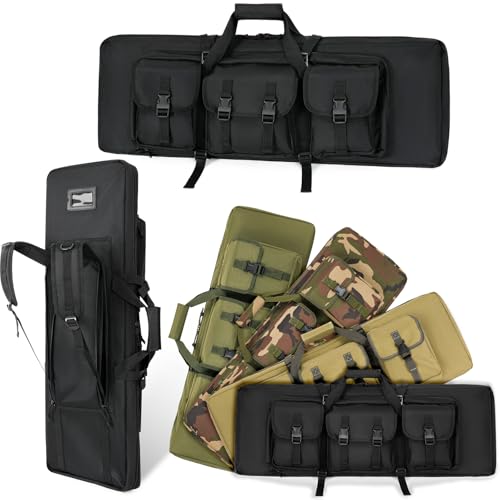


As an Amazon Associate we earn from qualifying purchases at no extra cost to you. Ratings are shown as listed on Amazon.
Quick comparison: soft rifle bags versus hard cases
| Case type | Typical interior lengths | Typical padding or shell | Typical empty weight | Best use |
|---|---|---|---|---|
| Basic soft rifle bag | 36–48 inches | 0.25–0.5 inch foam | 2–4 pounds | Range trips, vehicle transport, low budget |
| Premium soft rifle bag | 42–55 inches | 0.5–1 inch closed-cell or layered foam | 4–8 pounds | Frequent range use and organized gear storage |
| Injection-molded hard case | 40–52 inches | Rigid polymer shell with 1–2 inches of foam | 10–18 pounds | Vehicle transport and demanding outdoor use |
| Heavy-duty waterproof hard case | 42–55 inches | Sealed polymer shell with 2–3 inches of customizable foam | 18–32 pounds | Air travel, extreme weather, and long-term protection |
These are useful buying ranges rather than universal specifications. Exterior dimensions are usually several inches larger than the listed interior, and wheels, locks, thick hinges, and extra compartments can add substantial weight.
Best rifle bag choices by situation
Best for occasional range trips: a padded soft case
A soft case is the practical choice when the rifle travels from a locked storage location to a nearby vehicle and shooting range. Look for at least 0.5 inch of padding, reinforced stitching around the muzzle and stock areas, full-length zippers, and a hook-and-loop or buckle retention system. A shoulder strap is convenient, but two backpack-style straps are more comfortable for longer walks.
Soft cases also take less storage space. A 48-inch case can often be folded or hung in a closet, whereas a rigid case needs a permanent storage footprint. The trade-off is limited crush protection: a soft bag will not protect a scope or rifle from someone placing heavy equipment on top of it.
Best for frequent range use: a structured double rifle bag
A double rifle bag has separate padded compartments for two firearms, or one rifle plus a second compartment for accessories. Its extra capacity can be useful, but do not buy one merely because it holds more. A double bag may weigh 6–10 pounds empty and become awkward when loaded with ammunition, optics, cleaning supplies, and a shooting rest.
Choose a design with adjustable internal dividers so the rifle cannot slide into another compartment. Separate the firearm from hard accessories such as metal magazines, tools, and bipods. Those items can rub against the receiver or optic during transport.
Best for air travel or severe handling: a waterproof hard case
A hard case is the strongest option when the case may be dropped, stacked, exposed to rain, or handled by baggage crews. Brands such as Pelican, SKB, and Plano make established hard-case lines, but the brand name matters less than the dimensions, latches, hinge construction, and replacement-part availability.
For a travel case, prioritize a gasketed seal, pressure-release valve, corrosion-resistant hardware, lock holes that accept suitable locks, and wheels if the loaded case will be heavy. A hard case can protect the rifle from impacts, but it does not make an incorrectly packed firearm safe. The rifle should be unloaded and immobilized, and local transport and airline rules should be checked before departure.
How to size a rifle bag correctly
Measure the rifle as it will actually be transported. Include the stock, muzzle device, bolt handle, mounted optic, and any folded or extended bipod. Then compare those measurements with the case’s interior length and usable height, not its exterior dimensions.
- Measure from the furthest rear point of the stock to the furthest forward point of the muzzle device.
- Add about 2 inches of length for padding, zipper clearance, and easy insertion.
- Measure the widest point, usually the scope, turret, or folded bipod.
- Check the interior height at that point; a long case can still be too shallow for a large optic.
- Confirm that the retention straps close without pressing directly on the scope or adjustment turrets.
For example, a rifle measuring 44 inches from stock to muzzle generally needs at least a 46-inch usable interior. If the rifle has a large optic and a wide stock, choose a case with extra height and width rather than relying only on length. A case that is too large can also be a problem because the firearm moves inside it, so use adjustable straps or padded dividers to remove excess space.
Padding thickness: what the numbers mean
Padding thickness is only part of the protection equation. A thin layer of dense closed-cell foam can protect better than a thicker layer of soft, easily compressed foam. Closed-cell foam resists moisture absorption and retains its shape longer; open-cell foam is usually lighter and less expensive but may compress more quickly.
- 0.25–0.5 inch: suitable for preventing scratches during careful vehicle transport.
- 0.5–1 inch: a better everyday range for a scoped rifle and regular range trips.
- 1–2 inches inside a rigid shell: appropriate for impact protection and rough handling.
- 2–3 inches of customizable foam: useful when the rifle and accessories need a close-fitting travel layout.
Look for padding beneath the rifle, between compartments, and around the muzzle and buttstock. Some bags advertise thick walls but use little material on the bottom, where impacts are most likely. A rigid bottom panel or removable reinforced insert can be more valuable than another thin layer on the sides.
Decision matrix for choosing among the best rifle bags
| Your situation | Recommended format | Target specification | Why |
|---|---|---|---|
| Low budget, occasional local trips | Single soft case | 0.5-inch foam, 2–4 pounds, interior 2 inches longer than rifle | Low cost and easy storage |
| Weekly range use | Structured soft or double case | 0.5–1-inch foam, reinforced seams, adjustable dividers | Better organization and reduced wear |
| Scoped precision rifle | Wide soft case or fitted hard case | Extra interior height, 1 inch of padding or rigid shell | Protects the optic and turrets from side pressure |
| Frequent travel in rain or rough vehicles | Water-resistant soft case or hard case | Sealed zippers or gasket, waterproof materials, corrosion-resistant fittings | Reduces moisture and impact risk |
| Air travel or checked baggage | Lockable hard case | Rigid shell, gasket, lock points, 2 inches or more of foam | Provides crush and impact protection |
Features worth paying for
Reliable closures: Large coil or molded-tooth zippers are easier to operate around dirt and fabric than small lightweight zippers. On hard cases, latches should close firmly without excessive force and should not open when the case is lifted.
Useful retention: Straps should hold the rifle in place without compressing delicate controls. Padded dividers are preferable to loose accessory pockets that allow metal items to contact the firearm.
Moisture control: Water-resistant fabric helps with short exposure to rain but is not equivalent to a waterproof hard case. After a wet trip, remove the rifle and allow both firearm and bag to dry fully. A desiccant pack can help inside a closed case, but it does not replace drying and appropriate firearm maintenance.
Repairable construction: Replaceable shoulder straps, zipper pulls, wheels, latches, and foam inserts can extend the useful life of a case. This matters more for frequent users than decorative MOLLE panels or extra pockets.
Durability and ownership realities
The first parts to wear on a soft bag are commonly zipper teeth, zipper sliders, shoulder-strap stitching, and the bottom panel. Dragging a loaded case across concrete accelerates all four. Lift the case by its main carry handles when possible, and avoid placing heavy boxes on top of a soft case.
On hard cases, inspect hinge pins, latch alignment, wheels, and the lid gasket. A damaged gasket can allow moisture inside even when the latches still appear functional. Foam also loses resilience after repeated compression. Replace a crushed or crumbling insert rather than assuming the shell alone provides enough protection.
Clean fabric cases with a damp cloth and mild soap, then dry them open. Avoid soaking foam unless the manufacturer specifically permits it. Wipe dirt from hard-case seals and latches, and do not use excessive lubricant near foam or firearm surfaces. Keep ammunition and loose tools in their own secure containers instead of allowing them to move around the rifle compartment.
Final buying recommendation
For most local range users, the best rifle bags are single or double soft cases with at least 0.5 inch of dense padding, an interior roughly 2 inches longer than the rifle, and strong retention straps. Choose a hard case when crush resistance, weather sealing, or air travel matters more than low weight and easy storage. Whatever style you select, fit the case to the mounted rifle, immobilize the contents, keep the firearm unloaded during transport, and follow all applicable local, state, national, and carrier rules.