Key takeaways
- Large 150mm aperture delivers crisp, contrast-rich views of…
- Fast f/5 focal ratio, 750mm focal length
- Borosilicate parabolic primary mirror with Sky-Watcher’s proprietary Radiant…
The best Dobsonian telescopes for deep sky visual observation are usually an 8-inch or 10-inch model: an 8-inch Dobsonian is the most balanced choice for portability and galaxies, while a 10-inch gathers noticeably more light if you can transport and store its heavier base.
Our top picks
 Sky-Watcher Heritage 150 Tabletop Dobsonian Telescope
- Large 150mm aperture delivers crisp, contrast-rich views of…
- Fast f/5 focal ratio, 750mm focal length
- Borosilicate parabolic primary mirror with Sky-Watcher’s proprietary Radiant…
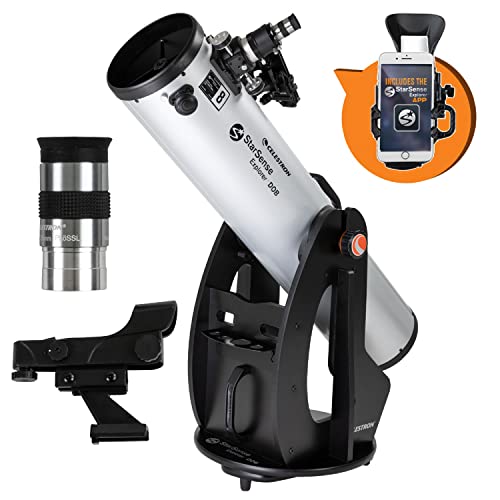 Celestron StarSense Explorer 8" Dobsonian Telescope with
- No experience needed! Just dock your phone, launch…
- Unlike other astronomy apps, StarSense Explorer uses sky…
- TONIGHT’S BEST TARGETS, INSTANTLY: The app generates a…
 Sky-Watcher Flextube 200 Dobsonian 8-inch Collapsible Large
- Get a bright, bold viewing experience at a…
- Unique strut design allows for optical tube to…
- These patented handles allow for accurate movement without…
As an Amazon Associate we earn from qualifying purchases at no extra cost to you.
Quick recommendations by observing situation
| Situation | Best fit | Why | Typical 2026 market range |
|---|---|---|---|
| First serious telescope, limited storage | 6-inch solid-tube Dobsonian | Useful deep-sky aperture without being difficult to carry or collimate | $350–$600 |
| Best all-round value | Sky-Watcher Classic 200P / 8-inch Dobsonian | Strong galaxy and nebula performance, manageable two-piece design, abundant accessories | $550–$750 |
| Suburban observer wanting more reach | 8-inch or 10-inch Dobsonian | Extra aperture helps with globular clusters and smaller nebulae, although light pollution still limits galaxies | $600–$1,000 |
| Frequent dark-sky trips by car | 10-inch collapsible or truss Dobsonian | Collects 56% more light than an 8-inch while remaining transportable for many observers | $800–$1,500 |
| Maximum faint-object performance without electronics | 12-inch Dobsonian | Large mirror shows substantially more detail in nebulae and galaxies | $1,000–$2,000+ |
| Apartment, balcony, or occasional use | Sky-Watcher Heritage 130P or 150P | Collapsible tabletop format, low weight, and quick setup | $250–$500 |
What aperture really changes for deep-sky viewing
Aperture is the diameter of the primary mirror, and it determines both light-gathering power and theoretical resolution. Compared with a 6-inch telescope, an 8-inch mirror gathers about 78% more light. A 10-inch mirror gathers about 178% more, and a 12-inch mirror gathers four times as much light as a 6-inch mirror.
Those figures do not mean a 12-inch telescope automatically gives four times the visual experience. Sky brightness, mirror cooling, optical quality, observer experience, and the object’s altitude all matter. Under suburban skies, a larger telescope makes globular clusters, planetary nebulae, and bright emission nebulae easier, but it cannot remove the gray background that hides low-contrast galaxies.
6 inches: practical and capable
A 6-inch Dobsonian is a strong choice for beginners who want more than lunar and planetary viewing. It can show many Messier objects, resolve brighter globular clusters, and reveal structure in objects such as the Orion Nebula. Its shorter tube and lighter base are easier to carry upstairs or fit in a small car.
8 inches: the sensible deep-sky baseline
An 8-inch Dobsonian is usually the best compromise. Under a reasonably dark sky, it can show hundreds of deep-sky objects, including spiral structure hints in brighter galaxies, dark lanes in nebulae, and individual stars around the edges of globular clusters. Solid-tube designs are simple and inexpensive; collapsible designs reduce transport length but require more careful protection from stray light and dew.
10 to 12 inches: more detail, more ownership effort
A 10-inch telescope is a meaningful step up from 8 inches rather than a minor size increase. It gives a 56% increase in light-gathering area and can make faint galaxies more accessible from dark locations. A 12-inch Dobsonian goes further, but the base can be bulky, the tube may require two people, and a short step stool may be useful when viewing near the zenith.
Head-to-head: solid tube versus collapsible Dobsonian
Solid-tube models
Solid-tube Dobsonians such as the Sky-Watcher Classic 150P and Classic 200P are usually the simplest deep-sky instruments to own. The tube blocks stray light, protects the secondary mirror better during storage, and requires little assembly. The trade-off is length: an 8-inch tube is roughly 1.2 metres long, while a 10-inch tube is commonly around 1.3 metres.
Collapsible and truss models
Collapsible designs such as the Sky-Watcher Heritage 130P and 150P pack into a much shorter space. Larger collapsible or truss Dobsonians from Sky-Watcher and other established manufacturers can make a 10- or 12-inch mirror feasible for car travel. They need a shroud or careful shielding around the open tube, and the poles or struts add setup time. Check that the collapsed dimensions fit your vehicle rather than judging portability by aperture alone.
| Typical Dobsonian | Mirror diameter | Common focal ratio | Approximate focal length | Typical complete weight | Best use |
|---|---|---|---|---|---|
| Tabletop compact | 130 mm | f/5 | 650 mm | 6–8 kg | Small spaces, bright nebulae, wide-field viewing |
| Tabletop compact | 150 mm | f/5 | 750 mm | 8–10 kg | Portable dark-sky trips and beginner deep-sky observing |
| Standard 6-inch | 150 mm | f/8 | 1,200 mm | 15–20 kg | Easy collimation and sharper high-power views |
| Standard 8-inch | 203 mm | f/6 | 1,200 mm | 18–25 kg | Best overall balance for galaxies and nebulae |
| Standard 10-inch | 254 mm | f/4.7–f/5 | 1,200–1,250 mm | 25–35 kg | Deeper observing when transported by car |
| Large Dobsonian | 305 mm | f/4.5–f/5 | 1,370–1,500 mm | 35–55 kg | Experienced observers with storage and dark-sky access |
Weights vary by manufacturer, focuser, finder, base material, and whether the figure includes the optical tube. Treat the table as planning guidance, not a lifting specification.
Focal ratio, eyepieces, and the objects you want to see
Focal ratio is focal length divided by aperture. An f/6 8-inch Dobsonian has a focal length near 1,200 mm, while an f/5 8-inch instrument is approximately 1,000 mm. The slower f/6 design is generally more forgiving of inexpensive eyepieces and shows less edge-of-field distortion. The faster f/5 design gives a wider potential field and a shorter tube, but eyepiece quality and collimation become more important.
Magnification is calculated by dividing telescope focal length by eyepiece focal length. With a 1,200 mm telescope, a 30 mm eyepiece gives 40x, a 15 mm eyepiece gives 80x, and a 9 mm eyepiece gives about 133x. A useful starting set is a wide-field 25–32 mm eyepiece for locating nebulae, a 12–15 mm eyepiece for galaxies and globular clusters, and a 7–10 mm eyepiece for compact planetary nebulae when atmospheric conditions allow.
For wide nebulae, a 2-inch focuser and a low-power 2-inch eyepiece can provide a wider true field than a standard 1.25-inch setup. However, a 2-inch focuser does not guarantee a wide field: the eyepiece’s field stop and the telescope’s focal length also control coverage. An optional UHC-type nebula filter can improve contrast on emission nebulae under light-polluted skies, while a narrow O-III filter is more specialized and can make some nebulae dramatically stronger but dim many stars.
Choosing for your light-pollution level
- Bright city skies: prioritize 6–8 inches, a reliable low-power eyepiece, and realistic targets such as the Moon, planets, double stars, open clusters, globular clusters, and bright planetary nebulae. Galaxies will often appear as small, faint smudges.
- Suburban skies: an 8- or 10-inch Dobsonian offers the best balance. A nebula filter can help emission nebulae, but it will not improve most galaxies because their light has a similar broad spectrum to the sky background.
- Dark rural skies: aperture becomes more valuable. A 10- or 12-inch telescope can reveal dust lanes, irregular galaxy shapes, and faint nebular extensions that are difficult or invisible from town.
Ownership realities before buying
The first maintenance task is usually collimation, not mirror cleaning. A Dobsonian’s primary and secondary mirrors need periodic alignment, especially after transport. A simple collimation cap or Cheshire tool is adequate for many f/6 instruments; faster f/5 and f/4.5 telescopes reward more precise alignment.
Do not clean the primary mirror every few months. Dust usually has little visible effect, while unnecessary washing increases the chance of scratches or coating damage. Keep the telescope capped, let dew evaporate before covering it, and store the optical tube in a dry, dust-controlled room. The accessories most likely to need replacement are basic eyepieces, plastic finders, collimation tools, and sometimes altitude or azimuth friction components—not the mirror itself.
Plan the lifting procedure before choosing a large model. An 8-inch Dobsonian is commonly manageable as two separate loads. A 10-inch model may also be practical in two pieces, but the base can be awkward through doorways. A 12-inch instrument can deliver spectacular views yet remain unused if assembling it feels like a chore. A smaller telescope that reaches dark skies often outperforms a larger one that stays indoors.
Bottom line
Choose a 6-inch Dobsonian for low cost and easy handling, a Sky-Watcher Classic 200P or comparable 8-inch f/6 model for the safest all-round recommendation, and a 10-inch Dobsonian if you regularly have vehicle access to darker skies. Move to 12 inches only when storage, lifting, collimation, and transport are already solved. For deep-sky visual observing, the most satisfying specification is not the largest mirror on paper but the largest aperture you will reliably set up under the darkest sky you can reach.