Key takeaways
- Type: plug-in receptacle tester for standard North American 120V AC three-wire outlets
- Display: LCD readout showing voltage and wiring status
- Named functions: GFCI outlet testing, electric voltage testing
- Format: single-piece body with a fixed three-prong plug, no leads to manage
- Circuit compatibility: 120V branch circuits, 15A and 20A receptacle configurations
- Price tier: mid-range
The best receptacle tester for most residential outlet diagnostics is the Klein Tools RT250 GFCI Outlet Tester with LCD Display. It answers the three questions that come up in nearly every outlet complaint — is the wiring correct, what is the actual line voltage, and does the GFCI device trip — from a single plug-in pass, and it does so with a numeric readout instead of a light pattern you have to decode against a chart. It suits homeowners, landlords, home inspectors, and apprentice electricians working on standard North American 120V, 15A or 20A, three-wire branch circuits. If you only need a yes-or-no wiring verdict and want to spend the least, the Klein Tools RT110 is the budget answer. If you would rather buy one box that covers both contact and non-contact testing, the Klein Tools 80025 two-piece kit is the premium pick. Everything below explains where each of the twelve testers fits and which one matches your situation.
Top 3 Picks
Best overall: Klein Tools RT250 GFCI Outlet Tester with LCD Display. It is the only single plug-in tester in this group that combines a numeric voltage readout, a full fault-indication set, and a GFCI trip button at a mid-range price. The LCD removes the single biggest source of user error with three-light testers — misreading the light pattern — and the voltage number tells you immediately whether you are looking at a 120V circuit or a dead one.
Best budget: Klein Tools RT110 Outlet Tester. A three-light tester with the fault chart printed on the face, built to the same general standard as the rest of the Klein line. It will not trip a GFCI and it will not show you a voltage number, but for a homeowner who wants a fast “is this outlet wired correctly” answer, it covers the majority of real-world faults for the least money.
Best premium: Klein Tools 80025 Outlet Tester Kit. A two-piece set that pairs a plug-in outlet/GFCI tester with a non-contact voltage tester. The non-contact tool lets you check whether a wire, cable, or outlet face is live before you touch anything, which is the step most people skip. It is the pick for anyone who wants one purchase to cover the whole diagnostic routine rather than assembling it piece by piece.
Quick Comparison
| Product | Best for | Key specs | Price tier |
|---|---|---|---|
| Klein Tools RT250 | All-around residential diagnostics | LCD voltage readout, GFCI test button, 120V AC three-wire, fault indication chart | Mid-range |
| Klein Tools RT110 | Lowest-cost wiring verdict | Three indicator lights, 120V AC three-wire, printed fault chart, no GFCI trip button | Budget |
| Klein Tools RT210 | GFCI checks at a mid-range price | Indicator lights plus GFCI test button, 120V AC three-wire, printed fault chart | Mid-range |
| KAIWEETS GFCI Outlet Tester Plug-in | Numeric voltage plus GFCI in one plug-in | LCD display, voltage test function, GFCI test button, AC 120V | Premium |
| Klein Tools 80025 Outlet Tester Kit | One-purchase contact and non-contact coverage | Two-piece kit: plug-in outlet/GFCI tester plus non-contact voltage tester | Premium |
| Southwire GFCI Receptacle Tester | Fast, compact budget GFCI checks | Push-button GFCI test, indicator-light fault readout, compact housing | Budget |
| Gardner Bender GRT-3500 | Reading wiring errors from a chart | Five wiring-error indications, easy-read chart, circuit analyzer function | Budget |
| Klein Tools RT310 | AFCI and GFCI device testing | AFCI test function, GFCI test function, 120V AC three-wire North American outlets | Premium |
| nVent Gardner Bender GFI-3501 | Mid-range GFCI circuit analysis | GFCI trip test, circuit analyzer indication set, 120V AC plug-in format | Mid-range |
| KAIWEETS Electrical Test Kit | Two-tool coverage with an LCD readout | Non-contact voltage tester plus GFCI outlet tester with LCD, wiring fault detection | Premium |
| Sperry Instruments STK001 | Two-tool kit from a test-instrument specialist | VD6504 non-contact voltage tester plus GFI6302 GFCI/receptacle tester | Mid-range |
| EOHELGRO Outlet Tester | Spare-tool basic fault checks | Indicator-light socket tester, standard North American 120V outlets | Budget |
How We Chose
This roundup is built from published product specifications, the wiring-fault sets each tester claims to indicate, and the way these tools are actually used in residential diagnostics — not from bench testing. Selection came down to four filters. First, category fit: does the tool do the job its name promises on standard North American 120V, three-wire branch circuits, without requiring an adapter or a workaround? Second, diagnostic depth: how many distinct fault conditions does it report, and does it report them in a way a non-electrician can act on? Third, readout method, because a numeric LCD, a labeled indicator set, and a three-light pattern with a printed chart are three genuinely different user experiences with different error rates. Fourth, upgrade path: a tester that leaves you needing a second tool three months later is a worse purchase than one that covers the next question you will ask.
We deliberately kept the list to testers that are currently listed and widely available, and we kept pricing at the tier level rather than quoting daily figures, since street prices on test instruments move constantly. Where a listing name does not specify a detail — display type, number of indicators, battery requirement — this guide describes the model by its spec class rather than inventing a number. Every product below is a plug-in or handheld electrical test instrument, and none of them replaces a multimeter or a licensed electrician for anything beyond basic receptacle diagnostics.
1. Klein Tools RT250 – Best for All-Around Residential Diagnostics
As an Amazon Associate we earn from qualifying purchases at no extra cost to you.

The RT250 is the tester to buy if you want one plug-in tool that handles the majority of outlet questions a homeowner, landlord, or apprentice will ever face. Its appeal is that it collapses two separate jobs into one pass: the fault-checking routine that a three-light tester performs, and the voltage confirmation that normally requires pulling out a multimeter. When an outlet is dead, the RT250’s LCD tells you whether the circuit is actually de-energized or whether you have a wiring fault that is feeding the outlet in a way your equipment is not expecting. When an outlet is live, the numeric readout gives you a rough sense of whether the branch is healthy or sagging.
Who it suits: anyone who has to make a decision on the spot. A homeowner troubleshooting a dead bedroom outlet, a landlord checking a turnover unit, a home inspector walking a property, or an apprentice who needs to confirm a circuit condition before reporting it to a journeyperson. It is also the natural first upgrade for someone who already owns a three-light tester and has been frustrated by an ambiguous light pattern.
- Type: plug-in receptacle tester for standard North American 120V AC three-wire outlets
- Display: LCD readout showing voltage and wiring status
- Named functions: GFCI outlet testing, electric voltage testing
- Format: single-piece body with a fixed three-prong plug, no leads to manage
- Circuit compatibility: 120V branch circuits, 15A and 20A receptacle configurations
- Price tier: mid-range
The strengths stack up in the order you actually use them. Plug it in and you get an immediate wiring verdict; if the wiring is correct, you get a voltage number; if the outlet is GFCI-protected, you press the test button and watch for the device to trip. There is no chart to squint at and no sequence of button presses to remember. The fixed three-prong plug also means there is nothing to lose, tangle, or replace — the tool is one piece of molded plastic with a display in it.
The limitations are the limitations of the entire plug-in tester category, and they matter. A plug-in tester cannot detect a bootleg ground, where the neutral is jumpered to the grounding terminal at the receptacle; the tester will read “correct” on a receptacle that is genuinely unsafe. It cannot measure voltage drop under load, so a loose backstab connection that sags under a space heater will read fine with nothing plugged in. And it is not an AFCI tester — arc-fault breakers need a different tool, which is where the RT310 comes in.
Pros
- Numeric voltage readout removes the guesswork of a three-light pattern
- GFCI test button built into the same plug-in body
- Single-piece design with no leads or separate probes to store
- Readable in one glance, which speeds up multi-outlet sweeps
- Covers the two most common residential questions in one tool
Cons
- Costs more than a basic three-light tester for the same fault set
- LCD readability depends on viewing angle and available light
- No AFCI test function
- Cannot detect bootleg grounds or high-resistance connections
- Not a substitute for a multimeter when you need real measurements
Compared with the Klein Tools RT210, the RT250 is the same basic idea with the display upgraded. The RT210 gives you the fault indicators and the GFCI button; the RT250 adds the voltage number. If you have ever stood in front of an outlet wondering whether the light pattern meant “open neutral” or “hot and ground reversed,” that upgrade is worth the price difference. If you have never once been confused by a light pattern, the RT210 does the job for less. Against the KAIWEETS LCD tester, the RT250 competes on brand familiarity and on the depth of its published fault set rather than on price.
2. Klein Tools RT110 – Best for the Lowest-Cost Reliable Wiring Verdict

The RT110 is the simplest tool in this roundup and, for a lot of households, the only one that will ever be needed. It is a classic three-light receptacle tester: you plug it into a 120V three-wire outlet, three indicator lights illuminate in a specific pattern, and you compare that pattern against the chart printed on the tester’s face. Each pattern maps to a wiring condition — correct wiring, open ground, open neutral, open hot, reversed polarity, and the various combinations. It is a diagnostic tool reduced to its absolute minimum, and that minimalism is the point.
Who it suits: the homeowner who wants a cheap, permanent resident in the junk drawer; the renter who wants to check an apartment’s outlets before signing a lease; the DIYer doing a pre-purchase walkthrough. It also suits anyone who needs several testers — one per floor, one in the garage, one in a toolbox — without spending mid-range money three times over. Because there are no batteries to die and no display to fail, a three-light tester is the one that still works after five years of neglect.
- Type: plug-in AC electrical receptacle tester
- Display: three indicator lights with a printed fault chart on the body
- Circuit compatibility: North American 120V outlets
- GFCI function: the listing does not specify a GFCI trip button; the RT210 is the model in this family that adds one
- Format: single-piece plug-in body
- Price tier: budget
What makes it good is what it does not have. No battery door, no LCD, no membrane keypad, no separate probe. The failure points that eventually kill a more complex tester — a display that fades, a button that stops registering, a battery contact that corrodes — simply do not exist here. The three-light design is also extremely fast: plug in, read the pattern, move on. For someone testing forty outlets in an afternoon, that speed compounds.
What it cannot do is the reason people outgrow it. There is no GFCI trip button, so you cannot verify that a bathroom or kitchen GFCI device actually interrupts. There is no voltage number, so you cannot tell a healthy 122V circuit from a marginal 108V one. And the light-pattern readout has a well-known ambiguity: on many three-light testers, the pattern labeled “hot and ground reversed” is far more often caused by an open neutral, because the tester is reading a voltage path that should not exist. That is not a defect in this specific model — it is a limitation of the entire three-light approach — but it is the single best argument for stepping up to a chart-based tester with more indication states, or to an LCD model.
Pros
- The least expensive reliable way to get a wiring verdict
- No battery, no display, no button — almost nothing to wear out
- Extremely fast to use across many outlets
- Chart printed on the body, so there is no separate reference card to lose
- Compact enough to live permanently in a drawer or bag
Cons
- No GFCI trip button
- No voltage readout
- Three-light patterns can be ambiguous on open-neutral faults
- Will not flag a bootleg ground
- Limited upgrade path — it stays a basic tester forever
Against the Klein Tools RT210, the RT110 is the same tester minus the GFCI button. That single missing button is the whole decision: if you own any GFCI receptacles — bathrooms, kitchens, garages, outdoors, basements — the RT210 is the better buy, because the monthly GFCI test is the one routine that actually prevents nuisance trips and catches a failed device. Against the Southwire GFCI Receptacle Tester, the RT110 trades the GFCI push-button for an even lower price and the Klein fault chart. Against the Gardner Bender GRT-3500, it gives up two or three indication states.
3. Klein Tools RT210 – Best for GFCI Checks at a Mid-Range Price
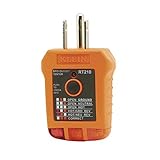
The RT210 is the middle child of the Klein receptacle-tester family, and for a large share of buyers it is the correct stopping point. It takes the RT110’s three-light fault indication and adds a GFCI test button, which turns a wiring checker into a wiring checker plus a device tester. That button matters more than it sounds: GFCI receptacles are life-safety devices, they are supposed to be tested periodically, and the only way to test one without walking to the panel is to plug in a tester that can simulate a fault.
Who it suits: homeowners in any house built or remodeled after GFCI requirements expanded, which by now is most of the housing stock. Landlords who need to document that a unit’s GFCI devices function. Anyone doing a kitchen or bathroom remodel who wants to verify protection before closing up walls. And anyone who has decided they want a GFCI-capable tester but does not need a numeric voltage display.
- Type: plug-in receptacle tester for GFCI and standard North American AC electrical outlets
- Display: indicator-light fault readout with printed chart
- GFCI function: test button that introduces a fault to trip a functioning GFCI device
- Circuit compatibility: North American 120V outlets
- Format: single-piece plug-in body
- Price tier: mid-range
The strength is the combination of breadth and simplicity. You get the standard fault set, you get the GFCI trip test, and you get it in a tool with no battery and no menu. In practice a technician or homeowner uses it in a fixed sequence: plug in, read the lights, press the GFCI button if the outlet is protected, confirm the device trips, then press the device’s own RESET button to restore it. That sequence takes under ten seconds per outlet once you know it, and it is the same sequence the RT250 uses, just without the voltage number.
The weakness is the display. Indicator lights with a printed chart are perfectly adequate once you have memorized the patterns, but they are slower for occasional users and they carry the open-neutral ambiguity described earlier. There is also no AFCI test, so bedrooms and living areas protected by arc-fault breakers remain outside its scope. And, like every plug-in tester, it cannot see a bootleg ground or a high-resistance connection that only fails under load.
Pros
- Adds a GFCI trip button for a modest step up from the basic model
- No battery, no display to fail, no firmware, no menu
- Full standard fault set with a chart printed on the body
- Fast enough for sweeping a whole house
- Durable molded housing suited to a toolbox or a service bag
Cons
- No numeric voltage readout
- Indicator patterns require learning and can be misread
- No AFCI test function
- Cannot detect bootleg grounds
- GFCI test depends on a valid equipment ground path to trip the device
Against the RT110, the RT210 is the same tool with the button you will actually use. If you are choosing between them and the price gap is small, take the RT210. Against the RT250, the RT210 gives up the LCD and the voltage number for a lower mid-range price — a fair trade if you already own a multimeter for voltage checks. Against the nVent Gardner Bender GFI-3501, the RT210 is simpler and lighter, while the GFI-3501 leans harder into circuit-analyzer labeling.
4. KAIWEETS GFCI Outlet Tester Plug-in – Best for a Numeric Voltage Readout

KAIWEETS built its reputation on affordable electrical test instruments, and this plug-in GFCI outlet tester is the model that goes head to head with the LCD-equipped Klein tester. It pairs an LCD display with a voltage test function and a GFCI test button in a single plug-in body rated for AC 120V. For a buyer who wants a numeric reading and a GFCI trip test but is not tied to a legacy tool brand, it is the most direct alternative in this roundup.
Who it suits: the homeowner who has decided that a light pattern is not good enough and wants to see an actual number. Also anyone assembling a small electrical toolkit from scratch who would rather have a matched set of instruments from one brand, and anyone who wants the readout to be legible at a glance during a fast walkthrough of a property.
- Type: plug-in GFCI outlet tester
- Display: LCD screen
- Named functions: voltage test, GFCI test
- Rated for: AC 120V
- Format: single-piece plug-in body
- Price tier: premium
The value proposition is straightforward: the LCD does two jobs at once. It shows the wiring condition in text or symbols, and it shows the measured voltage numerically. That combination is what separates a diagnostic instrument from a pass/fail indicator, and it is why LCD models have been displacing three-light testers in professional kits for years. The GFCI test button covers the device side of the job, and the whole thing fits in a shirt pocket.
The trade-offs are typical of LCD plug-in testers. Readability depends on viewing angle — these screens are small and often oriented for a straight-on look, which can be awkward when the outlet is low on a wall or behind furniture. If the design uses an internal battery, that battery becomes a consumable you have to track, and a dead battery can make the display look like a fault. And like every tool in this category, it does not test AFCI devices, does not measure voltage drop under load, and cannot see a bootleg ground.
Pros
- Numeric voltage display alongside wiring-status indication
- GFCI test button included in the same plug-in tool
- Compact, pocketable, and easy to carry on a walkthrough
- Faster to interpret than a three-light pattern for occasional users
- Brand also offers a matching non-contact tester kit for a two-tool setup
Cons
- Small screen with angle-dependent readability
- Premium tier pricing for a single-function plug-in tool
- No AFCI test capability
- Potential battery dependency to monitor
- No load testing, so high-resistance faults can go undetected
Against the Klein Tools RT250, the decision is largely about brand preference and the exact fault set each listing publishes. Both give you an LCD, a voltage reading, and a GFCI button; the Klein carries a longer track record in the trade, while the KAIWEETS unit is often the more aggressive buy on price within its tier. Against the KAIWEETS Electrical Test Kit, this single tester is the cheaper way into the same readout style — the kit simply adds a non-contact voltage pen, which is the one tool that makes the whole routine meaningfully safer.
5. Klein Tools 80025 Outlet Tester Kit – Best for One-Purchase Full Coverage

The 80025 is a two-piece kit rather than a single instrument, and that changes who should buy it. Klein’s outlet tester kit pairs a plug-in outlet/GFCI tester with a non-contact voltage tester — the two tools that between them answer almost every residential outlet question. The plug-in half handles wiring faults and GFCI device testing. The non-contact half lets you check whether a wire, cable, or outlet face is energized before you put your hands near it, which is the safety step that separates a careful DIYer from a lucky one.
Who it suits: the first-time electrical toolkit buyer who would rather make one purchase than three. New homeowners, DIYers starting a renovation, and anyone who has been using a borrowed tester and wants their own. It also suits the gift-buying case — a two-piece kit reads as a complete, considered present in a way a single plug-in tester does not.
- Type: two-piece outlet tester kit
- Contents: plug-in outlet/GFCI tester plus non-contact voltage tester
- Coverage: wiring-fault detection, GFCI device testing, and non-contact presence-of-voltage indication
- Circuit compatibility: standard North American residential outlets
- Format: one plug-in tool, one handheld pen-style tool
- Price tier: premium
The real strength is that the kit closes a gap most people do not know they have. A plug-in tester only tells you about an outlet after you have already touched it. A non-contact tester tells you whether the box, the cable, or the faceplate screw is live before you commit. Buying the two together means you never end up in the situation where you own the diagnostic tool but not the safety tool, and the pairing is also the natural workflow: sweep the room with the non-contact pen, then plug in and diagnose anything suspicious.
The limitations are the sum of the two instruments. The plug-in half will not test AFCI devices and will not detect a bootleg ground. The non-contact half is an indicator, not a measurement — it tells you voltage is likely present, not how much, and false positives are common when you are near other energized conductors in a crowded box. Neither tool measures voltage drop under load. And because it is a kit, if you already own a good non-contact tester, you are paying for redundancy.
Pros
- Two complementary tools in a single purchase
- Non-contact testing adds a genuine safety step to the routine
- Plug-in half covers both wiring faults and GFCI device testing
- Kit format is easy to store and hard to misplace
- Natural starting point for a first home electrical toolkit
Cons
- Premium tier price for two tools you might already own one of
- Non-contact tester gives indication, not measurement
- No AFCI testing
- No load or voltage-drop testing
- Two separate tools to keep track of instead of one
Against the KAIWEETS Electrical Test Kit, this is a very close matchup — both bundle a plug-in GFCI tester with a non-contact tester. The difference is the readout style on the plug-in half and the brand ecosystem you prefer. Against the Sperry Instruments STK001, the 80025 competes on brand familiarity in the trade, while Sperry competes on its long history as a dedicated test-instrument manufacturer. Against buying the RT250 alone, the kit trades a numeric voltage display for the non-contact safety tool — and for most beginners, that is the better trade.
6. Southwire GFCI Receptacle Tester – Best for Fast Budget GFCI Checks

Southwire is best known for wire, cable, and the tools that go with them, and this compact GFCI receptacle tester is the budget-tier entry in that family. It is a push-button tester: plug it in, read the fault indicators, press the button to check a GFCI device. Southwire markets it as a fast and accurate way to do wiring checks in a compact, durable housing, and that description is exactly what it delivers — no more, no less.
Who it suits: the buyer who wants GFCI test capability at the lowest possible price. Renters checking an apartment, homeowners who want a tester in every vehicle, contractors who hand testers to helpers and expect them to get lost. It is also a sensible second tester — the one you keep in the garage while the good one stays in the house.
- Type: plug-in GFCI receptacle tester
- Function: push-button GFCI test plus indicator-light wiring checks
- Format: compact single-piece housing with a fixed three-prong plug
- Circuit compatibility: standard North American 120V outlets
- Display: indicator lights
- Price tier: budget
The strengths are price and portability. Because it is small and light, it disappears into a pocket or a glovebox, which means it is actually present when you need it. The push-button GFCI test is the single most valuable feature you can add to a budget tester, since it turns a wiring checker into a device tester for a small premium. And Southwire’s construction is aimed at jobsite conditions, so the housing tolerates being tossed in a bag.
The weaknesses are the standard budget-tester set. Indicator lights only, no numeric voltage reading, and no AFCI testing. The fault indication is a light pattern, so the same open-neutral ambiguity that affects all three-light-style testers applies here. And, as with every plug-in GFCI tester, the trip test depends on the circuit having a valid equipment ground path — on an older two-wire ungrounded circuit, the tester may fail to trip a GFCI that is actually working correctly, so you should always confirm with the device’s own TEST button.
Pros
- GFCI test button at a budget-tier price
- Very compact and easy to carry or store
- Durable housing suited to jobsite and garage use
- No battery or display to fail
- Good candidate for a second or third tester around the property
Cons
- No voltage readout
- Indicator patterns require learning
- No AFCI test function
- Cannot detect bootleg grounds or load-dependent faults
- GFCI trip test can be inconclusive on ungrounded circuits
Against the Klein Tools RT110, this Southwire unit adds a GFCI test button, which makes it the better choice for any home with GFCI receptacles — and that is nearly all of them. Against the Gardner Bender GRT-3500, it gives up some indication states in exchange for a simpler, more compact body. Against the nVent Gardner Bender GFI-3501, it is the cheaper, less-labeled option: the GFI-3501 gives you more analyzer-style feedback for a mid-range price.
7. Gardner Bender GRT-3500 – Best for Reading Wiring Errors From a Chart

The GRT-3500 is a budget-tier outlet receptacle tester and circuit analyzer that indicates five wiring errors and leans on an easy-read chart to tell you what they mean. Gardner Bender — now part of nVent — has been making consumer electrical test tools for decades, and this model is aimed squarely at the buyer who wants more diagnostic resolution than a three-light tester provides but is not ready to pay mid-range or premium money for an LCD.
Who it suits: the homeowner who has been burned by an ambiguous light pattern and wants a clearer label. Also anyone diagnosing a specific fault — an outlet that reads strangely, a circuit that trips a breaker, a receptacle that has been rewired by a previous owner. The chart-based approach works well for someone who is willing to take ten seconds to read rather than guess.
- Type: outlet receptacle tester and circuit analyzer
- Indication set: five wiring errors
- Readout: indicator lights with an easy-read chart
- Format: single-piece plug-in body
- Circuit compatibility: standard North American 120V outlets
- Price tier: budget
The strength here is diagnostic resolution at a low price. Five discrete wiring-error indications is more than a basic three-light tester offers, and the chart is designed to be read quickly rather than memorized. For a homeowner who tests outlets once a year, the chart is actually the better interface — it does not rely on recall. Gardner Bender’s consumer-grade pricing also means you can buy one for the house and one for the shop without thinking about it.
The limits are the same category limits, plus a few of its own. There is no numeric voltage readout, so you cannot tell a healthy circuit from a marginal one. There is no GFCI trip button on this model — GFCI device testing is the job of the GFI-3501 in the same family. And the circuit-analyzer labeling can overpromise: a plug-in tester cannot analyze impedance, load capacity, or voltage drop, no matter what the marketing name suggests. It reads voltage presence and wiring configuration, and that is the honest scope.
Pros
- Five wiring-error indications, more than a basic three-light tester
- Easy-read chart reduces misreading for occasional users
- Budget-tier price
- No battery to replace
- Long-established consumer electrical brand with wide availability
Cons
- No GFCI test button on this model
- No numeric voltage readout
- “Circuit analyzer” labeling implies more capability than a plug-in tester has
- No AFCI testing
- Cannot detect bootleg grounds
Against the Klein Tools RT110, the GRT-3500 offers more indication states and a clearer chart, at a similar budget-tier price — a reasonable pick if fault resolution matters more to you than brand familiarity. Against the nVent Gardner Bender GFI-3501, this model is the cheaper sibling that gives up GFCI device testing. If your home has GFCI receptacles, spend the extra and take the GFI-3501 instead; if it does not, the GRT-3500 is the more informative budget tester of the two.
8. Klein Tools RT310 – Best for AFCI and GFCI Device Testing

The RT310 is the specialist in this roundup. Where the other Klein testers stop at GFCI, the RT310 adds arc-fault circuit interrupter testing, which puts it in a different category of usefulness for anyone dealing with modern residential wiring. AFCI breakers have been required for dwelling-unit bedrooms and, in successive code cycles, for a widening set of living-area circuits. Those breakers have their own test buttons at the panel, but a plug-in tester that can exercise an AFCI from the outlet is a genuine convenience.
Who it suits: anyone in a newer home, where AFCI protection is standard rather than exotic. Home inspectors who need to verify both GFCI and AFCI protection during a walkthrough. Electricians and apprentices doing final checks before a job is signed off. And homeowners troubleshooting a breaker that trips for no obvious reason, where confirming the AFCI device responds is the first diagnostic step.
- Type: plug-in AFCI and GFCI receptacle tester
- Named functions: AFCI testing, GFCI testing
- Circuit compatibility: North American AC electrical outlets, standard 120V three-wire configuration
- Format: single-piece plug-in body
- Readout: indicator-based status feedback
- Price tier: premium
The strength is coverage that no other plug-in tool in this list offers. GFCI protection is required in bathrooms, kitchens, garages, outdoors, basements, and crawl spaces; AFCI protection covers bedrooms and much of the general living space in newer construction. Between them, that is most of a modern house. A tester that handles both device types means one tool and one routine for the entire property, and it means you are not the person who tests half the safety devices and assumes the rest are fine.
The caveats are important and specific. Plug-in AFCI testers work by generating a waveform intended to simulate an arc signature; some AFCI breaker manufacturers explicitly recommend their own test button as the authoritative check, and a plug-in tester may not trip every AFCI device on the market. That is not a defect — it is a limitation of simulating an arc signature from the load side. Treat a successful trip as confirmation and an unsuccessful one as a prompt to test at the breaker, not as proof of a failed device. The RT310 also gives up the numeric voltage display that the RT250 provides, so if voltage measurement matters more to you than AFCI coverage, they are not interchangeable.
Pros
- Only tester in this list that covers AFCI as well as GFCI devices
- Matches the safety devices found in modern residential construction
- Single-piece plug-in format with no leads
- Consolidates two device tests into one tool and one routine
- Fits the workflow of inspection and final-check work
Cons
- Premium tier price
- No numeric voltage readout
- AFCI simulation may not trip every breaker brand
- Overkill for older homes without AFCI protection
- Cannot detect bootleg grounds or load-dependent faults
Against the Klein Tools RT250, this is a clean either/or: the RT250 gives you the LCD and voltage number, the RT310 gives you AFCI coverage. If your house was built or substantially rewired in the last two decades, the RT310’s coverage is probably the more useful of the two. Against the RT210, the RT310 is the same idea extended upward into device testing rather than readout quality. Against the KAIWEETS LCD tester, it trades the screen for arc-fault capability — and for a diagnostic routine, that trade is usually the right one.
9. nVent Gardner Bender GFI-3501 – Best for Mid-Range GFCI Circuit Analysis

The GFI-3501 is Gardner Bender’s step up from its budget tester: a GFCI outlet tester and circuit analyzer that adds device testing to the fault-indication routine. It sits in the mid-range tier, between the plain GRT-3500 and the premium kits, and it is aimed at the buyer who wants GFCI capability plus a richer set of circuit indications in one plug-in tool.
Who it suits: the homeowner who has decided a budget tester is not quite enough but does not want to pay premium prices for features they will not use. Landlords who need to verify GFCI protection at turnover. Anyone who prefers the Gardner Bender chart-and-indicator interface over an LCD, either because they find it faster or because they distrust a screen that can fail.
- Type: GFCI outlet tester and circuit analyzer
- Function: GFCI trip test plus wiring-fault indication
- Readout: indicator-based with reference chart
- Format: single-piece plug-in body
- Circuit compatibility: standard North American 120V outlets
- Price tier: mid-range
The strength is that it does the two things a residential diagnostic tester most needs to do: identify wiring faults and verify GFCI devices. The analyzer labeling reflects a broader indication set than the cheapest testers provide, and Gardner Bender’s interface is designed to be readable without memorization. There is no battery, no screen, and no firmware — the tool either reads the circuit or it does not, which is a durability argument as much as a simplicity one.
The limitations follow the pattern. No numeric voltage display, so you cannot distinguish a healthy 120V from a marginal reading. No AFCI testing, which rules out the bedroom and living-area circuits in newer homes. The “circuit analyzer” name should be read carefully: a plug-in tester can indicate wiring configuration and voltage presence, but it cannot measure impedance, available fault current, or voltage drop under load. And as always, the GFCI trip test depends on a valid equipment ground path to work as expected.
Pros
- GFCI device testing in a mid-range plug-in tool
- Broader circuit indication set than budget three-light testers
- No battery, screen, or keypad to fail
- Simple one-step plug-in operation
- Widely available from a long-established consumer electrical brand
Cons
- No numeric voltage readout
- No AFCI test function
- Indicator patterns still require interpretation
- Analyzer naming overstates what a plug-in tester can measure
- Cannot detect bootleg grounds or high-resistance connections
Against the Gardner Bender GRT-3500, the GFI-3501 is the upgrade you buy specifically for GFCI device testing; if that is not a need, the cheaper model is the better value. Against the Southwire GFCI Receptacle Tester, the GFI-3501 offers a richer indication set for its mid-range price while the Southwire unit wins on compactness. Against the Klein Tools RT210, the two are direct competitors in the same tier: the RT210 is smaller and simpler, the GFI-3501 gives you more labeled indications.
10. KAIWEETS Electrical Test Kit – Best for Combined Contact and Non-Contact Testing
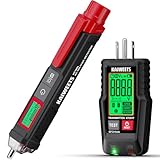
This KAIWEETS kit bundles the two instruments that cover the majority of residential electrical questions: a non-contact voltage tester and a GFCI outlet tester with an LCD display and wiring fault detection. It is the KAIWEETS answer to the Klein two-piece kit, and it lands in the same premium tier. The difference is the readout philosophy — KAIWEETS leans on the LCD, which puts a numeric voltage reading in the same package as the non-contact safety check.
Who it suits: the buyer who wants a complete diagnostic set in one purchase and wants a display rather than a light pattern. New homeowners assembling a first toolkit, DIYers who have been borrowing tools, and anyone who has decided that the two instruments they actually reach for are a voltage pen and a plug-in tester.
- Type: two-piece electrical test kit
- Contents: non-contact voltage tester plus GFCI outlet tester with LCD display
- Functions: wiring fault detection, GFCI device testing, non-contact voltage indication
- Circuit compatibility: standard North American residential outlets, AC 120V
- Readout: LCD on the outlet tester, indicator on the non-contact pen
- Price tier: premium
Affiliate disclosure. As an Amazon Associate we earn from qualifying purchases at no extra cost to you. Prices accurate as of the date shown.Best Receptacle Testers for Outlet DiagnosticsCheck price on Amazon