Key takeaways
- Type: Powered (self-amplified) floorstanding tower
- Bass drivers: Dual 10-inch subwoofers per cabinet
- Amplification: Built into the cabinet; no external receiver required
- Connectivity class: Consumer inputs typical of the TM series, including wireless streaming and wired line-level connections
- Finish: White
- Subwoofer required: No for small and medium rooms; possibly in a very large open plan
The Fluance Ai81 Elite is the best powered tower speaker for most people. It is a genuine active pair — the amplifier is built into the cabinet, rated 150W per the listing — so you get a complete 2.0 stereo system from a phone, a turntable with a built-in phono stage, or a TV, without buying a receiver, and it is voiced for music first. If your priority is cinema-scale bass rather than finesse, the Rockville TM150B is the better buy: dual 10-inch powered subwoofers in each tower at a mid-range price tier, with enough low-end output that most rooms never need a separate subwoofer. On a tighter budget, the Rockville TM80B delivers the same concept with dual 8-inch subs at a lower price tier. And if you already own a good amplifier or AV receiver, the Polk Monitor XT70 is the passive tower worth building a system around. Everything below sorts those twelve options by room size, amplification, connectivity, bass output, and whether you still need a sub.
Top 3 Picks
Best Overall: Fluance Ai81 Elite
The Ai81 Elite is the pick for anyone who wants tower-speaker scale without a rack of electronics. It is a self-amplified stereo pair with a 150W built-in amplifier, which means one box, two speakers, and no receiver — the cleanest possible path to a serious 2.0 music system. It suits apartments, dens, and living rooms where the TV is secondary and the turntable or streaming service is primary.
Best Budget: Rockville TM80B
The TM80B brings the powered-tower formula down to the entry tier: dual 8-inch subwoofers per cabinet, onboard amplification, and the same plug-and-play approach as the bigger TM150 models. It is the right answer for a small or medium room where a 10-inch driver would be overkill and the budget will not stretch to the mid-range tier.
Best Premium: Definitive Technology BP-9040
The BP-9040 is the enthusiast option — a bipolar tower with a built-in powered 8-inch subwoofer, so the bass is amplified separately from the midrange and treble. It suits a dedicated room, a receiver with proper bass management, and a buyer who wants a wide, diffuse soundstage for movies rather than a pinpoint stereo image.
Quick Comparison
| Product | Best for | Key specs | Price tier |
|---|---|---|---|
| Fluance Ai81 Elite | Music-first 2.0 without a receiver | Active pair, 150W built-in amplifier, 2-way floorstanding, wireless plus wired inputs | Premium |
| Definitive Technology BP-9040 | Premium home theater with built-in bass | Bipolar tower array, built-in powered 8-inch subwoofer, separate bass amplification | Premium |
| Rockville TM150W (white) | Bright, white-out rooms | Powered tower, dual 10-inch subwoofers per cabinet, onboard amp, consumer inputs | Mid-range |
| Rockville TM150B (black) | All-black home theater builds | Powered tower, dual 10-inch subwoofers per cabinet, onboard amp | Mid-range |
| Rockville TM150D (dark wood) | Wood-tone living rooms | Powered tower, 10-inch subwoofers, wood-grain finish | Mid-range |
| Rockville TM80B (black) | Budget powered towers, small rooms | Powered tower, dual 8-inch subwoofers per cabinet, onboard amp | Budget |
| Rockville TM80C (cherry) | Budget powered towers in cherry | Powered tower, dual 8-inch subwoofers per cabinet, cherry finish | Budget |
| Polk Audio Monitor XT60 | Building a system one speaker at a time | Passive tower, single unit, 1-inch-class dome tweeter, 6.5-inch-class woofer | Budget |
| Polk Audio Monitor XT70 | Large rooms, mid-range passive setup | Passive tower, single unit, larger cabinet than XT60, series matching center/surrounds | Mid-range |
| Polk Audio T50 | Entry-level passive towers | Passive floorstander, 150W power handling, 1-inch tweeter, 6.5-inch-class woofer | Budget |
| Polk Audio Signature Elite ES50 | Music-first stereo in walnut | Passive tower, single unit, contemporary walnut finish, Signature Elite voicing | Mid-range |
| Dayton Audio Classic T65 | Value passive pair for amp owners | Passive floorstanding pair, black finish, 6.5-inch-class two-way design | Budget |
Price tiers are deliberately broad, because listing prices on this category move constantly and a tower that is mid-range in one season can drift toward the budget tier in the next. Read the tiers as relative bands within this list, not as fixed figures.
How We Chose
Selection started with the category itself: what makes a tower speaker “powered,” and which of the well-known floorstanders on the market actually fit that description. Self-amplified models — where the amplifier, crossover, and inputs live inside the cabinet — were treated as the core of the list, and passive towers were included only where they represent a genuinely useful alternative for buyers who already own an amplifier or receiver. From there, each model was assessed on six criteria: the driver complement stated in the listing, the amplifier rating where one is published, the connectivity class (wireless, analog, digital, or line-level only), the bass capability implied by driver size and cabinet volume, the cabinet design and finish options, and whether the speaker can realistically stand alone without a subwoofer.
Category fit mattered as much as raw specification. A pair of dual 10-inch powered towers is a poor recommendation for a 12 by 12 foot apartment, and a single 6.5-inch passive tower is a poor recommendation for a 20 by 25 foot open-plan room. Upgrade path was the final filter: models from a series with matching centers, surrounds, and subwoofers score higher, because they let a buyer expand from stereo to surround sound without replacing anything.
1. Rockville TM150W – Best for Bright, White-Out Rooms
As an Amazon Associate we earn from qualifying purchases at no extra cost to you.

The TM150W is for the buyer whose room already has a white or pale palette and who does not want a black monolith in the corner. It is a powered home theater tower with dual 10-inch subwoofers in each cabinet, which places it firmly in the “no separate subwoofer required” category for typical living rooms. Because the amplification is onboard, you can feed it from a TV, a phone, or a streaming box without adding a receiver — the single biggest reason this category exists at all.
Rockville’s TM line is positioned as plug-and-play home theater: powered towers with consumer-grade inputs rather than audiophile separates. That framing tells you exactly who should buy it. If you want a system you can unbox, plug in, and have working in twenty minutes, this is the design philosophy you want. If you want to tinker with crossovers, bi-amping, and room correction, it is not.
- Type: Powered (self-amplified) floorstanding tower
- Bass drivers: Dual 10-inch subwoofers per cabinet
- Amplification: Built into the cabinet; no external receiver required
- Connectivity class: Consumer inputs typical of the TM series, including wireless streaming and wired line-level connections
- Finish: White
- Subwoofer required: No for small and medium rooms; possibly in a very large open plan
The real strength here is output per dollar in the low frequencies. Two 10-inch woofers per tower, each with its own amplification, move far more air than the single 6.5-inch drivers found on budget passive towers. In a medium room that translates into movie bass you can feel without a subwoofer taking up floor space and another power outlet. The trade-off is that powered towers put all their electronics in one place: if the amplifier module fails years down the line, the whole cabinet is affected, whereas a passive tower can simply be fed by a new receiver.
Cabinet design is conventional tower territory — a tall, narrow, ported enclosure with a plinth and feet. Ported designs trade a little tightness for noticeably more output, which is the right call for a home theater speaker. The white finish is the entire point of this model: it disappears against light walls and trim in a way that black towers never will.
Pros
- Dual 10-inch powered subwoofers per tower make a separate subwoofer optional in most rooms
- No receiver needed — dramatically lower total system cost and complexity
- White finish solves a real decorating problem rather than being a cosmetic afterthought
- Straightforward, family-friendly setup with consumer inputs
- Substantial bass output for the mid-range price tier
Cons
- Identical acoustically to the black and dark wood versions — you are paying for finish only
- Onboard electronics cannot be upgraded or swapped the way an external amplifier can
- Large cabinets with dual 10-inch drivers demand floor space and wall clearance
- Consumer-grade amplification is not voiced for critical two-channel listening
- White finishes show dust and scuffs more readily than dark wood grain
Against the nearest alternative, the choice is purely visual. The TM150B is the same speaker in black and the TM150D is the same speaker in dark wood, so the decision is about your room, not your ears. The TM80B is the step down: dual 8-inch drivers instead of dual 10-inch, a lower price tier, and less low-frequency authority in a large room.
2. Fluance Ai81 Elite – Best for Stereo Music Without a Receiver
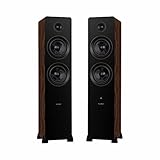
The Ai81 Elite is the most “hi-fi” entry on this list and the one to buy if music, not movies, is the reason you are shopping. It is a powered 2.0 floorstanding pair with a 150W built-in amplifier, which means the crossover, amplification, and inputs are all inside the cabinets and the signal path never touches a receiver. Fluance is a brand built around value-oriented direct sales, and the Ai81 Elite is its flagship floorstanding active model.
This is the tower for a listener with a turntable, a streaming subscription, and a small collection of well-loved albums. It is also the right pick for anyone who finds AV receivers intimidating: fewer boxes, fewer cables, fewer menus.
- Type: Powered (active) 2.0 floorstanding pair
- Amplification: 150W built-in amplifier per the listing
- Configuration: Two-way, one tower per channel
- Connectivity class: Wireless streaming plus wired analog and digital inputs
- Sold as: A matched stereo pair
- Subwoofer required: Optional — add one for movie bass in larger rooms
The strength of an active design is engineering control. When the amplifier is designed for one specific driver complement, the manufacturer can tune the response, protect the drivers, and avoid the mismatch that happens when a random receiver meets a random speaker. The result is usually a smoother, more predictable sound than a comparably priced passive tower plus budget amplifier. The Ai81 Elite’s two-way layout with a dome tweeter and a mid-bass driver is the classic voicing for stereo music, and the pair ships matched rather than as two separate single units.
The limitations are the mirror image of the strengths. There is no upgrade path inside the cabinet — you cannot swap the amplifier, and you cannot bi-amp. If you later want a full surround system, an active stereo pair is not the natural foundation; you would be adding a receiver and passive speakers alongside it rather than expanding it. And a 150W amplifier driving a two-way tower will not produce the same floor-shaking output as a dedicated powered subwoofer array, so movie night in a big room may still want a sub.
Pros
- Complete stereo system with no receiver, no speaker cables to a rack, and no setup menus
- 150W of purpose-matched amplification per the listing
- Voiced for music first, with a two-way layout that suits acoustic and vocal material
- Sold as a matched pair, so both channels are identical out of the box
- Cleanest visual footprint of any option here — two towers, two power cables
Cons
- Premium price tier; you are paying for integration, not driver count
- No path to bi-amping, external amplification, or amplifier upgrades
- Less low-frequency output than the dual 10-inch Rockville towers
- Not a natural building block for a future 5.1 surround system
- Two-way designs ask more of each driver than three-way designs at high volume
Compared with the Definitive Technology BP-9040 — the other premium pick — the philosophy differs completely. The BP-9040 assumes you own a receiver and want a wide, cinema-style presentation with separately amplified bass. The Ai81 Elite assumes you own nothing and want a compact, music-first stereo system. Compared with the Rockville TM150B, the Ai81 Elite gives up bass quantity and gains integration, finish quality, and a music-first tonal balance.
3. Rockville TM150B – Best for All-Black Home Theater Builds

The TM150B is the version of Rockville’s dual 10-inch powered tower that most people should default to, simply because black disappears in a dark home theater room. It is a self-amplified floorstanding tower with dual 10-inch subwoofers per cabinet, intended as the front left and right channels of a system that does not need a separate subwoofer. If your room has a projector, a dark wall, and a sofa facing a screen, this is the finish and the specification that fits.
It suits the buyer who wants a big, effortless movie sound without buying five separate components. Two of these towers plus a center channel covers the front stage of a surround system, and the bass is already handled.
- Type: Powered (self-amplified) floorstanding tower
- Bass drivers: Dual 10-inch subwoofers per cabinet
- Amplification: Onboard, with consumer inputs typical of the TM series
- Finish: Black
- Subwoofer required: No in small and medium rooms
- Role in a system: Front left and right, or a standalone stereo pair
The core advantage is displacement. Bass output is fundamentally about how much air a driver can move, and two 10-inch woofers in a tall ported cabinet move several times the volume of a single 6.5-inch driver. That is why this category exists: you get subwoofer-like low-frequency output without a separate subwoofer box, an extra amplifier, and another set of cables. The powered design also means the tower’s bass drivers are not drawing power from your receiver, which keeps a modest AV receiver from clipping when the soundtrack gets loud.
The weaknesses are the standard powered-tower compromises. Everything is integrated, so nothing is upgradeable, and the onboard electronics are the most likely long-term failure point in any self-amplified speaker. The cabinet is large and needs some breathing room from the wall — ported towers placed flush against drywall tend to sound boomy rather than deep. And a consumer-grade amplifier tuned for movie impact will not have the last word in subtlety for solo piano recordings.
Pros
- Dual 10-inch powered subwoofers per cabinet deliver genuine subwoofer-class output
- No separate subwoofer, no subwoofer cable, no subwoofer placement problem
- Onboard amplification takes the bass load off your receiver
- Black finish suits dark rooms and hides well in shadow
- Mid-range price tier for a very large amount of driver surface
Cons
- Acoustically identical to the white and dark wood versions of the same model
- Integrated electronics are not serviceable or upgradeable by the owner
- Tall cabinets with dual 10-inch drivers need floor space and rear clearance
- Bass tuning favours impact over nuance
- Two towers plus a center channel is a substantial visual commitment
The nearest alternative is the TM80B, which is the same concept with dual 8-inch drivers and a lower price tier. In a room under about 1,500 cubic feet, the TM80B is arguably the smarter buy because the larger drivers will not have room to work. In anything bigger, the TM150B’s extra displacement is audible on every explosion and every bass line. Against the Polk Monitor XT70, the TM150B trades refinement and an upgrade path for bass output and simplicity.
4. Rockville TM80B – Best Budget Powered Tower for Small Rooms

The TM80B is the entry point into powered towers. It is a self-amplified home theater floorstander with dual 8-inch subwoofers per cabinet, sold at the budget tier. It is the right choice for a bedroom, a small apartment living room, or a dorm-style setup where a pair of dual 10-inch towers would overwhelm the space and the neighbours.
Buyers who want the plug-and-play convenience of the TM150 series but cannot justify the mid-range price — or do not have the room — should start here. The design philosophy is identical; only the driver size and the price tier change.
- Type: Powered (self-amplified) floorstanding tower
- Bass drivers: Dual 8-inch subwoofers per cabinet
- Amplification: Onboard, no receiver required
- Finish: Black
- Subwoofer required: No in small rooms; yes in large rooms
- Best room size: Small to medium, roughly up to 1,500 cubic feet
Dual 8-inch woofers are a genuinely useful middle ground. They move noticeably more air than a single 6.5-inch driver, so movie bass has real weight, but they do not require the cabinet volume or the wall clearance of a 10-inch design. In a small room, that combination often sounds better than a bigger tower turned down, because the drivers are operating in their comfortable range rather than being throttled.
The honest limitation is headroom. In a large or open-plan room, dual 8-inch drivers running out of excursion is a real possibility on demanding soundtracks, and the onboard amplifier has less reserve than the bigger models. If you can see yourself moving to a bigger space within a couple of years, the TM150 models are the safer purchase. There is also the familiar powered-tower caveat: the electronics are integrated and not upgradeable.
Pros
- Lowest-cost way to get a genuine powered tower with dual subwoofers
- Dual 8-inch drivers are well matched to small and medium rooms
- No receiver, no separate subwoofer, no subwoofer cable
- Smaller cabinet than the 10-inch models, so placement is easier
- Same plug-and-play philosophy as the rest of the TM line
Cons
- Less low-frequency output and headroom than the TM150 models
- Will need a separate subwoofer if you move to a large room
- Integrated amplification limits future upgrades
- Budget-tier finish and hardware compared with premium alternatives
- Not the pick for critical two-channel music listening
Versus the TM80C, the difference is the finish — cherry instead of black — and nothing else. Versus the TM150B, you are trading roughly two inches of woofer diameter per driver for a lower price and an easier fit in a small room. Versus the Polk Audio T50, the TM80B wins on bass output and simplicity but loses on upgrade path and long-term serviceability.
5. Rockville TM150D – Best for Wood-Tone Living Rooms

The TM150D is the dark wood version of the dual 10-inch powered tower, and it exists for one reason: some rooms have hardwood floors, wood trim, and wood furniture, and a black or white speaker looks wrong in them. Acoustically it is the same platform as the TM150B and TM150W — dual 10-inch powered subwoofers per cabinet, onboard amplification, no receiver required.
It suits a living room that doubles as a movie room, where the speakers need to look like furniture rather than equipment. It is also a reasonable choice for a buyer who wants the bass output of a dedicated subwoofer without the black box in the corner.
- Type: Powered (self-amplified) floorstanding tower
- Bass drivers: 10-inch subwoofers, dual configuration per cabinet
- Amplification: Onboard, consumer inputs typical of the TM series
- Finish: Dark wood grain
- Subwoofer required: No in typical rooms
- Best room size: Medium to large
The practical advantage over a black tower is acceptance. Speakers that match the room get used more, positioned better, and are less likely to be hidden behind a sofa. Wood-grain finishes also hide dust and fingerprints better than gloss black or white, which matters in a room that gets lived in. Underneath the veneer, you get the same dual 10-inch powered bass engine that makes a separate subwoofer optional.
The trade-offs are identical to its siblings. It is a large cabinet, so it needs floor space and a few inches of clearance behind it for the port to breathe. The onboard electronics are not upgradeable. And the dark wood finish, while forgiving of dust, is less forgiving of direct sunlight over several years than a painted or vinyl-wrapped cabinet.
Pros
- Dual 10-inch powered subwoofers give subwoofer-class bass without a subwoofer
- Dark wood finish integrates with traditional furniture and hardwood floors
- No receiver needed — one less box, one less set of cables
- Hides dust and fingerprints better than black or white finishes
- Same driver complement and output as the black TM150B
Cons
- Finish is the only difference from the TM150B and TM150W
- Large footprint for a living room that is not dedicated to media
- Integrated amplification is the long-term weak point
- Wood grain can fade or dry if placed in direct sun
- Not tuned for critical stereo listening
Against the TM150B, this is a pure aesthetics decision and there is no sonic argument either way. Against the Polk Audio Signature Elite ES50 in contemporary walnut, the TM150D gives up musical refinement and finish quality but wins decisively on bass output and on not needing an amplifier. If your priority is how the room looks and how the movies sound, the TM150D is the better fit; if it is how the music sounds, the ES50 is.
6. Polk Audio Monitor XT60 – Best for Building a System One Speaker at a Time
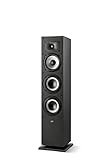
The Monitor XT60 is a different animal from everything above: it is a passive tower, sold as a single speaker, and it needs an amplifier or AV receiver to make any sound at all. Polk’s Monitor XT series is a full lineup with matching centers, surrounds, and subwoofers, and that is exactly why the XT60 belongs on a powered-tower list — it is the affordable, expandable alternative for buyers who already own a receiver.
It suits the person assembling a 5.1 system over several months, buying one or two pieces at a time. Because it is sold individually, you can start with a pair and add a center channel later without being locked into a bundle.
- Type: Passive floorstanding tower (requires external amplification)
- Sold as: Single speaker — order two for a stereo pair
- Drivers: 1-inch-class dome tweeter with a 6.5-inch-class woofer
- Series: Polk Monitor XT, with matching center, surround, and subwoofer models
- Amplifier required: Yes — an AV receiver or stereo amplifier
- Subwoofer required: Yes for movie bass; optional for music
The advantage of buying into a series is the upgrade path. A single 6.5-inch passive tower will not shake a room, but it will reproduce dialogue and midrange cleanly, and it can be joined later by a matching center channel, surround speakers, and a subwoofer without any tonal mismatch across the front stage. That is worth more over five years than a few extra decibels of bass on day one.
The disadvantage is the total system cost. A passive tower needs amplification, which means a receiver, which means speaker cable, which means a subwoofer for real movie bass. Added up, a “budget” passive tower plus a receiver often costs more than a mid-range powered tower that needs nothing else. Buy the XT60 because you want the receiver-based path, not because it looks cheaper on the shelf.
Pros
- Part of a complete series with matching center, surround, and subwoofer options
- Sold individually, so you can buy exactly as many as you need
- Passive design means the amplifier can be upgraded independently of the speakers
- Compact cabinet for a floorstander, easy to place in smaller rooms
- Budget price tier per speaker
Cons
- Requires a receiver or amplifier — not a standalone solution
- Single 6.5-inch-class woofer means limited bass; a subwoofer is effectively mandatory for movies
- Total system cost is higher than the sticker suggests
- Sold as one unit, so a stereo pair means buying two
- Less output per dollar than a powered tower at a similar total spend
Against the Polk Monitor XT70, the XT60 is the smaller, cheaper, easier-to-place option in the same series — choose the XT70 if your room is large. Against the Rockville TM80B, the XT60 offers a genuine upgrade path and better long-term serviceability, while the TM80B offers more bass and no receiver requirement. If you already own a receiver, the XT60 is the more flexible purchase.
7. Rockville TM80C – Best Budget Powered Tower in Cherry

The TM80C is the cherry-finish version of the dual 8-inch powered tower. Like its black sibling, it is self-amplified, needs no receiver, and is aimed at small to medium rooms where a 10-inch driver would be more than the space can support. The cherry finish is the differentiator, and for a lot of buyers it is the deciding factor — a cherry tower reads as furniture in a way that black never does.
It suits a living room with warm wood tones, a home office, or a bedroom system where the speakers will be visible and the budget is at the entry tier.
- Type: Powered (self-amplified) floorstanding tower
- Bass drivers: Dual 8-inch subwoofers per cabinet
- Amplification: Onboard, no receiver required
- Finish: Cherry wood grain
- Subwoofer required: No in small rooms
- Best room size: Small to medium
The dual 8-inch configuration is the sweet spot for a compact powered tower. It gives you real bass extension without the cabinet volume of a 10-inch design, and in a small room that usually sounds cleaner than a larger speaker that never gets to stretch. The cherry finish adds a warm tone that hides dust well and sits comfortably next to oak and walnut furniture.
The compromises are the same as the TM80B: less headroom than the TM150 models, integrated electronics that cannot be upgraded, and a budget-tier build. If you plan to move to a larger home within a few years, the extra money for a dual 10-inch model is usually money well spent.
Pros
- Powered design with dual 8-inch subwoofers at a budget price tier
- Cherry finish suits warm, wood-furnished rooms
- No receiver and no separate subwoofer required
- Compact enough for a bedroom or small living room
- Simpler to place than the taller, deeper 10-inch models
Cons
- Identical acoustically to the black TM80B
- Limited output for large or open-plan rooms
- Onboard electronics are the failure point and cannot be replaced
- Budget-tier hardware and binding posts
- Not intended for critical music listening
Versus the TM80B, this is a finish decision. Versus the Polk Audio Monitor XT60, the TM80C offers far more bass and no receiver requirement, but no upgrade path. Versus the Dayton Audio Classic T65 pair, the TM80C costs more but includes the amplification and the subwoofers that the Dayton pair lacks — a meaningful difference if you do not already own an amplifier.
8. Polk Audio Monitor XT70 – Best Mid-Range Passive Tower for Large Rooms

The Monitor XT70 is the larger tower in Polk’s Monitor XT series, described by Polk as a large home tower speaker and sold as a single unit. It is passive, so it needs a receiver or amplifier, and it is aimed at buyers who want a big-room floorstander with more cabinet volume and more driver surface than the XT60, within the same matching series.
It suits a home theater in a medium-to-large room where the front left and right channels need to fill more space than a compact tower can manage, and where the owner already has — or intends to buy — a proper AV receiver.
- Type: Passive floorstanding tower (requires external amplification)
- Sold as: Single speaker
- Size class: Large tower, the step-up model above the Monitor XT60
- Series: Polk Monitor XT, with matching center, surround, and subwoofer models
- Amplifier required: Yes
- Subwoofer required: Yes for full movie bass
The case for the XT70 over the XT60 is scale. A taller cabinet with more internal volume and more driver area produces more output with less distortion at the same volume level, which is exactly what a large room needs. In a 3,000-cubic-foot space, a compact tower runs out of steam before the room does; a larger tower does not. And because it belongs to the same series, it can be paired with Polk’s matching center channel and surrounds for a tonally consistent surround stage.
The cost of that scale is twofold. First, the receiver: a large passive tower benefits from a genuinely capable amplifier, so pairing it with a bargain-basement receiver wastes the speaker. Second, the subwoofer: no passive tower with a single mid-bass driver reproduces the lowest octave with authority, so a dedicated subwoofer remains part of the plan. Neither is a flaw — they are simply the terms of the passive path.
Pros
- Larger cabinet and more driver area than the XT60 for better large-room output
- Part of a matching series with center, surround, and subwoofer options
- Passive design keeps the speakers upgradeable and long-lived
- Sold individually for flexible purchasing
- Mid-range price tier for a genuinely large tower
Cons
- Needs a capable receiver — a cheap amplifier will hold it back
- Still needs a subwoofer for movie-grade low frequencies
- Larger cabinet demands more floor space and wall clearance
- Single-unit pricing means a stereo pair costs twice the listed figure
- No amplification included, unlike the Rockville powered towers
Against the XT60, the XT70 is the right choice if your room is larger than about 1,500 cubic feet and you own an amplifier with real power. Against the Rockville TM150B, the XT70 offers better refinement, a genuine upgrade path, and a matching surround lineup, but it gives up the built-in bass and the no-receiver simplicity. Against the Polk Signature Elite ES50, the XT70 is the more theater-oriented speaker; the ES50 is the more music-oriented one.
9. Definitive Technology BP-9040 – Best Premium Tower With Built-In Subwoofer
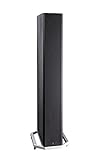
The BP-9040 is the premium option and the most technically interesting speaker here. It is a bipolar tower — Definitive Technology’s BP designation refers to a driver array that radiates both forward and rearward — with a built-in powered 8-inch subwoofer in the cabinet. That means the low frequencies have their own dedicated amplifier, separate from whatever drives the midrange and treble, which is a fundamentally different architecture from every other speaker on this list.
It suits a dedicated or semi-dedicated home theater room, a buyer with a capable AV receiver, and someone who values a wide, enveloping soundstage over a pinpoint stereo image.
- Type: Bipolar tower with a built-in powered subwoofer
- Bass: Powered 8-inch subwoofer with dedicated onboard amplification
- Architecture: Bipolar array — drivers fire forward and rearward
- Amplifier required: Yes for the midrange and treble channels
- Subwoofer required: No — the built-in powered woofer handles the low end
- Price tier: Premium
Bipolar radiation is the reason to buy this speaker. Because sound leaves the cabinet in two directions, much of it arrives at the listener after reflecting off the walls, which creates a diffuse, room-filling presentation rather than a narrow sweet spot. For movies, that translates into a bigger sense of space and a front stage that feels wider than the physical distance between the speakers. For a room with several seats and no single ideal listening position, that is a genuine advantage.
The built-in powered subwoofer adds a second benefit: the bass is amplified separately, so it does not steal power from the receiver’s main channels, and the crossover between bass and midrange is managed inside the cabinet rather than by a receiver’s bass management. In practice, this gives you subwoofer-class low frequencies without an additional box on the floor.
The trade-offs are real. A bipolar speaker is less precise for two-channel critical listening — imaging is diffuse by design, which some listeners love and others do not. The speaker still needs a receiver for its main channels, so it is not a plug-and-play solution. And the premium price tier reflects both the driver array and the integrated amplification.
Pros
- Bipolar array produces a wide, enveloping soundstage ideal for movies
- Built-in powered 8-inch subwoofer means no separate subwoofer needed
- Dedicated bass amplification keeps the load off the receiver’s main channels
- Better low-frequency integration than a passive tower plus external sub
- Premium build quality and finish
Cons
- Premium price tier — the most expensive approach here
- Bipolar design is less precise for critical stereo listening
- Still requires an AV receiver or amplifier for the main channels
- Rear-firing drivers need wall clearance behind the cabinet
- Integrated subwoofer electronics are not upgradeable
Against the Fluance Ai81 Elite — the other premium pick — the BP-9040 is the theater speaker and the Ai81 Elite is the music speaker. The Ai81 Elite needs no receiver and images precisely; the BP-9040 needs a receiver and images diffusely but fills a room far more convincingly. Against the Rockville TM150B, the BP-9040 is a significant step up in refinement and bass integration, at a significantly higher price tier.
10. Polk Audio T50 – Best Entry-Level Passive Tower

The Polk Audio T50 is the classic first floorstander: a passive home theater tower rated at 150W, with a 1-inch tweeter and a 6.5-inch-class woofer, sold at the budget tier. It has been a default recommendation for entry-level surround systems for years, and it remains a sensible starting point for a buyer who already owns a receiver or plans to buy one.
It suits a first home theater build, a secondary room, or a buyer who wants tower-speaker presence in a stereo setup without spending much. Confirm whether your listing is a single speaker or a pair before ordering — Polk’s T-series appears in both configurations depending on the seller, and buying one when you expected two is a common and avoidable mistake.
- Type: Passive floorstanding tower (requires external amplification)
- Power handling: 150W per the listing
- Drivers: 1-inch tweeter with a 6.5-inch-class woofer
- Finish: Black
- Amplifier required: Yes
- Subwoofer required: Yes for movie bass
The T50’s strength is that it does the basics correctly for very little money. A 6.5-inch woofer in a tower cabinet produces more bass than a comparably priced bookshelf speaker, and the tower form factor puts the tweeter at something close to ear