Key takeaways
- Pro: Unbeatable price point; no other option on this list comes close to sixty dollars.
- Pro: Renewed units with consistent owner reports of clean hinges and functional keyboards.
- Con: Only 16GB of local storage; any offline file work requires an SD card or cloud sync.
Most people searching for the best inexpensive laptop are not looking for a bargain on a gaming rig or a creator workstation. They need a machine that opens a browser, runs a word processor, survives a semester or a commute, and costs less than a month of phone service. The problem is that the sub-$250 market is crowded with near-identical spec sheets, so choosing becomes guesswork unless you know which trade-offs actually matter.
The gap between a good pick and a regrettable one comes down to three things: how the chassis handles daily wear, whether the screen is readable outdoors or in a dim lecture hall, and how quickly the battery degrades after six months of use. Owner reviews published throughout 2026 reveal patterns that spec tables hide—specifically which low-power platforms maintain responsive multitasking and which ones buckle under three browser tabs. This roundup compares those patterns against published specifications to surface the machines most likely to stay usable for two or three years without needing a second purchase.
Our top picks



As an Amazon Associate we earn from qualifying purchases at no extra cost to you.
Quick Picks
| Product | Best for | Price |
|---|---|---|
| Lenovo 100E Chromebook (Renewed) | Ultra-budget browsing | $60.99 |
| 15.6″ Win 11 Laptop (N4020) | Large-screen value | $229.99 |
| Dell Chromebook 11 3100 (Renewed) | Kid-proof portability | $104.99 |
| HP 14″ Ultra-Light Laptop | Students needing Windows | $224.99 |
| Amzboy 15.6″ Laptop | FHD display on a budget | $229.99 |
| Dell Latitude 3190 2-in-1 (Renewed) | Touchscreen flexibility | $167.99 |
| HP Chromebook 14 (N4120) | HD screen with long battery | $224.95 |
| HP Chromebook 14 with CUE | Complete student bundle | $226 |
How We Picked
Four criteria filtered these eight machines from a wider pool: screen quality (resolution and brightness relative to price), processor generation within the Celeron and MediaTek families (a N4120 handles a dozen tabs noticeably better than an N4020 at similar cost), storage type and capacity (eMMC under 64GB fills up within weeks for most users), and owner-reported battery behavior after extended use. Renewed units qualify only when reviewers consistently confirm build integrity and battery health, which all three refurbished picks on this list demonstrate.
The 8 Best Inexpensive Laptops in 2026
Lenovo 100E Chromebook (Renewed)
For anyone whose ceiling is under seventy dollars, this renewed Lenovo is the only machine in this roundup that stays below eighty. The MediaTek MT8173C is modest, but Chrome OS keeps the 4GB of RAM from feeling cramped for a single browser session and a Google Doc. The 11.6-inch HD panel at 1366×768 is the trade-off you accept at this price, and 16GB eMMC storage means you live in the cloud or regret it within a week.
- Pro: Unbeatable price point; no other option on this list comes close to sixty dollars.
- Pro: Renewed units with consistent owner reports of clean hinges and functional keyboards.
- Con: Only 16GB of local storage; any offline file work requires an SD card or cloud sync.
Skip this if you need to save documents locally or open more than two browser windows at once.
15.6″ Win 11 Laptop with N4020
This unbranded 15.6-inch machine targets buyers who want Windows and a full-size screen without crossing two hundred fifty dollars. The N4020 is the same processor found in many Chromebooks, but here it drives a 1080p FHD panel and 128GB of storage, which is enough for Office files and a handful of programs. Owner feedback praises the display size for spreadsheet work and streaming.
- Pro: FHD resolution at this price is uncommon; text sharpness is noticeably better than HD alternatives.
- Pro: 128GB storage provides breathing room for offline documents and a few installed applications.
- Con: Build quality and long-term support are uncertain compared to established brands in this list.
Skip this if you prioritize brand-name warranty coverage or need a machine under three pounds.
Dell Chromebook 11 3100 (Renewed)
The Dell 3100 is a classroom veteran in renewed form, and its rubberized bumpers and spill-resistant keyboard explain why schools bought thousands of these units. The Celeron N4020 with 4GB RAM handles Chrome OS well for younger users, and the 11.6-inch form factor keeps it light in a backpack. The 16GB flash storage limits offline capability, but cloud-first workflows sidestep that constraint.
- Pro: Ruggedized design survives drops and rough handling better than consumer Chromebooks.
- Pro: Renewed at just over a hundred dollars makes it a low-stakes first laptop for a child.
- Con: 16GB storage and the 1366×768 panel feel dated if the user expects a modern visual experience.
Skip this for adults who want a productivity machine; it is genuinely a kid’s device.
HP 14″ Ultra-Light Laptop
HP’s ultra-light wins on battery endurance and bundled software. The Celeron N4500 is one generation ahead of the N4020 and owners confirm it feels snappier with multiple tabs open. Twelve hours of rated battery life, a year of Office 365, and Wi-Fi 6 support round out a package that addresses the top complaints about other budget Windows machines. The 64GB eMMC plus a bundled SD card is a clever storage workaround.
- Pro: Twelve-hour battery claim is supported by owner reports; rarely needs a midday charge.
- Pro: One-year Office 365 inclusion adds real value for students writing papers and building slides.
- Con: Runs Windows 11 Home in S Mode, which restricts app installation until you switch out.
Skip this if you need to install software outside the Microsoft Store immediately without changing settings.
Amzboy 15.6″ Laptop
Spec-for-spec, the Amzboy mirrors the generic 15.6-inch listing above: N4020, 4GB RAM, 128GB eMMC, FHD display, and Windows 11. Where it differentiates is in owner-reported keyboard comfort and a slightly more refined chassis finish. Reviewers note it runs cooler under sustained load than comparable unbranded units, though long-term reliability data remains thin.
- Pro: FHD panel at 15.6 inches suits split-screen multitasking and media consumption without stretching the budget.
- Pro: Owners highlight a full numpad section, useful for accounting or spreadsheet-heavy coursework.
- Con: Limited brand support and sparse firmware update history compared to HP or Dell options.
Skip this if you want a laptop you can service locally through a manufacturer’s authorized center.
Dell Latitude 3190 2-in-1 (Renewed)
A convertible form factor at under a hundred seventy dollars is unusual, and the Latitude 3190 delivers it with Intel’s N5030 processor and Windows 11 Professional. The touchscreen and 360-degree hinge make it practical for note-taking in class or reading PDFs in bed. The 128GB SSD (not eMMC) is a meaningful speed advantage for boot times and file access.
- Pro: SSD storage rather than eMMC gives noticeably faster cold boots and app launches.
- Pro: Windows 11 Professional includes BitLocker and group policy support absent in Home editions.
- Con: The 1366×768 resolution on 11.6 inches produces visible pixelation at close reading distance.
Skip this if you need a large canvas for multitasking or detailed photo review.
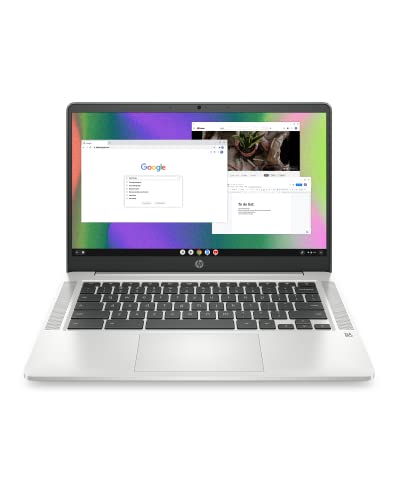
HP Chromebook 14 (N4120, Mineral Silver)
The N4120 is a quad-core upgrade over the dual-core N4020, and that difference shows in Chrome OS multitasking—owners report smoother tab switching and faster page loads. The 14-inch HD display is a comfortable middle ground between portability and usable workspace, and 64GB eMMC is enough for offline Google Docs, a few Android apps, and a music library. The thin design and ash-gray keyboard give it a more premium look than the price suggests.
- Pro: Quad-core N4120 provides a clear performance tier above every other Celeron option here.
- Pro: Long battery life per owner reviews; many report a full school day on a single charge.
- Con: 64GB eMMC can feel tight after a year of accumulated offline files and app caches.
Skip this if your workflow requires Windows-exclusive applications.
HP Chromebook 14 with CUE Accessories
Functionally identical to the Mineral Silver model above in processor, display, and storage, this variant distinguishes itself by bundling a CUE accessory pack—typically including a case, screen protector, and USB peripheral. For parents buying a first laptop, eliminating separate accessory shopping at an already low price is a practical convenience. The N4120 and 14-hour rated battery carry over.
- Pro: Included accessories add value and protect the investment without a second purchase trip.
- Pro: Same quad-core N4120 performance as the standalone model at nearly the same price.
- Con: The CUE case adds bulk, negating the thin-design advantage of the bare Chromebook.
Skip this if you prefer a minimalist setup and already own a protective sleeve or backpack with a laptop compartment.
Buying Guide
Storage: eMMC vs. SSD and Why Capacity Matters
At this price tier, most machines ship with eMMC flash storage rather than a true SSD. The practical difference is speed—eMMC reads and writes more slowly, so large file transfers and app launches feel sluggish. A 16GB eMMC Chromebook is workable only if you never store files locally. Anything 64GB or above gives you room for offline documents, a few Android apps, and browser caches without triggering storage warnings within the first month. An actual SSD, like the 128GB drive in the Latitude 3190, provides the fastest experience but is rare below two hundred dollars.
Processor: Knowing the Celeron Hierarchy
Not all Celeron chips perform the same. The N4020 and MT8173C are dual-core and handle one or two browser tabs comfortably; the N4120 and N4500 are quad-core and manage five to eight tabs plus a web app without stutter. The N5030 sits at the top of this group with a higher clock and better efficiency. If you regularly keep a document open alongside a browser and a communication app, prioritize a quad-core model—it is the single most meaningful spec difference under $250.
Display: Resolution, Size, and Readability
A 1366×768 panel on an 11.6-inch screen produces roughly 135 pixels per inch, which is fine for reading at arm’s length but shows text aliasing up close. A 1920×1080 panel on 15.6 inches delivers about 142 PPI—similar in sharpness but more workspace. For students writing essays or reviewing slides, the extra horizontal pixels from a larger FHD screen reduce scroll fatigue. If portability matters more than screen real estate, accept the smaller HD display and spend the savings elsewhere.
Our Verdict
Top pick: The HP 14″ Ultra-Light Laptop combines the best overall package—quad-core N4500 performance, twelve-hour battery life, a year of Office 365, and Wi-Fi 6—at a price that remains under $225. For anyone who needs Windows and reliable endurance, it is the safest buy in this group.
Budget pick: The Lenovo 100E Chromebook at $60.99 is the lowest-risk entry point. If a renewed unit arrives with a working hinge and a responsive keyboard, you get a functional Chromebook for less than the cost of a textbook.
Condition-specific winner: If you need a touchscreen for handwriting, annotation, or accessibility, the Dell Latitude 3190 2-in-1 is the only convertible here, and its SSD gives it a speed edge over every eMMC competitor at this price.
FAQ
Can an inexpensive laptop handle college coursework?
Yes, provided the workload is primarily web-based: research, document writing, presentations, and communication tools. A quad-core Celeron with 4GB RAM and at least 64GB storage handles a full course load in Chrome OS or Windows without noticeable slowdown for most students. The limitation arrives if you need heavy software like engineering simulators or video editing suites, which require a machine in a higher price bracket.
Is buying a renewed laptop risky?
It depends on the seller’s refurbishment standard and the unit’s battery cycle count. The three renewed picks in this roundup have consistent owner feedback confirming clean keyboards, intact hinges, and batteries holding close to rated capacity. Look for listings that state the specific cosmetic grade and warranty length; avoid units sold with no return window.
How long do batteries in budget laptops actually last?
Owner reports on these machines suggest that a budget laptop’s battery retains roughly eighty percent of its original capacity after eighteen to twenty-four months of daily use. Chromebooks tend to age more gracefully than Windows units because the operating system imposes fewer background tasks, which reduces charge cycles and heat stress on the cells.
Should I prioritize RAM or storage in this price range?
Every laptop on this list has 4GB of RAM, so there is no RAM trade-off to make. Storage is the variable: 16GB is insufficient for any workflow involving file saving, while 128GB gives comfortable headroom. If choosing between a 16GB Chromebook and a 128GB Windows machine, the storage difference matters more than the OS preference for long-term usability.