Key takeaways
- Irrigation and Landscape Lighting (6-12″ deep, 3-4″ wide): Any walk-behind trencher is sufficient. A narrow 4-inch cup chain keeps the yard cleaner and reduces backfill.
- French Drain or Downspout Drain (18-24″ deep, 6″ wide): Walk-behind with 24-36″ boom is ideal. Choose a Shark-tooth combo chain for better spoil removal in damp topsoil.
- Water Line or Electrical to Outbuilding (36-48″ deep, 6-8″ wide): This is the crossover point. A heavy walk-behind can reach 36 inches but will struggle in clay or roots. A small ride-on like the Ditch Witch RT12 or Vermeer RTX130 bridges the gap if you have access.
- Main Water, Gas, or Fiber Drops (48-60″ deep, 8″ wide): Ride-on required. You need the weight, torque, and rock chain option to hold grade and width.
The best trenchers for most homeowners and small-yard work are walk-behind models like the Ditch Witch C16X and Vermeer RTX130, while contractors needing deeper, longer trenches on job sites should choose ride-on models like the Ditch Witch RT45 and Vermeer RTX350.
Walk-behind trenchers trench up to 36 inches deep and 4-6 inches wide with 13-15 HP engines, making them ideal for irrigation, low-voltage lighting, and drainage in tight spaces. Ride-on trenchers trench 48-60 inches deep and up to 8-12 inches wide with 25-50+ HP engines and offer far higher chain torque, dedicated ground drive, and better handling in rocky or compacted soils. Your choice comes down to trench size, soil type, and how much ground you need to cover per day.
Our top picks


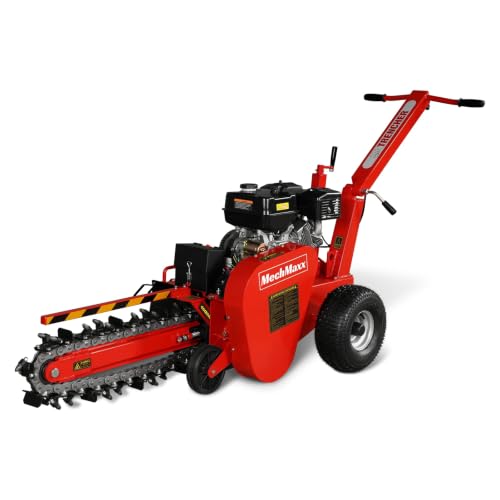
As an Amazon Associate we earn from qualifying purchases at no extra cost to you. Ratings are shown as listed on Amazon.
Walk-Behind vs Ride-On Trencher: Core Differences
The fundamental distinction is not just size, but how power is delivered to the chain and wheels. Walk-behind units use a single engine to drive both the digging chain and the wheels, which limits traction and torque in tough ground. Ride-on units have separate hydrostatic systems for propulsion and chain drive, plus heavier weight for down-pressure.
| Spec | Walk-Behind (e.g., Ditch Witch C16X, Barreto 1320, Toro TRX-250) | Ride-On (e.g., Ditch Witch RT45, Vermeer RTX350, Vermeer RT200) |
|---|---|---|
| Trench Depth | 12 – 36 inches (most common: 24-36″) | 36 – 72 inches (most common: 42-60″) |
| Trench Width | 3 – 6 inches (4″ standard) | 6 – 12 inches (8″ standard, combo blades up to 12″) |
| Engine Power | 13 – 15.5 HP Honda GX390 or Briggs Vanguard | 24.8 – 49 HP Kohler, Kubota or Deutz diesel / gas |
| Chain Type Options | Combo chain (Cup + Shark tooth), Rock chain limited | Full range: Cup, Shark, Rock/Frost, Digging System interchangeable |
| Weight | 550 – 1,050 lbs | 1,950 – 4,800 lbs |
| Digging Speed | 0 – 3 ft/min in clay, up to 6 ft/min in sandy loam | 3 – 12 ft/min depending on width/depth/soil |
| Creep / Ground Drive | Push-assisted or manual hydro creep | Hydrostatic creep with dedicated operator platform |
| Typical Daily Rental Range (US Market) | $150 – $350 per day | $350 – $650 per day |
How to Choose Based on Trench Dimensions
Match the machine to the utility you are installing, not just the deepest spec on the brochure. Code and practical depth matter more than maximum capability.
- Irrigation and Landscape Lighting (6-12″ deep, 3-4″ wide): Any walk-behind trencher is sufficient. A narrow 4-inch cup chain keeps the yard cleaner and reduces backfill.
- French Drain or Downspout Drain (18-24″ deep, 6″ wide): Walk-behind with 24-36″ boom is ideal. Choose a Shark-tooth combo chain for better spoil removal in damp topsoil.
- Water Line or Electrical to Outbuilding (36-48″ deep, 6-8″ wide): This is the crossover point. A heavy walk-behind can reach 36 inches but will struggle in clay or roots. A small ride-on like the Ditch Witch RT12 or Vermeer RTX130 bridges the gap if you have access.
- Main Water, Gas, or Fiber Drops (48-60″ deep, 8″ wide): Ride-on required. You need the weight, torque, and rock chain option to hold grade and width.
If your widest cut is 6 inches or less and you are digging less than 150 linear feet in a day, a walk-behind will finish faster when you count transport and setup. For runs over 200 linear feet at 36 inches or deeper, a ride-on cuts total time by half or more despite its larger footprint.
Chain Type and Soil Compatibility Explained
Chain selection determines whether you trench or just polish the dirt. Manufacturers offer three main patterns:
1. Cup Tooth Chain (Standard Dirt Chain)
Cups scoop and carry spoil out of the trench. Best for clean, sandy loam, cultivated topsoil, and light clay without rock. It cuts fastest and leaves the cleanest trench for irrigation. It fails quickly in rocky or heavily rooted soil – cups round off and chain stretches.
2. Shark Tooth Combo Chain
Alternating cup and welded shark teeth. This is the default for walk-behind rental fleets because it handles mixed conditions: clay, small roots up to 1 inch, and gravelly loam. If you only get one choice for a residential yard with unknown soil, choose this.
3. Rock and Frost Chain
Solid rock bits with carbide tips, no cups. Required for shale, limestone, sandstone, caliche, and frozen ground. Only practical on ride-on machines with 25+ HP and heavy chain tensioners. In soft soil a rock chain is slower and more expensive to run, so do not choose it unless you know you have rock.
Soil Rule of Thumb: If you cannot drive a spade 6 inches by foot pressure, assume compacted clay. If a pick bounces or rings, assume rock and do not rent a walk-behind expecting it to power through. You will burn the belt, wear the teeth, and get an uneven trench.
Engine Power and What It Actually Changes
Horsepower numbers are misleading without weight and hydraulics. A 15 HP walk-behind has roughly 9-11 HP available at the chain after ground drive losses. A 37 HP ride-on can deliver 28-32 HP directly to the chain through a separate hydraulic motor.
This matters in three places:
- Chain Stall Resistance: Underpowered chains stall in roots or hardpan and require you to lift and re-enter. Higher hydraulic torque lets a ride-on keep chain speed constant, which holds trench grade.
- Grade Holding: Walk-behind machines tend to ride up in hard soil, giving you a wavy bottom. Ride-on weight (2,000+ lbs vs 700 lbs) and down-pressure keep the boom at depth.
- Spoil Handling: More power means better auger and spoil discharge, which prevents trench cave-in on deep cuts.
Decision Matrix: Which Trencher Fits Your Situation
| Your Situation | Best Fit | Why |
|---|---|---|
| Small fenced yard, gate under 36″ wide, irrigation repair, under 100 ft | Walk-Behind (Ditch Witch C16X / Barreto 1320) | Fits through gates, minimal turf damage, easy to unload from pickup |
| Medium yard, 100-300 ft, clay or moderate roots, 24-36″ deep | Heavy Walk-Behind (Toro TRX-250 / Vermeer RTX130) | More traction than light walk-behind without needing a trailer with brakes |
| Open lot, new construction, 300+ ft at 42″ or deeper, rocky or compacted fill | Ride-On (Ditch Witch RT45 / Vermeer RTX350) | Depth, width, rock chain and speed justify trailer and fuel cost |
| Homeowner doing one-time install, no experience | Walk-Behind Rental | Simpler controls, lower tip-over risk, lower cost if job takes longer than expected |
| Contractor or utility crew, daily use | Ride-On Purchase or Long-Term Rental | Ownership cost spreads across footage; downtime from stalled chain costs more than machine |
Cost Per Foot: A Worked Calculation
To see why machine choice matters beyond rental price, calculate cost per linear foot.
Example: 200 linear feet at 30 inches deep in loamy clay for a drainage line
- Walk-Behind: Rental $250 + chain wear $30 + fuel $10 = $290. At 2.5 ft/min average, digging time is ~80 minutes plus 60 minutes for turns and cleanup = 140 minutes total. Cost = $1.45 per foot.
- Ride-On: Rental $450 + chain wear $45 + diesel $20 + trailer $50 = $565. At 7 ft/min average, digging time is ~29 minutes plus 40 minutes for setup = 69 minutes total. Cost = $2.83 per foot.
In this case the walk-behind costs less per foot and does less lawn damage. Now change depth to 48 inches for a water line: the walk-behind cannot reach it, so you would need to make two passes or hand-dig, which doubles labor. The ride-on at $2.83 per foot becomes the only viable option.
Takeaway: For shallow, short trenches, walk-behind wins on economics. For deep or long trenches, ride-on wins even at a higher rental rate because it avoids rework.
Durability and Ownership Realities
Trenchers wear at predictable points. Understanding consumables prevents surprise charges, especially on rentals where damage to teeth or chains is billed.
- What Wears First: Teeth, then chain, then boom wear bars and sprocket. Cup teeth need sharpening or replacement every 200-500 feet in abrasive soil. Carbide rock bits last longer but cost 3x more per tooth.
- Chain Stretch: New chains stretch most in the first 20 hours. Check tension every 4 hours. A loose chain derails and damages the boom. A too-tight chain burns the hydraulic motor.
- Common Mistakes: Engaging chain at full RPM while boom is on the ground, trenching in reverse, hitting buried concrete or large roots at full speed, and not cleaning spoil off the tracks or wheels before transport. All four void rental protection plans.
- Cleaning: Clay packs behind the chain and inside the boom. Pressure wash within hours, not days, or it hardens and adds 30-50 lbs of dead weight. Grease boom rollers daily.
- Storage: Chains rust quickly. Light oil after cleaning extends life. Store with boom slightly up to relieve tension on the idler.
If you own, budget $250-$600 per year for teeth, chain splice, rollers and oil for a walk-behind used monthly, and $800-$1,500 for a ride-on used weekly. Riding trenchers also need hydraulic filter changes every 250 hours.
Access and Site Constraints Checklist
Before booking, measure three things:
- Gate and Slope: Walk-behind width is 34-46 inches, ride-on is 48-62 inches. On slopes over 15 degrees, walk-behinds are harder to control laterally; ride-ons have better braking but can rut soft lawns.
- Underground Utilities: Call 811 (USA) or local locate service before any depth over 6 inches. Trenchers will cut fiber, shallow electric, and irrigation mains without slowing. Ride-on depth increases strike risk.
- Spoil Space: A 100 ft trench at 4 inches wide and 30 inches deep produces roughly 0.9 cubic yards of spoil. You need room to cast it to one side. In tight beds, a narrower chain and slower speed keeps the yard usable.
FAQ
Can a walk-behind trencher cut through tree roots?
Shark-tooth combo chains can cut roots up to about 1 to 1.5 inches. Larger roots will stall the chain or deflect it. For heavy root mats near mature trees, a ride-on or a dedicated stump/root cutter is safer, or plan to cross roots with a shallower, hand-dug section.
Is a ride-on trencher overkill for a sprinkler system?
Usually yes. Sprinkler trenches are 8-12 inches deep. A ride-on will do the job faster on a large property but compacts soil and needs a wider access path. Most irrigation contractors use walk-behind or vibratory plow for 1-inch pipe to preserve turf.
Do I need a rock chain for gravelly soil?
Not for loose gravel or crushed stone fill. A shark-tooth combo handles that. You need a rock chain for solid, layered rock, shale or frost. If you are unsure, dig a 24-inch test hole with a digging bar. If the bar chips rock instead of penetrating, request rock chain.