Key takeaways
- Power source: 20V MAX XR lithium-ion battery (tool only; battery and charger sold separately)
- Motor: brushless, rated 2-1/4 peak horsepower
- Base: plunge base with dual steel guide rods and a plunge lock lever
- Speed control: variable-speed dial with soft start and an electronic brake
- Depth adjustment: micro-fine depth adjustment ring plus a rotating turret stop
- Collet capacity: 1/4 in. and 1/2 in. shank bits
- Dust collection: integrated dust port for a vacuum hose
- Price tier: premium
The best plunge router for most woodworking shops in 2026 is the Bosch 1617EVSPK. It pairs a 2.25 HP, 12-amp motor with both a plunge base and a fixed base, spins from 8,000 to 25,000 RPM, and accepts both 1/4 in. and 1/2 in. shank bits — which covers everything from a 1/4 in. roundover to a panel-raising bit in a single purchase. If your budget is tight, the SKIL RT1322-00 14-amp plunge and fixed base combo delivers the same two-base layout for roughly the price of a single mid-range router motor, with less refinement in the plunge mechanism and speed control. If you want the most capable plunge platform and you regularly swing large-diameter bits, the Triton TRA001 3-1/4 HP dual-mode router is the premium pick, thanks to its above-table height winder, 1/2 in. collet capacity, and plunge mechanism designed to be locked down and left in a table. This guide compares plunge depth, motor power, speed control, base stability, dust collection, and bit-changing convenience across twelve currently listed routers, so you can match a machine to the work you actually do rather than to the biggest number on the box.
Top 3 Picks
Best Overall: Bosch 1617EVSPK
The 1617EVSPK is the closest thing the category has to a default answer. Two bases in one kit means you can leave the fixed base bolted under a router table and still keep the plunge base free for handheld mortises, dados, and template work. Constant-response electronics hold RPM under load, which is exactly what you want when a 3/4 in. straight bit starts biting into hard maple. It suits the woodworker who wants one router that does everything reasonably well rather than three that each do one thing perfectly.
Best Budget: SKIL RT1322-00
The RT1322-00 gets you a 14-amp corded motor, a plunge base, and a fixed base for the price of an entry-level single-base machine. The plunge action is not as silky as a Bosch or Makita, and the depth stops are coarser, but the fundamentals — variable speed, a real plunge lock, and enough power for 1/4 in. and moderate 1/2 in. bits — are all there. It is the right call for a first router, a second router dedicated to a table, or occasional trim and dado work.
Best Premium: Triton TRA001
The TRA001 is built around a different idea: a plunge router that also works properly as a fixed-base machine in a table. A 3-1/4 HP motor, a 1/2 in. collet, and an above-table height winder mean you can adjust bit height without crawling under the table. If you route raised panels, cope-and-stick joints, or long production runs, the extra rigidity and the dual-mode design justify the premium tier.
Quick Comparison
| Product | Best For | Key Specs | Price Tier |
|---|---|---|---|
| DEWALT DCW620B 20V MAX XR Plunge Router | Cordless site work and hinge/dado cutting where outlets are scarce | 20V MAX XR battery (tool only), brushless, 2-1/4 peak HP, variable speed with soft start and electronic brake, plunge base with dual steel rods, 1/4 in. and 1/2 in. shank capacity | Premium |
| SKIL RT1322-00 Plunge and Fixed Base Combo | First router, table-dedicated router, tight budgets | 14-amp corded, variable speed, plunge base plus fixed base, depth-stop turret, dust port, 1/4 in. shank standard | Budget |
| Bosch GOF13-25 Mid-Size Plunge Router | Edge profiling, template work, and mid-size bits in a compact body | 1-3/4 HP, 11,000–28,000 RPM, soft start, constant electronics, detachable parallel guide, dust extraction port | Mid-range |
| DEWALT DW61-Series Fixed and Plunge Base Kit | All-round corded kit at the lower end of the two-base class | 12-amp corded, 24,000 RPM top end, soft start, variable-speed trigger, fixed and plunge bases, 1/4 in. and 1/2 in. collet support | Mid-range |
| DEWALT DW618PK Fixed/Plunge Base Kit | Table plus handheld work in one corded purchase | 12-amp, 2-1/4 HP, 8,000–24,000 RPM, electronic variable speed with feedback, soft start, fixed and plunge bases, 1/4 in. and 1/2 in. collets | Mid-range |
| Bosch 1617EVSPK Combination Router | The one-router shop; the best balance of power, refinement, and versatility | 2.25 HP, 12-amp, 8,000–25,000 RPM, constant response circuitry, soft start, plunge and fixed bases, 1/4 in. and 1/2 in. collets | Mid-range |
| Makita RP1800 Plunge Router | Heavy handheld routing with large-diameter bits | 3-1/4 HP, 15-amp, 22,000 RPM top end, variable speed, soft start, 1/4 in. and 1/2 in. collets, three-stage depth turret, large base opening | Premium |
| DEWALT DNP612 Plunge Base for Compact Router | Adding plunge capability to a compact router you already own | Accessory base only, dual steel rods for a smooth plunge stroke, accepts DEWALT compact router motors, no motor included | Budget |
| VEVOR Compact Router 1.25 HP Kit | Occasional trim work and a first plunge-capable kit on a minimal budget | 1.25 HP class motor, variable speed, fixed, plunge, and tilt bases, 1/4 in. collet | Budget |
| Triton TRA001 Dual Mode Precision Plunge Router | Router-table work with above-table adjustment and handheld heavy cuts | 3-1/4 HP, 15-amp class, dual mode (plunge and fixed/table), above-table height winder, soft start, variable speed, 1/2 in. and 1/4 in. collets | Premium |
| Bosch MRC23EVSK Combination Router | High-power production work with both base types | 15-amp, 2.3 HP, variable speed 8,000–25,000 RPM, soft start, constant response, plunge and fixed bases, 1/4 in. and 1/2 in. collets | Premium |
| VEVOR 1 HP 710W Palm Router | Edge trimming, small roundovers, laminate, and light hinge work | 710 W (1 HP class), variable speed, 1/4 in. collet, compact trimmer body | Budget |
How We Chose
Selection started from the specifications that actually change outcomes in a woodworking context rather than from marketing labels. Motor class was judged by amp draw and stated horsepower, because a 1-3/4 HP mid-size router and a 3-1/4 HP production router are not interchangeable tools even though both are called plunge routers. Plunge stroke length, base opening diameter, and collet capacity were checked against the bit sizes each machine can realistically swing — a router that cannot pass a 2-1/2 in. panel bit through its sub-base is not a panel-raising tool no matter what its motor claims. Speed control was assessed by range and by whether the electronics maintain RPM under load, since burning and chatter are usually speed problems before they are technique problems.
Category fit mattered as much as raw specs. Compact trim routers with plunge base accessories, mid-size plunge routers, and full-size two-base kits solve different problems, so each entry was placed in the tier where it competes honestly. Use case drove the final sort: cordless platforms for site work, two-base kits for the shop that needs one machine to do everything, and heavy single-base plunge routers for table and large-bit work. Finally, upgrade path was weighed — whether the machine accepts 1/2 in. bits, whether replacement sub-bases and template guides are available, and whether a fixed base exists for the same motor, since those factors decide whether a router stays useful for five years or gets replaced in two.
1. DEWALT DCW620B 20V MAX XR Plunge Router – Best Cordless Plunge Router
As an Amazon Associate we earn from qualifying purchases at no extra cost to you.

The DCW620B is aimed squarely at the woodworker who already owns DEWALT 20V MAX XR batteries and wants plunge routing without a cord dragging across a finished surface. It is a full-size plunge router built around a brushless motor rated at 2-1/4 peak horsepower, which puts it in the same power conversation as corded 12-amp mid-range machines rather than in the trim-router class. The listing sells it as tool only, so batteries and a charger are a separate purchase — a detail that matters a great deal when you are comparing the total cost against a corded two-base kit.
Key Specs
- Power source: 20V MAX XR lithium-ion battery (tool only; battery and charger sold separately)
- Motor: brushless, rated 2-1/4 peak horsepower
- Base: plunge base with dual steel guide rods and a plunge lock lever
- Speed control: variable-speed dial with soft start and an electronic brake
- Depth adjustment: micro-fine depth adjustment ring plus a rotating turret stop
- Collet capacity: 1/4 in. and 1/2 in. shank bits
- Dust collection: integrated dust port for a vacuum hose
- Price tier: premium
The two features that separate this machine from a generic cordless router are the electronic brake and the brushless motor. An electronic brake stops the bit in a fraction of the time a free-spinning armature takes to coast down, which is genuinely useful when you are setting the router down between hinge mortises or repositioning a template with the base still on the workpiece. Soft start prevents the torque kick that tips a router on its base when you squeeze the trigger, and the micro-fine depth ring lets you sneak up on a final depth in small increments instead of fighting a coarse rack.
Dust collection is a port rather than a full shroud, which is typical for plunge bases. Connected to a shop vacuum, it captures a useful share of the chips from edge work and shallow dados; on deep mortises you will still be clearing chips between passes. The dual steel rods give the plunge action a straight, low-slop stroke, and the turret stop lets you set two or three depth stages for progressive cuts without re-zeroing.
Pros
- No cord to drag across finished work or catch on clamps
- Electronic brake and soft start make it noticeably more controllable than a basic corded router
- Brushless motor delivers more runtime per amp-hour than a brushed equivalent
- Full-size 2-1/4 peak HP class power in a platform many shops already own
- Accepts 1/2 in. shank bits, so it is not limited to light trim work
Cons
- Tool-only pricing means batteries and a charger are extra if you are starting fresh
- Runtime is finite; a long panel-raising session will need pack swaps
- Noticeably heavier with a large pack than a compact trim router
- No fixed base in the box, so it cannot be permanently mounted in a table without an accessory
- Peak horsepower ratings on cordless tools are not directly comparable to sustained corded output
How it compares: Against the DEWALT DW618PK, the trade is freedom versus endurance. The DW618PK is corded, so it never needs a battery, includes both a fixed and a plunge base, and costs less than a cordless router plus two packs. The DCW620B wins wherever there is no outlet nearby — installing stair treads in a client’s house, fitting doors on site, or cutting hinge mortises on an assembled cabinet — and the brake makes it the safer of the two to handle between cuts. If your routing happens entirely in one shop with power at the bench, the corded kit is the better buy. If it happens anywhere else, the DCW620B is the one you will reach for.
2. SKIL RT1322-00 14 Amp Plunge and Fixed Base Router Combo – Best Budget Plunge Router
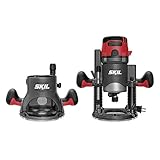
The RT1322-00 is the value play in this list, and it is a genuinely useful one. For a budget-tier price you get a 14-amp corded motor, a plunge base, and a fixed base — a combination that most manufacturers charge mid-range money for. That matters because the two-base layout is the single biggest capability upgrade a new router owner can make: the fixed base lives in a router table, and the plunge base stays free for handheld mortises, stopped grooves, and template work.
Key Specs
- Motor: 14-amp corded, roughly 2 HP class
- Bases included: plunge base and fixed base
- Speed control: variable-speed dial
- Depth adjustment: depth-stop rod with a turret for staged cuts
- Collet capacity: 1/4 in. shank as standard; confirm 1/2 in. support against the spec sheet before buying large-diameter bits
- Dust collection: basic dust port on the base
- Price tier: budget
The honest framing is that this router buys you capability, not refinement. Fourteen amps is enough to spin a 1/2 in. straight bit through a 3/4 in. deep dado in oak if you take sensible passes, and it is more than enough for the roundovers, chamfers, flush-trim work, and hinge mortises that make up most of a hobbyist’s routing. The plunge mechanism uses the same dual-rod architecture as the mid-range machines, though the fit and finish of the rods and the smoothness of the return spring are where the money was saved. You will feel a little more stiction on the way down and a slightly less predictable return on the way up.
Where budget routers most often disappoint is the depth adjustment and the base plate. The depth stop on this class of machine is a rod with a threaded adjuster rather than a fine-thread micro-adjuster, so dialing in a precise 0.010 in. change is a matter of feel. The sub-base is also a softer material on most budget machines, which means it will wear and score faster if you slide the router across abrasive stock, and a scored sub-base drags and tilts. Replacing it with a shop-made hardboard or acrylic sub-base is a cheap, high-value upgrade on any budget router.
Pros
- Two bases — plunge and fixed — at a budget-tier price
- 14-amp motor has real capacity for 1/2 in. bits in moderate passes
- Variable speed covers the range needed for large bits and small bits alike
- Ideal as a dedicated table router while a better machine handles handheld work
- Low enough cost that a mistake is an inconvenience rather than a disaster
Cons
- Plunge stroke is less smooth than mid-range and premium machines
- Depth adjustment is coarser, making fine increment work harder
- Collet and sub-base quality are the first things to degrade
- Dust collection is minimal compared with the better-engineered ports on Bosch and Makita models
- Motor electronics do not hold RPM under heavy load as firmly as constant-response designs
How it compares: The nearest alternative is the DEWALT DW618PK, and the gap between them is precisely the gap between budget and mid-range. The DW618PK has a 2-1/4 HP motor, electronic feedback that maintains speed in hardwoods, a smoother plunge action, and better dust extraction — for a mid-range price. The SKIL costs less and still gives you both bases, which is why it wins for a first router or a table-dedicated second machine. If you route once a month, the SKIL is the sensible purchase. If you route every weekend in hardwood, the extra money for the DEWALT or the Bosch 1617EVSPK pays for itself in cleaner cuts and fewer spoiled boards.
3. Bosch GOF13-25 1-3/4 HP Mid-Size Plunge Router – Best Mid-Size Plunge Router
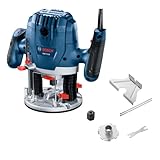
The GOF13-25 occupies a category that is easy to overlook and often exactly right: the mid-size plunge router. At 1-3/4 HP it is smaller and lighter than a full-size 2-1/4 HP machine, which makes it far more pleasant to use one-handed for edge profiles, hinge mortises, and template work, while still having enough motor to swing a 1/2 in. shank bit in a controlled pass. The listing’s 11,000 to 28,000 RPM range is unusually wide, and that top end is genuinely useful for small-diameter bits in softwood where a full-size router’s minimum speed is too slow.
Key Specs
- Motor: 1-3/4 HP corded
- Speed range: 11,000 to 28,000 RPM, variable
- Electronics: soft start and constant speed under load
- Base: plunge base with a detachable parallel guide for straight edge work
- Dust collection: dust extraction port at the base
- Design: ergonomic body with low-profile handles for one-handed control
- Price tier: mid-range
The detachable parallel guide is the detail that earns this router a place in a serious shop. A parallel guide lets you rout a straight groove or dado at a fixed offset from the workpiece edge without clamping a straightedge, which turns a two-clamp setup into a ten-second adjustment. It is the kind of accessory that gets used constantly once it is in the case, and it is often sold separately for other brands.
Constant electronics matter more on a mid-size router than on a large one. A 1-3/4 HP motor has less reserve, so when a bit loads up in a deep cut, RPM drops and the cut quality drops with it. Bosch’s constant-speed circuitry compensates by feeding more current to hold the selected RPM, which keeps chip load consistent and reduces burnishing. Combined with a 28,000 RPM ceiling, this router handles both a 1/4 in. flush-trim bit at high speed and a 1-1/2 in. roundover at the low end without either being a compromise.
The trade-off for the lighter body is depth of cut capacity and heat dissipation. A 1-3/4 HP motor running a 2 in. panel bit all afternoon will get warm and will need slower feed rates; that is simply physics, and it is why shops that raise their own panels keep a 3-1/4 HP machine around. For everything below that threshold — dados, mortises, roundovers, chamfers, hinge recesses, template inlays, edge profiling — the mid-size format is the more comfortable tool to actually hold.
Pros
- Wide 11,000–28,000 RPM range suits both tiny and mid-size bits
- Light enough for confident one-handed control on edge work
- Constant electronics hold speed in hardwood instead of bogging
- Detachable parallel guide turns edge-guided grooves into a quick setup
- Ergonomic handle layout reduces fatigue on long template sessions
Cons
- 1-3/4 HP is not enough for sustained large-diameter panel or raised-panel bits
- Plunge depth and stroke are shorter than full-size machines
- No fixed base included, so table mounting requires a separate purchase
- Mid-range pricing puts it close to two-base kits with more total capability
How it compares: The obvious rival is the Bosch 1617EVSPK, which is the same brand’s full-size two-base combination. The 1617EVSPK has more power, ships with a fixed base as well, and costs a similar amount — so if you want one router to do everything, it is the better buy. The GOF13-25 wins on hand feel and speed range: it is the machine you pick up for a quick roundover on a shelf edge or a set of hinge mortises, and its 28,000 RPM top end gives cleaner cuts with small bits than a full-size router idling at 8,000 RPM. Many shops eventually own both, using the mid-size for handheld finesse and the full-size for the table.
4. DEWALT DW61-Series 12-Amp Fixed and Plunge Base Kit – Best for a First Two-Base Corded Kit

The listing name for this kit is truncated, so treat it as the 12-amp DW61-series fixed and plunge base combination rather than a specific model number. What the listing does establish is the important part: a 12-amp corded motor with a 24,000 RPM top end, soft start, a variable-speed trigger, and both a fixed base and a plunge base in the box. That is a complete routing setup for a mid-range price, and it sits just below the DW618PK in DEWALT’s range.
Key Specs
- Motor: 12-amp corded
- Speed: variable speed with a 24,000 RPM top end
- Starting: soft start to reduce startup torque kick
- Control: variable-speed trigger
- Bases included: fixed base and plunge base
- Collet capacity: 1/4 in. and 1/2 in. shank support per the kit listing
- Price tier: mid-range
The variable-speed trigger is the feature worth thinking about. On a dial-controlled router you set a speed and then switch on; on a trigger-controlled machine you modulate speed with finger pressure, which some woodworkers find more intuitive for plunge entry — start slow as the bit bites, then open up as it settles into the cut. The trade-off is that a trigger is harder to lock to an exact RPM for repeatable production work, and it is one more mechanism to keep clean. For a first router used on varied jobs, the trigger is generally an advantage; for a table-mounted machine where you want a fixed, repeatable speed, a dial is better.
Soft start is genuinely valuable on a 12-amp router. Without it, the motor’s startup torque can twist the base slightly on the workpiece at the moment of switch-on, which is exactly when the bit is least supported. With soft start, the motor ramps up and the cut begins predictably. The 24,000 RPM ceiling is high enough for small-diameter bits in softwood and for flush-trimming veneer edges, while the variable control lets you dial down for a 1-1/4 in. roundover or a 1/2 in. straight bit in a deep pass.
The plunge base on this class of machine uses dual steel rods with a lock lever and a turret depth stop. Twelve amps is a solid but not extravagant power figure — enough for 1/2 in. shank bits in reasonable passes, not enough to hog a 3/4 in. deep groove in one pass through hard maple. Plan on 1/8 in. to 3/16 in. depth per pass in hardwood and you will get clean results.
Pros
- Two bases in one kit at a mid-range price
- Soft start improves control at the moment of plunge entry
- Variable-speed trigger gives fine control over cut entry and exit
- 24,000 RPM top end handles small bits and flush-trim work well
- Accepts both common shank sizes, so it is not limited to trim bits
Cons
- 12 amps is modest for heavy 1/2 in. bit work in dense hardwood
- Trigger control is less repeatable than a dial for table use
- Sits below the DW618PK in power, so it is the entry point to the two-base class rather than the top of it
- The truncated listing name makes exact model verification worth doing before purchase
How it compares: The DW618PK is the natural step up and the more common recommendation. It adds a 2-1/4 HP motor, electronic speed feedback that holds RPM under load, and a wider 8,000–24,000 RPM range, all of which show up as cleaner cuts in hardwood and better behaviour with large bits. The DW61-series kit counters with a lower mid-range price and a trigger that some users prefer for handheld plunge work. If your routing is mostly 1/4 in. shank bits, roundovers, and light dados, this kit is entirely sufficient. If you plan to run 1/2 in. shank bits in oak or maple regularly, spend the difference on the DW618PK.
5. DEWALT DW618PK Fixed and Plunge Base Kit – Best Corded All-Rounder for the Money

The DW618PK has been a standard recommendation in woodworking shops for years, and the reason is straightforward: it delivers 2-1/4 HP, a genuinely wide 8,000–24,000 RPM speed range with electronic feedback, soft start, and both a fixed and a plunge base at a mid-range price. It is the machine that lets a shop own one router instead of three, because the fixed base can stay bolted in a table while the plunge base handles everything handheld.
Key Specs
- Motor: 12-amp, 2-1/4 HP
- Speed range: 8,000 to 24,000 RPM, electronic variable speed with full feedback
- Starting: soft start
- Bases included: fixed base and plunge base
- Collet capacity: 1/4 in. and 1/2 in. shank bits
- Depth adjustment: micro-adjustable depth rod with a turret stop
- Dust collection: dust port on the base
- Price tier: mid-range
Electronic feedback is the difference between a router that holds its speed and one that sags. When a 1/2 in. straight bit enters a deep pass, load increases and RPM drops; feedback circuitry senses the drop and pushes more current to the motor to hold the selected speed. The practical result is a consistent chip load, which means less burning, less chatter, and a cut that does not change character halfway down a 30 in. groove. On a router without feedback, you compensate by slowing your feed rate, which increases the time the bit spends rubbing in one spot — the classic recipe for a burn mark.
The 8,000 RPM floor is important for large bits. Bit manufacturers publish maximum safe RPM that drops sharply as diameter increases; a 2 in. raised-panel bit that must not exceed roughly 12,000 RPM would be dangerous at a router whose minimum is 16,000 RPM. The DW618PK’s low end makes large-diameter bits usable, and the fixed base makes them safer, because a table-mounted setup with a fence and a guard is the correct way to run a panel bit — never freehand.
Bit changing on this kit is conventional: a two-wrench collet change, with the shaft lock or a second wrench holding the spindle. It is quick once you develop the habit of seating the bit fully and then pulling it back about 1/16 in. so the collet grips the shank rather than bottoming out. The plunge base’s rods and lock lever are the parts that need attention over time; keeping them clean and dry-lubricated keeps the stroke smooth for years.
Pros
- 2-1/4 HP with electronic feedback holds speed under real load
- 8,000–24,000 RPM range covers small trim bits and large panel bits
- Both bases included, which is the single biggest versatility upgrade available
- Accepts 1/2 in. shank bits for rigidity on deep cuts
- Widely supported with aftermarket sub-bases, guides, and accessories
Cons
- Heavier than a mid-size router for one-handed edge work
- Two-wrench bit changes are slower than a spindle-lock single-wrench system
- Dust port captures chips well on edge cuts but less well on deep mortises
- Not the quietest machine in the category under load
How it compares: The direct competitor is the Bosch 1617EVSPK, and the two are close enough that the choice often comes down to which base design you prefer in the hand. The Bosch has a slightly higher 2.25 HP rating and a 25,000 RPM top end; the DEWALT’s 8,000 RPM floor is comparable and its depth adjustment is well liked. Against the DW61-series kit, the DW618PK is the clear upgrade — more power, feedback electronics, and a wider speed range for a modest price step. If you want one corded router that covers a whole shop, this is the safe pick; if you want the same capability with a marginally different feel, the Bosch is its equal.
6. Bosch 1617EVSPK Combination Plunge and Fixed-Base Router – Best Overall Plunge Router

The 1617EVSPK is the router most often recommended to someone who asks which one machine to buy, and it earns that position. A 2.25 HP, 12-amp motor runs from 8,000 to 25,000 RPM with constant response circuitry that maintains speed under load, and the kit includes both a plunge base and a fixed base. Add 1/4 in. and 1/2 in. collet capacity and you have a router that can handle flush trimming, dadoes, mortises, edge profiles, and — in the fixed base, mounted in a table — large-diameter bits.
Key Specs
- Motor: 2.25 HP, 12-amp corded
- Speed range: 8,000 to 25,000 RPM, variable with constant response circuitry
- Starting: soft start
- Bases included: plunge base and fixed base
- Collet capacity: 1/4 in. and 1/2 in. shank bits
- Depth adjustment: micro-fine depth adjustment with a turret stop
- Dust collection: dust port and integrated chip shield
- Price tier: mid-range
Constant response circuitry is the headline feature and it is not marketing language. The electronics monitor motor load and adjust current to hold the RPM you selected, which keeps the chip load — the thickness of material each cutting edge removes per revolution — roughly constant as the bit moves through varying grain density. Consistent chip load is what separates a clean dado from a scorched one. It also means the speed you set for a 1/2 in. bit stays the speed you get when the bit is buried, rather than sagging and forcing you to slow the feed.
The plunge base uses dual steel rods with a lock lever and a rotating turret stop, and the depth adjustment is micro-fine, so you can take a cut, measure, and then adjust by a few thousandths rather than guessing. The base opening is large enough to pass common mid-size bits, and the sub-base accepts standard template guides with an adapter, which opens up inlay, hinge-mortise jigs, and pattern routing. The fixed base has its own height adjustment and is designed to be bolted into a table; once it is there, the motor swaps between bases with a twist, so one motor serves both roles.
The 25,000 RPM top end is useful for small-diameter bits in softwood where a slower speed leaves a fuzzy edge, and the 8,000 RPM floor lets you run larger bits safely. Between those extremes the dial gives you the whole practical range. Dust collection through the base port is effective for edge work and shallow grooves, and the chip shield keeps debris away from your line of sight on the cut.
Pros
- Constant response circuitry holds RPM under load for cleaner cuts
- Both bases included, so one motor covers table and handheld work
- 8,000–25,000 RPM range covers the full practical bit spectrum
- Micro-fine depth adjustment makes precise incremental cuts repeatable
- Accepts 1/2 in. shank bits and standard template guides
Cons
- Full-size body is heavier than a mid-size router for long edge sessions
- Base swapping between plunge and fixed takes a moment of practice
- Dust collection is good, not exceptional, on deep mortises
- Mid-range price is higher than single-base machines with the same motor
How it compares: Against the DEWALT DW618PK the contest is nearly a tie — the Bosch has a marginally higher horsepower figure and a 25,000 RPM top end, the DEWALT has an 8,000 RPM floor and a depth-adjustment design many users prefer. Against the Bosch MRC23EVSK, the 1617EVSPK gives up 0.05 HP and a little motor headroom in exchange for a lower premium-tier price and a lighter body. And against the mid-size Bosch GOF13-25, it trades hand feel for power and a second base. For a shop buying one router, the 1617EVSPK remains the most balanced package in this list.
7. Makita RP1800 3-1/4 HP Plunge Router – Best Heavy-Duty Handheld Plunge Router

The RP1800 is a single-purpose machine in the best sense: it is a full-size plunge router built to swing large bits with authority and to do it without drama. The 3-1/4 HP, 15-amp motor with a 22,000 RPM top end puts it in a different power class from the 12-amp mid-range machines, and that reserve shows up as an ability to maintain speed in deep cuts where smaller routers bog and burn. It ships as a plunge router only, with no fixed base in the box.
Key Specs
- Motor: 3-1/4 HP, 15-amp corded
- Speed: variable speed with a 22,000 RPM top end and a low range for large-diameter bits
- Starting: soft start
- Base: plunge base with dual guide rods and a plunge lock
- Depth adjustment: three-stage turret stop with a fine depth adjuster
- Collet capacity: 1/4 in. and 1/2 in. shank bits
- Base opening: large enough for substantial mid-size and panel bits
- Dust collection: dust nozzle at the base
- Price tier: premium
Three-stage