Key takeaways
- Output at your actual position: Look for the distance at which the manufacturer reports its lux rating. Then check whether that distance works with your desk depth and screen placement.
- Illuminated area: A larger panel can be easier to keep within your field of view if you shift in your chair. A small panel saves space but needs more deliberate positioning.
- Adjustability: A tilting head or height-adjustable stand helps direct light toward your face while avoiding reflections on a monitor. A flat panel may need a separate stand or a stable surface at the right height.
- Safety information: For bright-light lamps, look for clear UV-filtering information, manufacturer instructions, and a warranty. A “UV-free” or UV-filtered claim does not mean every person should use the device without considering their health circumstances.
- Controls and routine: Brightness options, a timer, and easy-to-reach controls can make a lamp simpler to use consistently. Do not treat a timer as a substitute for following the manual.
Best Home Phototherapy Lamps: Top Picks for 2026
The best home phototherapy lamp for most people is a compact, UV-free, broad-area device with adjustable positioning and clearly documented light output—but the right choice depends on whether you need a desk-friendly lamp, a larger panel, or a device for a specific skin-care routine. “Phototherapy” covers different kinds of light treatment, so first match the device to its intended use: bright-light lamps for seasonal mood routines are not interchangeable with UVB devices used for skin conditions.
Top picks by situation
Best for a desk routine: Carex Day-Light Classic Plus
This is a larger bright-light therapy lamp designed for seated use. Its broad, adjustable panel makes it easier to position near a desk than a small, fixed-face light. Choose it if you have a regular spot for a lamp and want to keep your face and eyes comfortably oriented toward the light without staring directly into it. The trade-off is its substantial footprint: measure the desk and storage space before buying.
Our top picks


As an Amazon Associate we earn from qualifying purchases at no extra cost to you. Ratings are shown as listed on Amazon.
Best compact choice: Verilux HappyLight Luxe
The HappyLight Luxe is a portable, UV-free bright-light lamp with selectable brightness and color-temperature settings. Its smaller form suits a nightstand, shared desk, or travel bag better than a large panel. The smaller illuminated area means positioning matters more: place it at the distance and angle specified in the manual, rather than assuming that a compact lamp can sit anywhere and work the same way.
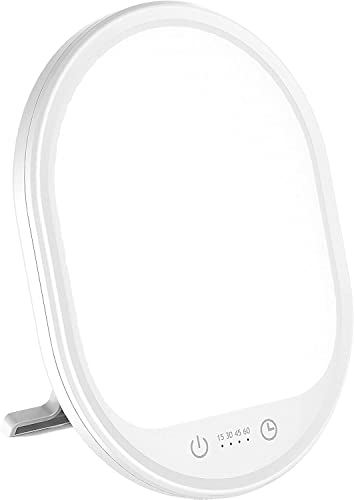
Best simple, space-saving panel: Verilux HappyLight Touch Plus
This flat-panel option is easier to store and move between rooms than a stand-mounted lamp. It is a practical fit for a small home or a routine that changes locations. Check the included stand or mounting options and the manufacturer’s distance guidance before choosing it; a thin panel is convenient, but it may offer less freedom to position the light than an articulated lamp.
Best for a skin-care prescription: a clinician-selected narrowband UVB device
If you are looking for UVB phototherapy, do not substitute a consumer bright-light lamp. Ask a dermatologist or other qualified clinician whether a home narrowband UVB unit is appropriate and which device, wavelength, treatment area, schedule, and protective equipment to use. UV exposure can injure skin and eyes, and treatment parameters are not something to estimate from a product listing.
Compare the practical differences
Manufacturers sometimes revise models and specifications. Confirm the exact model number and current manual before purchase, particularly for dimensions, output, included stands, and recommended exposure distance. Bright-light output figures are not directly comparable unless the measurement distance and method match.
| Option | Light type and stated output | Approximate size or weight | Positioning and controls | Best fit |
|---|---|---|---|---|
| Carex Day-Light Classic Plus | UV-filtered bright light; up to 10,000 lux at the manufacturer-specified distance | About 15 × 12 × 31 in; roughly 6 lb | Large panel with adjustable angle and height; model-dependent brightness settings | Dedicated desk or table routine |
| Verilux HappyLight Luxe | UV-free bright light; up to 10,000 lux at the specified distance | About 8 × 5 × 1 in; roughly 1 lb | Portable panel; adjustable brightness and color-temperature settings | Small spaces and flexible placement |
| Verilux HappyLight Touch Plus | UV-free bright light; up to 10,000 lux at the specified distance | About 9 × 6 × 1 in; roughly 1 lb | Flat panel with touch controls and a compact stand | Easy storage and moving between rooms |
| Home narrowband UVB unit | UVB; wavelength and output vary by device | Varies by panel or handheld design | Must follow the prescribed distance, dose, and eye-protection instructions | Only when selected and supervised by a clinician |
Dimensions and weights are approximate and may vary by model revision. Treat a stated lux figure as meaningful only alongside its measurement distance: a lamp rated at 10,000 lux at a short distance may deliver much less at your usual seating position.
Choose by room, routine, and experience
| Your situation | What to prioritize | Likely direction |
|---|---|---|
| You use a lamp most mornings at one desk | Large illuminated area, stable stand, easy angle adjustment | A full-size desk lamp such as the Carex Day-Light Classic Plus |
| You share a small desk or put the lamp away daily | Compact dimensions, light weight, simple setup | A portable panel such as the HappyLight Luxe or Touch Plus |
| You are new to bright-light routines or sensitive to glare | Multiple brightness settings, flexible placement, clear instructions | A dimmable model; start with the manual’s guidance and adjust only as directed |
| You want light treatment for a skin condition | Clinician guidance, prescribed wavelength and dose, eye protection | A professionally selected UVB device—not a bright-light mood lamp |
| You move between rooms or travel | Weight, power requirements, protective storage | A compact panel, after checking voltage and portability details |
What to check before you buy
- Output at your actual position: Look for the distance at which the manufacturer reports its lux rating. Then check whether that distance works with your desk depth and screen placement.
- Illuminated area: A larger panel can be easier to keep within your field of view if you shift in your chair. A small panel saves space but needs more deliberate positioning.
- Adjustability: A tilting head or height-adjustable stand helps direct light toward your face while avoiding reflections on a monitor. A flat panel may need a separate stand or a stable surface at the right height.
- Safety information: For bright-light lamps, look for clear UV-filtering information, manufacturer instructions, and a warranty. A “UV-free” or UV-filtered claim does not mean every person should use the device without considering their health circumstances.
- Controls and routine: Brightness options, a timer, and easy-to-reach controls can make a lamp simpler to use consistently. Do not treat a timer as a substitute for following the manual.
If you have an eye condition, take medication that increases light sensitivity, or have concerns about mood changes or sleep, ask a healthcare professional before starting a bright-light routine. Follow the device instructions, and do not stare directly into the light. Stop use and seek advice if you experience concerning symptoms.
Set it up for your space
Before committing to a model, use a tape measure to mark the manufacturer’s recommended distance from your usual seated position. Check that the panel can reach the recommended height and angle without blocking your screen or shining into another person’s eyes. This quick fit check matters more than choosing a lamp by its maximum lux number alone.
- Pick a consistent seat. A lamp that fits one desk position is easier to set up correctly than one you move around at random.
- Position the light as directed. Follow the model’s manual for distance and angle; do not assume that closer is better.
- Keep the area clear. Avoid placing papers, fabric, or other objects against the lamp, and keep cords away from walking paths.
- Make adjustments gradually. Use the manufacturer’s schedule and settings. If you are unsure how to adapt a routine, ask a clinician rather than improvising.
Ownership: cleaning, wear, and common mistakes
For an LED bright-light lamp, the LED panel is not usually a routine replacement item, but the power adapter, cable, stand joints, and buttons can wear first. Store a portable panel where it will not be bent or scratched, and avoid repeatedly forcing an adjustable hinge past its natural range. Check the warranty and whether replacement power supplies are available before buying.
Unplug the device before cleaning. Wipe its exterior and light surface gently with a soft, dry or slightly damp cloth if the manual permits it; avoid spraying cleaner into seams or using abrasive materials. For UVB equipment, follow the manufacturer’s cleaning and maintenance directions and the clinician’s instructions.
Common avoidable mistakes include buying a bright-light lamp for a UVB treatment, judging output without checking measurement distance, positioning the lamp where a monitor reflects it into the eyes, and assuming that a larger lux rating means a better fit. A comfortable, correctly positioned lamp with clear instructions is usually a more practical choice than the most powerful-looking number on the box.
Bottom line
Choose the Carex Day-Light Classic Plus if you can dedicate desk space to a larger adjustable panel; consider the Verilux HappyLight Luxe or Touch Plus if portability and storage matter more. For skin phototherapy, start with a qualified clinician and a device selected for your prescribed treatment. Across all options, verify the current model’s output distance, panel dimensions, adjustment range, safety instructions, and warranty before purchasing.