Key takeaways
- Stated capacity: 29.3 cu. ft. total
- Door layout: 3-door French door — two fresh-food doors, one bottom freezer drawer
- Finish: stainless steel
- Smart features: app-connected controls, the kind of Wi-Fi diagnostics and temperature monitoring that has become standard in this tier
- Ice maker: factory-installed. In this size and door class, ice is normally either dispensed through the door or drawn from a bin in the freezer drawer — listings in this category vary, so confirm the exact dispenser type before ordering
- Typical footprint for the class: roughly 36 in. wide, 30–33 in. deep, 69–70 in. tall; expect 300–340 lbs shipped
- Typical noise for the class: around 38–42 dB during steady running, with a brief spike when the ice maker harvests
The best refrigerator with an ice maker for most kitchens in 2026 is the Midea MRF29D6AST, a 29.3 cu. ft. stainless 3-door French door model with smart controls. It wins on the combination that matters most: the largest usable capacity in this roundup, the door layout that gives you full-width shelves and a deep pull-out freezer drawer, and a factory ice maker from a manufacturer with a genuine global service footprint. It suits households of three to five people who cook often and want ice and cold water on demand without thinking about it.
If you are working to a tighter budget, the Electactic 18.1 cu. ft. side-by-side is the value pick — it delivers a built-in ice maker in a body narrow enough for a small kitchen. If you want the most ice a full-size refrigerator can realistically produce, the Kenmore 29 cu. ft. 36-inch side-by-side is the premium choice. And if ice itself is the reason you are shopping — iced coffee, cocktails, coolers — the COSTWAY under-counter ice maker at 90 lbs per 24 hours out-produces every full-size refrigerator here by a wide margin.
Top 3 Picks
Best Overall: Midea MRF29D6AST
A 29.3 cu. ft. 3-door French door refrigerator with smart controls and a factory ice maker, built by one of the largest appliance manufacturers in the world. It gives you wide, unobstructed shelves in the fresh-food section, a bottom freezer drawer that is easier to organize than a top-mount compartment, and enough total volume that a family of four or five will not outgrow it. The mid-range tier keeps it well short of premium side-by-side pricing while still offering the layout most people actually prefer.
Best Budget: Electactic 18.1 Cu. Ft. Side-by-Side
A 2-door side-by-side with a built-in ice maker and a separate freezer column, at the lowest price tier in this roundup. Side-by-side layouts fit narrow kitchens and doorways better than French doors, and the vertical split means you can reach both fresh and frozen food without bending. It is the right answer for renters, first apartments, and anyone who needs ice but cannot justify a 29 cu. ft. footprint.
Best Premium: Kenmore 29 Cu. Ft. 36″ Wide Side-by-Side
A full-width 36-inch side-by-side with 29 cu. ft. of capacity and a fingerprint-resistant stainless finish. The tall freezer column holds more frozen volume in an easier-to-scan format than a bottom drawer, and the through-door ice path on a side-by-side tends to be the shortest and most direct in the category. It is the pick for large households and anyone who wants serious ice output from a full-size appliance.
Quick Comparison
Every model below is a real, currently listed refrigerator or ice-making appliance. Prices move constantly, so they are grouped by tier rather than by a figure that will be stale next week.
| Product | Best for | Key specs | Door layout / form | Price tier |
|---|---|---|---|---|
| Midea MRF29D6AST | Best overall for 3–5 person households | 29.3 cu. ft.; stainless steel; smart/app-connected controls; factory ice maker | 3-door French door, bottom freezer drawer | Mid-range |
| Electactic 18.1 Cu. Ft. Side by Side | Best budget full-size with built-in ice | 18.1 cu. ft.; built-in ice maker; separate freezer column | 2-door side-by-side | Budget |
| BLACK+DECKER BR2400JIMW | Best large top-mount with freezer ice | 24 cu. ft.; ice maker in the freezer compartment; white finish | Top mount (freezer above) | Premium |
| DUURA Elite DE210FDBMDSS | Best for built-in cabinetry | French doors; adjustable glass shelves; dual-drawer bottom freezer; built-in class | Built-in French door | Mid-range |
| Kenmore 29 cu. ft. Side-by-Side | Best for maximum ice volume in a full-size fridge | 29 cu. ft.; 36 in. wide; fingerprint-resistant stainless steel | Side-by-side | Premium |
| Commercial Cool 20 Cu. Ft. Top Mount | Best utility, garage, or rental-kitchen fridge | 20 cu. ft.; ice maker in freezer; two-door build | Top mount | Mid-range |
| BLACK+DECKER BR1810HIMB | Best compact budget top mount | 18.1 cu. ft.; ice maker; black finish | Top mount | Budget |
| Antarctic Star 2 French Door | Best for nugget ice and a beverage-station setup | French doors plus side freezer; water dispenser; nugget ice and cube ice | French door with side freezer | Premium |
| COSTWAY Under Counter Ice Maker | Best for bulk ice and entertaining | 90 lbs/24h production; under-counter footprint; refrigeration function; black | Under-counter appliance | Budget |
How We Chose
We built this list around how ice makers behave in real kitchens, not around how refrigerators look in a showroom. The first filter was ice path: does the appliance make ice in the freezer compartment, dispense it through the door, or produce it as a standalone function? That single question changes how much usable shelf space you lose, how loud the appliance is, and how often you will be thawing a frozen fill tube.
Second, capacity and footprint were weighed together. A 29 cu. ft. refrigerator is only useful if it clears your doorway, your cabinet run, and your door swing. Third, we looked at the layout consequences — side-by-side columns give you tall freezer storage but narrow shelves, while French doors give you wide shelves but a bottom drawer you have to bend for. Fourth, we considered consumables and service: water filters, ice maker components, and whether the brand on the door is also the company that makes and services the appliance. Finally, we placed each model in a price tier and checked that it earns that tier on layout and capacity rather than on cosmetics. We did not test these units hands-on; the assessment is based on published specifications, manufacturer documentation, and established category behavior.
1. Midea MRF29D6AST – Best for Large Families Who Want One Appliance to Do Everything
As an Amazon Associate we earn from qualifying purchases at no extra cost to you.

This is the refrigerator most people should start with. At 29.3 cu. ft., the Midea MRF29D6AST sits at the top of the capacity range for a standard 36-inch French door footprint, which means you get the wide shelves without paying the premium-tier markup that usually comes with them. The 3-door configuration puts two full-width fresh-food doors up top and a single pull-out freezer drawer below.
Who it suits: households of three to five people who cook most nights, buy in bulk, and want ice and water available without a separate appliance. It also suits anyone replacing a tired 25–26 cu. ft. unit who wants noticeably more room without remodeling.
Key specs and class expectations:
- Stated capacity: 29.3 cu. ft. total
- Door layout: 3-door French door — two fresh-food doors, one bottom freezer drawer
- Finish: stainless steel
- Smart features: app-connected controls, the kind of Wi-Fi diagnostics and temperature monitoring that has become standard in this tier
- Ice maker: factory-installed. In this size and door class, ice is normally either dispensed through the door or drawn from a bin in the freezer drawer — listings in this category vary, so confirm the exact dispenser type before ordering
- Typical footprint for the class: roughly 36 in. wide, 30–33 in. deep, 69–70 in. tall; expect 300–340 lbs shipped
- Typical noise for the class: around 38–42 dB during steady running, with a brief spike when the ice maker harvests
Why it earns the top spot. Midea is one of the largest appliance manufacturers in the world, and it builds for plenty of other brands as well as its own. That matters for two reasons: parts availability and the likelihood that a service technician in your area has seen the platform before. A 29.3 cu. ft. French door from an established manufacturer is a lower-risk purchase than the same capacity from a brand with no service network.
The layout is the other argument. Wide shelves in a French door hold a full sheet pan, a large pizza box, and a sheet cake without gymnastics. The bottom freezer drawer is the compromise — you bend to reach it, and you lose the door-shelf storage a top-mount freezer gives you — but it also runs colder and holds temperature better when the door opens, because cold air stays put instead of spilling out.
Ice and storage reality. Full-size in-door ice systems in this class typically produce somewhere in the range of 3–5 lbs of ice per day, with a bin holding roughly 3–6 lbs. That is enough for a family using ice in drinks daily, and it is not enough for a party cooler. The bin refills in cycles, so heavy back-to-back use will empty it faster than it refills. If you routinely fill a cooler on Friday night, plan on buying bagged ice as a backup or adding a dedicated ice maker.
Pros
- Largest total capacity in this roundup at 29.3 cu. ft.
- French door layout gives full-width, unobstructed shelves
- Smart controls add temperature alerts and remote monitoring
- Manufacturer is a major global appliance producer, which helps with parts and service
- Mid-range tier pricing for premium-tier capacity
Cons
- Bottom freezer drawer requires bending and offers less door storage than a top mount
- Requires a plumbed water line for the ice maker
- Roughly 36 in. wide — it will not fit a 30 in. cabinet opening without modification
- Ice output is family-sized, not party-sized
- Stainless steel shows fingerprints unless the finish is specifically treated
How it compares with the nearest alternative. Against the DUURA Elite DE210FDBMDSS, the Midea gives you more total capacity and a mainstream service network, while the DUURA is designed for built-in cabinetry and flush installation. If your refrigerator is going into a freestanding slot at the end of a cabinet run, the Midea is the better buy. If it is going into a purpose-built cabinet surround, the DUURA is the one built for that job. Against the Kenmore 29 cu. ft. side-by-side, the Midea wins on shelf width and loses on freezer organization and ice path length.
2. Electactic 18.1 Cu. Ft. Side by Side Refrigerator – Best for Tight Budgets and Narrow Openings

At 18.1 cu. ft. with a built-in ice maker, the Electactic side-by-side is the least expensive way into a full-size refrigerator that makes its own ice. It is a two-door, two-column design: fresh food on one side, freezer on the other, with the ice maker living in the freezer column.
Who it suits: renters, first apartments, small households of one or two, and anyone replacing an older narrow refrigerator in a kitchen where a 36-inch French door simply will not fit. It also works as a secondary refrigerator in a basement or garage kitchen where you want ice but do not want to spend mid-range money.
Key specs and class expectations:
- Stated capacity: 18.1 cu. ft. total
- Door layout: 2-door side-by-side with a separate freezer compartment
- Ice maker: built in, located in the freezer column
- Typical footprint for the class: around 30–33 in. wide, 66–70 in. tall, 26–30 in. deep
- Typical ice output for the class: roughly 2–4 lbs per day, bin capacity in the 2–4 lb range
- Water line: required for ice production
Why it is the budget pick. The side-by-side format is the most space-efficient way to fit a full-height refrigerator into a narrow slot. Both doors swing within a smaller radius than French doors, and the columns are shallow enough that a 30-inch opening is realistic. If your kitchen was built in the 1980s or 1990s, there is a good chance a side-by-side is what the space was designed for.
The trade-off is shelf width. Side-by-side fresh-food shelves are roughly half the width of a French door’s, which means a sheet pan, a wide platter, or a large frozen pizza will not fit flat. You also get less usable capacity per cubic foot than a top mount, because the vertical divider and the ice maker assembly eat into the interior. An 18.1 cu. ft. side-by-side feels meaningfully smaller than an 18.1 cu. ft. top mount.
Ice and storage reality. A freezer-column ice maker is simple and reliable. There is no through-door dispenser chute to freeze up, no paddle switch to wear out, and no long auger path to jam. You open the freezer, scoop from the bin, and that is the entire interaction. The cost is convenience — you cannot get ice without opening the freezer door, which dumps cold air every time. If you use ice several times a day, that repeated door opening adds up on your energy bill.
Pros
- Lowest-priced full-size refrigerator with a built-in ice maker in this roundup
- Narrow footprint fits kitchens where French doors will not
- Side-by-side doors need less swing clearance than French doors
- Simple freezer-bin ice system with few failure points
- Good candidate for a garage, basement, or rental unit
Cons
- Narrow shelves cannot hold wide items flat
- Less usable interior volume per rated cubic foot than a top mount
- No through-door ice or water dispensing
- Smaller ice bin requires more frequent attention
- Budget-tier build quality and finish compared with mid-range models
How it compares with the nearest alternative. The closest competitor is the BLACK+DECKER BR1810HIMB, also 18.1 cu. ft. and also budget tier. The BLACK+DECKER is a top mount, so its fresh-food section is one wide open cavity with no vertical divider — better for large items — but its freezer is a chest-height compartment you have to reach up into, and its ice maker sits in that freezer. If you value wide shelves and simple construction, the BLACK+DECKER wins. If you value a tall, upright freezer column and doors that swing in a tight space, the Electactic wins.
3. BLACK+DECKER BR2400JIMW 24 Cu. Ft. Top Mount – Best for Simple, Serviceable Ice Making Without a Dispenser

The BR2400JIMW is a 24 cu. ft. top-mount refrigerator with an ice maker in the freezer compartment and a white finish. Top mount means exactly what it sounds like: the freezer is the top half, the fresh-food section is the bottom half, and there is no dispenser in the door.
Who it suits: buyers who want maximum interior volume for the money, who prefer the simplest possible ice system, and who do not need ice or water through the door. It also suits anyone replacing a top-mount refrigerator in a kitchen where a bottom-freezer drawer would put frozen food out of comfortable reach.
Key specs and class expectations:
- Stated capacity: 24 cu. ft. total
- Door layout: top mount — freezer above, fresh food below
- Finish: white
- Ice maker: factory unit mounted in the freezer compartment
- Typical footprint for the class: roughly 30–33 in. wide, 66–68 in. tall, 30–32 in. deep
- Typical ice output for the class: about 3–4 lbs per day, bin in the 3–5 lb range
Why the top mount still wins on efficiency. A top-mount refrigerator is the most thermally efficient layout in the category. Cold air is denser than warm air, so putting the freezer on top and letting gravity hold the cold air in place means less work for the compressor every time a door opens. The freezer compartment is also fully enclosed by its own door, so it holds temperature better than a bottom drawer that pulls open and exposes the entire frozen inventory at once. If you care about energy use and long-term reliability more than convenience, this is the layout to buy.
Ice and storage reality. A freezer-mounted ice maker is the least complicated ice system you can buy in a full-size refrigerator. There is no through-door chute to insulate, no dispenser motor, no paddle switch, and no auger. The failure points reduce to the fill valve, the fill tube, and the ice mold heater — all of which are accessible from inside the freezer. That accessibility matters at year seven, when the parts most likely to need attention are the ones a technician can reach without pulling the appliance out of the wall.
The trade-off is that you lose freezer door storage where the ice maker sits, and you have to open the freezer and scoop. For households that use ice a few times a day, that is a non-issue. For households that use ice constantly, it becomes an irritation fast.
A note on the brand. BLACK+DECKER’s name appears on a wide range of home products, including large appliances, through brand licensing arrangements. The practical implication is that the manufacturer of record may differ from the name on the door. Before buying, check the warranty terms and confirm who handles service in your area — that is the question that matters five years in, not the logo.
Pros
- 24 cu. ft. is generous capacity for a top-mount footprint
- Top-mount layout is the most energy-efficient configuration
- Simple freezer-mounted ice maker with few failure points
- No through-door dispenser to freeze, jam, or leak
- Wide, undivided fresh-food cavity holds large items easily
Cons
- No through-door ice or water dispensing
- Freezer requires reaching up and bending around the ice maker
- White finish limits kitchen design options
- Ice maker occupies freezer door shelf space
- Premium tier pricing for a layout that is usually priced lower
How it compares with the nearest alternative. The Commercial Cool 20 cu. ft. top mount is the natural comparison: same layout philosophy, four fewer cubic feet, and a mid-range rather than premium tier. The BLACK+DECKER gives you more capacity and a more recognizable brand name; the Commercial Cool gives you the same functional package for less. If the 24 cu. ft. size is what your kitchen was built around, the BLACK+DECKER fits the slot. If you are flexible on size, the Commercial Cool is the value play.
4. DUURA Elite DE210FDBMDSS – Best for Built-In Cabinetry and Flush Installations

The DUURA Elite DE210FDBMDSS is a built-in French door refrigerator with adjustable glass shelves and a dual-drawer bottom freezer. The built-in designation is the headline: this is a refrigerator designed to sit inside a cabinet surround rather than stand alone at the end of a run.
Who it suits: anyone with custom cabinetry, a kitchen remodel in progress, or a design where the refrigerator needs to read as part of the millwork rather than as a freestanding box. It also suits buyers who want the French door layout but need a shallower depth than a standard freestanding unit.
Key specs and class expectations:
- Door layout: French doors up top, dual-drawer bottom freezer
- Shelving: adjustable glass shelves — glass holds temperature better than wire and wipes clean
- Freezer: two separate bottom drawers, which lets you split frozen goods by category instead of digging through one bin
- Finish: stainless steel
- Installation class: built-in — requires cabinet enclosure and toe-kick ventilation
- Typical built-in depth for the class: 24–25 in. to sit flush with standard 24 in. base cabinets
Why built-in changes everything. A freestanding refrigerator vents from the back and sides, which is why it needs a couple of inches of air gap around it. A built-in refrigerator is engineered to vent through the toe kick and often through the top, which is what allows it to sit nearly flush inside cabinetry. That difference is why built-ins cost more for the same interior volume — you are paying for a redesigned airflow path and a heavier-duty hinge and leveling system, not for extra shelves.
The dual-drawer freezer is a genuine organizational upgrade over a single drawer. You can dedicate one drawer to everyday items and the other to long-term storage, which cuts down on the time the freezer is open. That matters more than it sounds: freezer temperature recovery is slower than fresh-food recovery, so every extra second with the drawer open costs you ice cream quality.
Installation reality. A built-in refrigerator is not a drop-in replacement for a freestanding one. The cabinet opening has to match the unit’s dimensions closely, the toe kick has to be open or vented, and the doors need enough swing clearance that they clear the adjacent cabinet faces and drawer pulls. Measure the opening, measure the door swing arc, and check that your water line can reach the connection point before you commit. If you are retrofitting an existing freestanding slot, a built-in will usually not work without cabinet modification.
Pros
- Designed for flush, integrated installation in cabinetry
- Dual-drawer freezer improves organization and reduces open-door time
- Adjustable glass shelves are easy to clean and hold temperature well
- French door layout gives wide, usable fresh-food shelves
- Stainless finish suits a modern kitchen design
Cons
- Requires a compatible cabinet opening — not a universal fit
- Built-in installation is more expensive to execute than a freestanding swap
- Capacity is typically lower than a same-width freestanding model
- Service access may require pulling the unit from the cabinet
- Ice and water dispensing depends on the specific configuration
How it compares with the nearest alternative. The Midea MRF29D6AST is the comparison that matters most. The Midea offers substantially more capacity for the same mid-range tier and installs freestanding with minimal fuss. The DUURA offers the flush, integrated look and a dual-drawer freezer that the Midea does not have. Choose the DUURA when the cabinetry is the point; choose the Midea when the storage is the point.
5. Kenmore 29 Cu. Ft. 36″ Wide Side-by-Side – Best for Serious Ice Volume in a Full-Size Fridge

The Kenmore 29 cu. ft. side-by-side is the largest refrigerator in this roundup by rated capacity, and it is built at the full 36-inch width. The finish is fingerprint-resistant stainless steel, which is a small detail that makes a large difference in a kitchen where the refrigerator door gets touched fifty times a day.
Who it suits: large households of four or more, home entertainers, and anyone who has been frustrated by a freezer that fills up before the fresh-food section does. The tall freezer column is the reason to buy this one.
Key specs and class expectations:
- Stated capacity: 29 cu. ft. total
- Width: 36 in. — full-width installation
- Finish: fingerprint-resistant stainless steel
- Door layout: side-by-side with full-height freezer column
- Ice maker: factory installed, with the ice path running through the freezer door on this layout
- Typical footprint for the class: about 36 in. wide, 69–71 in. tall, 30–34 in. deep; expect 280–330 lbs
- Typical ice output for the class: roughly 3–5 lbs per day, bin in the 4–8 lb range on larger side-by-sides
Why the side-by-side ice path is an advantage. On a side-by-side, the freezer door is tall and narrow, which means the ice maker and dispenser can sit close together with a short auger run between them. Shorter ice paths mean less opportunity for ice to jam, less distance for ice to travel and partially melt, and a dispenser that tends to work more reliably over a long service life. On French door models, the ice maker is often in the freezer drawer or in the fresh-food door, and the path is longer and more convoluted.
Freezer organization. A full-height freezer column is genuinely better than a bottom drawer for scanning and inventorying. You can see everything at eye level, stack items vertically, and pull out one thing without unloading a bin. The trade-off is that the freezer is narrow, so a large frozen turkey or a wide pizza box will not fit flat. If your freezer holds mostly bags, boxes, and containers, the column works beautifully. If it holds large awkward shapes, it will frustrate you.
Fresh-food trade-off. The same narrowness applies to the refrigerator side. Side-by-side fresh-food shelves are roughly half the width of a French door’s, so wide platters and sheet pans are out. For a large household cooking in volume, that is a real limitation. Many side-by-side owners end up using the refrigerator side for containers and the freezer side for bulk, which is the opposite of what a French door encourages.
Pros
- 29 cu. ft. and a full 36 in. width — the largest capacity here
- Full-height freezer column is easy to scan and organize
- Short, direct ice path tends to be reliable long-term
- Fingerprint-resistant stainless stays presentable in a busy kitchen
- Kenmore is a long-established appliance brand with broad parts availability
Cons
- Narrow fresh-food shelves cannot hold wide items flat
- 36 in. width will not fit smaller kitchen openings
- Heavier than comparable French door models — plan for installation help
- Premium tier pricing
- Both doors swing outward, so it needs clearance on both sides
How it compares with the nearest alternative. Against the Midea MRF29D6AST, the Kenmore matches on total capacity but takes the opposite approach to layout. The Midea gives wide shelves and a bottom drawer; the Kenmore gives a tall freezer column and narrow shelves. If you freeze more than you refrigerate — bulk meat, batch cooking, garden harvest — the Kenmore is the better tool. If you refrigerate more than you freeze, the Midea is.
6. Commercial Cool 20 Cu. Ft. Top Mount Refrigerator – Best for Utility, Garage, and Rental Kitchens

The Commercial Cool 20 cu. ft. top mount is a two-door refrigerator with a top freezer and a factory ice maker. It is the practical, unglamorous option: mid-range tier, straightforward layout, and no features that will confuse anyone.
Who it suits: landlords furnishing a rental, anyone setting up a garage or basement kitchen, and households that want a second refrigerator for overflow and bulk ice. It is also a sensible primary refrigerator for a small household that wants capacity without paying for a French door.
Key specs and class expectations:
- Stated capacity: 20 cu. ft. total
- Door layout: top mount — freezer above, fresh food below
- Ice maker: factory installed in the freezer compartment
- Typical footprint for the class: roughly 30 in. wide, 66–68 in. tall, 30–32 in. deep
- Typical ice output for the class: about 2–4 lbs per day
- Water line: required for ice production
Why 20 cu. ft. is the sweet spot for a utility fridge. Twenty cubic feet is enough to hold a week of groceries for two or three people plus a stocked freezer, in a body narrow enough to fit through a standard 30-inch doorway without removing doors. That combination — real capacity plus easy maneuverability — is what makes this size so common as a secondary refrigerator.
Garage and outbuilding caveats. If you plan to put this in an unheated garage, check the manufacturer’s ambient temperature rating before you commit. Most refrigerators are rated for a specific temperature band, often somewhere in the range of 55°F to 110°F ambient. Below that band, the compressor may struggle to build pressure, the freezer may not hold temperature, and the ice maker may stop producing. Some units are explicitly rated as garage-ready; most are not. This is one of the most common and most expensive mistakes buyers make with secondary refrigerators, because a unit run outside its ambient range can fail early and void its warranty.
Ice and storage reality. The freezer-mounted ice maker here is the same simple design used across top-mount models: fill valve, ice mold, ejector, bin. Fewer parts, fewer failures. The freezer compartment is small enough that the ice maker takes up a noticeable share of it, so budget your frozen storage accordingly. If ice is your priority and frozen food is secondary, that trade is fine. If you are trying to freeze a quarter of a cow, it is not.
Pros
- 20 cu. ft. balances real capacity with a manageable footprint
- Top-mount layout is efficient and simple to service
- Factory ice maker with a short, accessible service path
- Mid-range tier — reasonable cost for the capacity
- Good candidate for a second refrigerator or rental unit
Cons
- No through-door ice or water dispensing
- Ice maker reduces usable freezer volume
- Likely not rated for unheated garage use — verify first
- Fewer premium features than mid-range French door competitors
- Top-mount styling limits kitchen design flexibility
How it compares with the nearest alternative. The BLACK+DECKER BR2400JIMW is the direct comparison: same layout, four more cubic feet, premium tier. The Commercial Cool gives you nearly the same functionality at a mid-range price, which makes it the better value if you do not need the extra capacity or the brand name. If you are buying a primary refrigerator for a family and want the extra room, the BLACK+DECKER is worth the step up.
7. BLACK+DECKER BR1810HIMB 18.1 Cu. Ft. Top Mount – Best for Small Households on a Budget

The BR1810HIMB is an 18.1 cu. ft. top-mount refrigerator with a factory ice maker and a black finish. It is the smallest full-size refrigerator in this roundup and the second entry at the budget tier.
Who it suits: singles, couples, dorm-adjacent apartments, and anyone who needs a compact full-size refrigerator with ice in a kitchen where a 30-inch footprint is the ceiling. The black finish also suits kitchens where stainless would clash.
Key specs and class expectations:
- Stated capacity: 18.1 cu. ft. total
- Door layout: top mount — freezer above, fresh food below
- Finish: black
- Ice maker: factory installed in the freezer compartment
- Typical footprint for the class: roughly 28–30 in. wide, 64–67 in. tall, 28–31 in. deep
- Typical ice output for the class: about 2–3 lbs per day
Why the top mount is the right layout at this size. At 18.1 cu. ft., every cubic foot of usable space counts, and the top-mount layout wastes the least. There is no vertical divider, no bottom drawer mechanism eating depth, and no in-door ice assembly taking up shelf space. The fresh-food cavity is one open box. That is why a small top mount feels bigger inside than a same-capacity side-by-side.
The freezer is the compromise. It is a chest-height compartment, so you reach up and over the fresh-food door to get into it, and the ice maker occupies part of the door and part of the interior. For a household of one or two, that is a workable arrangement. For a household of four, it becomes a daily annoyance.
Capacity math for small households. A useful rule of thumb is roughly 1.5 to 2 cu. ft. of total refrigerator capacity per person for a household that cooks at home most nights. By that measure, 18.1 cu. ft. comfortably serves two people and works for three if you shop weekly rather than stocking up. If you buy in bulk from warehouse clubs, add 4–6 cu. ft. to whatever the formula gives you, because bulk packaging is inefficient — a case of beverages takes up far more space than the same volume of loose items.
Pros
- Compact footprint fits kitchens with narrow openings
- Top-mount layout maximizes usable space at this capacity
- Black finish is an alternative to stainless in some kitchen designs
- Simple, accessible freezer-mounted ice maker
- Budget tier pricing
Cons
- 18.1 cu. ft. is tight for households of four or more
- Small ice bin and modest daily output
- No through-door dispensing
- Freezer requires reaching up and over
- Budget-tier construction and finish compared with mid-range units
How it compares with the nearest alternative. The Electactic 18.1 cu. ft. side-by-side is the direct match — same stated capacity, same tier, opposite layout. The BLACK+DECKER gives you wide, undivided fresh-food shelves and a top freezer; the Electactic gives you a tall upright freezer column and a narrower body that fits tighter spaces. If your limiting factor is width, the Electactic likely wins. If your limiting factor is how easily you can fit a big pan or a sheet cake, the BLACK+DECKER wins.
8. Antarctic Star 2 French Door Refrigerator – Best for Nugget Ice and a Beverage-Station Setup
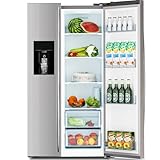
The Antarctic Star 2 is the odd one out in the best possible way: a French door refrigerator with a side freezer, a water dispenser, and an ice system that produces both nugget ice and cube ice. If you have ever paid three dollars for a cup of chewable ice, you understand why this exists.
Who it suits: households where ice quality is a genuine daily pleasure — iced coffee drinkers, cocktail enthusiasts, and anyone who has been disappointed by the crescent-shaped ice most refrigerators produce. It also suits buyers who want a water dispenser without a full through-door ice chute.
Key specs and class expectations:
- Door layout:
Affiliate disclosure. As an Amazon Associate we earn from qualifying purchases at no extra cost to you. Prices accurate as of the date shown.Best Refrigerators With Ice Makers for Every KitchenCheck price on Amazon