Key takeaways
- Length: 6 ft per cable, two cables per pack (12 ft total)
- Connectors: 3-pin XLR male to XLR female, balanced wiring
- Conductors: stranded copper class, typically 20–24 AWG in this category
- Shield: full-coverage shield around the balanced pair, with the shield tied to pin 1
- Strain relief: molded/overmolded boot at both connectors
- Jacket: PVC-class, flexible enough to route around a desk without memory coils
If you want the short answer: the Cable Matters 2-Pack Premium XLR to XLR cable (6 ft) is the best microphone cable for most home studios and small stages in 2026 — a balanced, shielded 3-pin XLR build at a length that suits desk-mounted interfaces, sold as a pair so you get a working cable plus a spare or a second input. Choose the Amazon Basics 2-Pack shielded XLR if you want the lowest-cost reliable pair, and the AuxLink 25 ft 6-pack if you are outfitting a full band or a rental rig and want gold-plated connectors with enough length to cross a stage. For genuinely long runs — a stage box 50 feet from front of house — the EBXYA 50 ft 2-pack is the pick. The rest of this guide compares connector plating, shield construction, conductor class, flexibility and the parts that actually fail first, so you can match a cable to your room instead of to a spec sheet.
Top 3 Picks
Best overall: Cable Matters 2-Pack Premium XLR to XLR (6 ft). It sits in the mid-range tier but behaves like a cable twice its length class: balanced 3-pin wiring, a proper shield, and a length that keeps a desktop interface tidy without a coil of slack under the desk. The two-pack means you are never one broken cable away from a dead session.
Best budget: Amazon Basics 2-Pack XLR Male to Female, shielded. Two matched cables, all-copper conductors and a shield, at the lowest price tier here. They are not the cables you buy for a touring rack, but for a bedroom setup, a podcast desk or a pair of drum overheads they do the job and cost little enough to keep spares.
Best premium: AuxLink XLR 25 ft 6-Pack, gold-plated 3-pin. Six 25-foot cables — 150 feet of balanced run — with gold-plated contacts that resist the oxidation that causes crackle in humid venues and outdoor stages. It is the fastest way to wire a five-piece band, and the plating matters most where cables get handled weekly.
Quick Comparison
| Product | Best for | Key specs | Price tier |
|---|---|---|---|
| Cable Matters 2-Pack Premium XLR to XLR | Home studio desks and small setups | 2 × 6 ft, XLR M–F, balanced, shielded, molded strain relief, PVC jacket | Mid-range |
| Amazon Basics XLR Male to Female (single) | One-mic budget recording | Single cable, all-copper conductors, balanced, shielded, multiple length options | Budget |
| AuxLink XLR 25 ft 6-Pack | Full bands and rental rigs | 6 × 25 ft (150 ft total), gold-plated 3-pin XLR M–F, balanced, listed for mic and powered-speaker use | Premium |
| Amazon Basics Low-Noise XLR (single) | PA spares and general stage use | Single cable, all-copper conductors, low-noise shield emphasis, balanced, length options | Budget |
| Tnlaile 6-Pack 25 ft Color-Coded | Multi-channel stages that need labeling | 6 × 25 ft, six distinct jacket colors, XLR M–F, balanced 3-pin | Premium |
| Gearlux XLR 25 ft 2-Pack | Duos, small stages, single-stand setups | 2 × 25 ft, fully balanced, XLR M–F, heavier jacket class than budget cables | Mid-range |
| Baroflone XLR 25 ft 6-Pack | Value bulk buying for installs and bands | 6 × 25 ft, XLR M–F, 3-pin balanced | Premium |
| EBXYA XLR 50 ft 2-Pack | Long throws to front of house | 2 × 50 ft (100 ft total), 3-pin XLR M–F, balanced | Mid-range |
| EBXYA XLR 20 ft 4-Pack | Hybrid mic and DMX lighting runs | 4 × 20 ft, balanced, listed as mic and DMX cable, XLR M–F | Mid-range |
| Amazon Basics 2-Pack Shielded XLR | Matched pairs on a tight budget | 2 cables, XLR M–F, shielded, all-copper conductors, balanced | Budget |
| EBXYA XLR 25 ft 6-Pack | Permanent studio and venue wiring | 6 × 25 ft (150 ft total), XLR M–F, 3-pin balanced | Premium |
| VANDESAIL XLR 3 ft 2-Pack | Rack, patchbay and desk patching | 2 × 3 ft, OFC conductors, noise-reduction shield, XLR M–F | Budget |
How We Chose
This roundup is built from published listing specifications and well-established facts about balanced audio cable, not from bench testing. We started with the five attributes that determine whether a cable works in a real room: connector type and plating, length relative to the job, shield construction, conductor class and gauge, and jacket flexibility. A 6-foot cable and a 50-foot cable are not competing products — they solve different problems — so each entry is judged against the situation it is sold for.
From there we applied four filters. First, spec completeness: does the listing actually state balanced wiring, shield type and conductor material, or does it leave you guessing? Second, category fit: does the length and pack count match a recognizable job, such as a desk, a drum kit, a stage box run or a rack patchbay? Third, upgrade path: is there a sensible next step if the reader’s needs grow, or is the cable a dead end? Fourth, price tier as a market range rather than a per-unit figure, because cable pricing moves weekly and a “best value” claim goes stale faster than the cable does.
We also noted where listings in the same tier overlap almost completely. The premium tier contains four 25-foot six-packs, and the honest differentiator between them is color coding, contact plating and brand ecosystem — not audio quality. Being clear about that is more useful than pretending they are meaningfully different cables.
1. Cable Matters 2-Pack Premium XLR to XLR – Best for Compact Studio Desks
As an Amazon Associate we earn from qualifying purchases at no extra cost to you.

This is the cable for someone whose microphone never moves more than a few feet from the interface. Six feet is the sweet spot for a desk-mounted audio interface, a podcast setup with a boom arm, or a vocal booth where the mic stand and the preamp live in the same small footprint. The two-pack matters more than it sounds: in a home studio, the failure mode you actually experience is a cable going intermittent at the worst possible moment, and having a second one already on the desk turns a lost session into a five-second swap.
Key specs
- Length: 6 ft per cable, two cables per pack (12 ft total)
- Connectors: 3-pin XLR male to XLR female, balanced wiring
- Conductors: stranded copper class, typically 20–24 AWG in this category
- Shield: full-coverage shield around the balanced pair, with the shield tied to pin 1
- Strain relief: molded/overmolded boot at both connectors
- Jacket: PVC-class, flexible enough to route around a desk without memory coils
Strengths
The short length is a genuine engineering advantage, not a compromise. Every foot of cable adds capacitance, and capacitance against a high source impedance rolls off treble. At six feet, the total capacitance in a typical 20–50 pF/ft mic cable is somewhere in the 120–300 pF range — small enough that it is essentially irrelevant regardless of what you plug in. The build quality sits a clear step above the cheapest tier: the connector barrels feel solid, the boot protects the joint where the jacket meets the shell, and the balanced wiring means the cable behaves correctly with phantom power for condenser microphones.
The practical upside of buying this pair rather than a single budget cable is that you standardize. Both cables are the same length and the same build, so when you add a second microphone you already have the cable, and your troubleshooting is simpler because you are not comparing two unknown cables against each other.
Pros
- Two cables, so a spare is always on hand
- Balanced, shielded construction handles phantom power cleanly
- 6 ft keeps a desktop tidy with minimal slack
- Low total capacitance at this length — no measurable treble penalty
Cons
- 6 ft is too short for any stage or floor-run use
- Mid-range price tier means a higher cost per foot than bulk multipacks
- No color coding, so multi-mic desks need your own labels
How it compares
Against the Amazon Basics 2-Pack, the Cable Matters pair costs more but sits in a higher build class with better connector finishing — worth it if the cables live on a desk and get plugged and unplugged weekly. Against the VANDESAIL 3 ft 2-Pack, this is the better choice for anything except pure rack patching: three feet is too short to reach from a mic on a boom arm to an interface, while six feet is comfortable. If you later need to run a cable across a room, step up to the Gearlux 25 ft pair rather than adding an extension, because every extra connector in a mic line is another potential intermittent fault.
2. Amazon Basics XLR Male to Female (Single) – Best Budget Single Cable for Home Recording

This is the entry point: one balanced XLR cable, all-copper conductors, shielded, sold at the budget tier. It suits the person who has exactly one microphone, one interface input, and no interest in buying a bundle before they know whether the hobby sticks. It is also the right purchase for anyone replacing a single dead cable in a drawer full of mismatched ones, because buying one cable you can afford beats buying three you cannot.
Key specs
- Format: single XLR male to XLR female microphone cable
- Conductors: all-copper, stranded
- Wiring: balanced 3-conductor plus shield
- Shielding: shield layer around the signal pair to reject interference
- Lengths: offered in multiple lengths in this family — check which one you are selecting
- Connectors: molded XLR shells with integrated strain relief
Strengths
The reason to buy this cable is that balanced audio is remarkably forgiving. A microphone signal is low level and low impedance, which is the ideal combination for a shielded twisted pair: interference couples onto both conductors roughly equally and cancels at the differential input of your preamp. That means a well-made budget cable and a mid-range cable will sound the same in a three-foot run through a quiet room. What you are paying for at higher tiers is not tone — it is the mechanical durability to survive being coiled, thrown in a bag and stepped on for three years.
For a fixed home setup, that durability is rarely tested. The cable sits behind the desk, gets plugged in twice a week, and never moves. In that scenario the budget tier is not a compromise at all; it is the correct allocation of money, and the savings are better spent on a mic stand that does not sag or a pop filter that actually filters.
Pros
- Lowest cost tier — easy to buy two and keep a spare
- All-copper conductors and balanced wiring, which is all a short run needs
- Widely available in several lengths, so you can size it to the job
- Fine with phantom power for condenser microphones
Cons
- Single cable, no spare included
- Molded connectors cannot be repaired or re-soldered easily if a joint fails
- No published capacitance figure, so long-run performance is unknown
How it compares
The nearest alternative in this list is the other Amazon Basics single-cable listing, which emphasizes low-noise shielding. In practice these two listings are siblings in the same budget family with heavily overlapping specifications, and the meaningful difference is which lengths each listing currently carries. If you need a specific length, buy whichever listing offers it; if both do, buy the one whose stated shield description you prefer. Against the Amazon Basics 2-Pack, this single cable makes sense only if you genuinely need one — the two-pack usually costs less per cable, and having a spare is worth more than the few dollars saved. Against the Cable Matters pair, you trade build class and a spare for the lowest possible entry price.
3. AuxLink XLR 25 ft 6-Pack – Best Premium Set for Full Bands and Rental Rigs
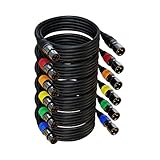
Six 25-foot cables is the configuration that matches a working band. It covers four vocal microphones plus a couple of instrument or DI channels, and 25 feet is long enough to reach from a mic position to a stage box at the back of the riser without stretching. The gold-plated 3-pin connectors are the reason this sits in the premium tier: gold does not oxidize the way bare nickel or brass does, and oxidation at the contact surface is a leading cause of the crackle and dropouts that plague cables used in humid clubs, outdoor stages and trailers.
Key specs
- Quantity and length: 6 cables × 25 ft = 150 ft of balanced run
- Connectors: 3-pin XLR male to female, gold-plated contacts
- Wiring: balanced, with the shield bonded to pin 1
- Listed use: microphone cable, and also sold for speaker and PA applications — meaning powered speakers fed at line level, not passive cabinets fed from an amplifier
- Strain relief: reinforced boot at the connector transition
Strengths
The plating is the headline, and it is worth understanding why. A connector contact is a mechanical interface that is also an electrical one. Every time it is mated and unmated, a thin layer of metal transfers and the surface roughens. Add humidity and airborne contaminants and the contact resistance climbs, which shows up first as intermittent signal and later as a channel that simply stops working. Gold plating resists that process far better than untreated metal, which is exactly what you want on cables that get handled every week rather than living behind a desk.
Six cables in one purchase also solves a logistics problem. Buying matched cables means matched capacitance, matched length and matched connectors, so when you troubleshoot a hum you are not wondering whether the problem is the cable, the mismatched pair, or the connector on the odd one out. For a band that plays out twice a month, 150 feet of matched cable is the difference between a setup that packs consistently and a tangle of unknown history.
One clarification worth stating plainly: XLR connectors carry microphone and line level signals. They are not appropriate for connecting a passive speaker cabinet to an amplifier, where the current and voltage are much higher and a proper speaker cable is required. The “speaker” language in listings like this one refers to feeding powered speakers, which have their own amplifier built in and accept a line-level XLR input.
Pros
- Gold-plated contacts resist oxidation and intermittent signal
- 150 ft total covers a full band’s channel list
- Matched set simplifies troubleshooting
- 25 ft reaches typical stage-box positions without strain
Cons
- Premium tier — the highest outlay of any pack here
- Six cables is more than a solo performer or duo needs
- No color coding, so channels still need labeling tape
How it compares
Against the EBXYA 25 ft 6-Pack, the AuxLink set wins on contact plating, which matters most in humid or outdoor environments; the EBXYA set wins on ecosystem, because the same brand covers 20 ft and 50 ft lengths if you want one consistent stock. Against the Tnlaile color-coded six-pack, the trade is plating versus labeling: Tnlaile solves “which cable is channel 4,” while AuxLink solves “why does channel 4 crackle.” If you run a fixed install where cables never move, Tnlaile’s colors are more valuable; if your cables travel, AuxLink’s plating is. Against the Baroflone six-pack, this is the higher-spec option at a similar tier, and the difference is again in the connector finish rather than the copper.
4. Amazon Basics Low-Noise XLR (Single) – Best Budget PA and Spare Cable
This is the cable you keep in the gig bag. It is a single, budget-tier, all-copper XLR built for recording, PA and speaker-system duty, and its value is not in outperforming anything — it is in being cheap enough that you own one before you need one. The person this suits is the performer who has a working setup but no redundancy, or the small venue that wants a couple of spares on the shelf without spending premium money.
Key specs
- Format: single XLR male to female microphone cable
- Conductors: all-copper, stranded
- Wiring: balanced 3-conductor plus shield
- Shield emphasis: marketed for low noise, i.e. interference rejection on longer runs
- Intended use: recording studio, speaker or PA system, as stated on the listing
- Lengths: offered in several lengths within the same family
Strengths
The honest case for this cable is arithmetic. A spare cable that costs a fraction of a premium one and lives in a bag until needed is worth more than a premium cable you did not buy. When a channel drops out mid-set, the audience does not care about your contact plating; they care how fast you can swap. At the budget tier you can afford two of these and still spend less than one premium cable, which gives you redundancy in two directions.
Shield quality matters more as length increases, and this listing’s low-noise emphasis is aimed at exactly that scenario: a mic line running past power cables, dimmer packs and laptop chargers. The mechanism is the same one that makes balanced audio work — the shield intercepts capacitively coupled noise and the differential input rejects what remains. On a short run in a quiet room the shield barely earns its keep; on a 20-foot run across a stage floor next to an extension cord, it earns it quickly.
Pros
- Budget tier makes redundancy affordable
- Balanced wiring works correctly with phantom power
- Low-noise shielding emphasis is useful on longer, noisier runs
- Multiple lengths available in the same family
Cons
- Single cable — no matched pair
- Molded construction is not field-repairable
- Specification detail is thin, so gauge and capacitance are not published
How it compares
Against the other Amazon Basics single-cable listing, the two overlap almost entirely: same brand family, same balanced all-copper approach, same budget tier. The practical way to choose is by available length and by whichever shield description you find more convincing, because neither listing publishes the numbers that would separate them objectively. Against the Amazon Basics 2-Pack, the two-pack is the better buy for a fixed setup, since the per-cable cost is lower and you get a matched pair. Where this single cable wins is as a gig-bag spare: you want exactly one, in a specific length, and you do not want to pay for six.
5. Tnlaile 6-Pack 25 ft Color-Coded – Best for Color-Coded Multi-Mic Stages

This is the pack for anyone who has ever stood at a stage box at 6 p.m. trying to work out which of six identical black cables goes to the hi-hat. Six 25-foot XLR cables in six distinct jacket colors turn channel identification from a continuity-test problem into a glance. It suits worship teams, function bands, school and community theatre groups, and anyone running a multi-mic setup where different people set up the stage on different nights.
Key specs
- Quantity and length: 6 cables × 25 ft = 150 ft total
- Color coding: six different jacket colors, one per cable
- Connectors: 3-pin XLR male to female, balanced
- Construction: shielded twisted pair with a flexible jacket class suited to repeated coiling
- Strain relief: molded boot at each connector
Strengths
Color coding looks like a gimmick until you have run a ten-channel stage. The real cost of unlabeled cable is not the cable — it is the twenty minutes of patching errors, the channel that feeds back because the wrong mic got the wrong gain, and the mid-set diagnosis that requires a human to walk the stage. A color-coded snake removes all of that. Assign red to lead vocal, blue to guitar amp, green to bass DI, and the patch becomes readable from the desk.
It also changes how you maintain the set. Cables fail at different rates depending on where they run — the one taped across a doorway gets abused, the one behind the drum riser does not. With colors you can track which specific cable has been failing, retire it deliberately, and know instantly which position is now short. With six identical black cables, a failure is anonymous until you test each one.
Twenty-five feet is the practical middle length for stage work: long enough to reach a stage box positioned upstage or at the side, short enough that you are not coiling 40 feet of slack at every position. If your runs are consistently longer than that, buy fewer long cables and more short ones rather than making every channel long.
Pros
- Instant channel identification without labeling tape
- 150 ft total covers a full band’s mic list
- Failures can be tracked per cable rather than anonymously
- 25 ft suits most stage-box positions
Cons
- Premium tier pricing for what is otherwise a standard spec
- Colored jackets can show scuffs and dirt more than black ones
- No gold plating stated, so humid-venue oxidation protection is not the selling point
How it compares
Against the AuxLink six-pack, this is the labeling-versus-plating decision. Tnlaile answers “which cable is this,” AuxLink answers “why is this cable noisy.” For a fixed venue where cables are patched once and left, Tnlaile is the more useful purchase. For a touring or rental rig where cables are mated and unmated constantly and stored in damp trailers, plating wins. Against the EBXYA 25 ft 6-Pack, Tnlaile trades brand consistency across lengths for the color system. Against the Baroflone six-pack, the spec is comparable and the color coding is the deciding feature. If you only ever run two microphones, none of the six-packs are right — buy the Cable Matters pair or the Gearlux pair instead.
6. Gearlux XLR 25 ft 2-Pack – Best Mid-Range Pair for Small Stages
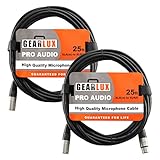
Two 25-foot fully balanced cables is the right quantity for a duo, a solo singer-guitarist, a single-stand podcast setup with a floor run, or anyone who needs one long cable and one spare. It sits in the mid-range tier, between the budget singles and the premium six-packs, and it is the sensible answer for the reader who knows they need length but does not need a full stage’s worth of it.
Key specs
- Quantity and length: 2 cables × 25 ft = 50 ft total
- Wiring: fully balanced, XLR male to female
- Shielding: shield around the balanced pair for interference rejection
- Jacket: heavier-duty class than budget cables, built for floor runs and coiling
- Connectors: 3-pin XLR with strain relief at the shell
Strengths
Twenty-five feet is where cable quality starts to matter measurably. Capacitance accumulates with length: at a typical 20–50 pF/ft, 25 feet gives you roughly 500–1,250 pF of total capacitance. Against a microphone’s low output impedance — usually in the 150–200 ohm range — that is still harmless, and the high-frequency rolloff lands far above the audible band. But against a high-impedance source, such as an electric guitar plugged straight into a long cable, the same capacitance produces an audible treble loss. That is why the standard advice is a DI box for instruments and a balanced cable for microphones, rather than one long cable doing both jobs.
The “fully balanced” claim matters for a specific reason: balanced operation only works if the whole path is balanced. A cable with three conductors and a shield, wired to a balanced output and a balanced input, will reject common-mode noise. The same cable into an unbalanced input gives up that rejection entirely. So the value of this cable depends on your interface or mixer actually having balanced XLR inputs, which most modern audio interfaces and small mixers do.
Pros
- Two 25 ft cables suit small acts without overbuying
- Fully balanced construction maximizes noise rejection
- Heavier jacket class survives floor runs and regular coiling
- Mid-range price tier keeps the outlay reasonable
Cons
- Only two cables, so a four-mic setup runs short
- No color coding or gold plating at this tier
- Cost per foot is higher than in bulk six-packs
How it compares
Against the Cable Matters 6 ft pair, this is a straight length decision: buy Gearlux if the cable has to cross a floor, buy Cable Matters if it lives on a desk. Against the EBXYA 20 ft 4-Pack, the trade is quantity versus reach — four 20-foot cables cover more channels, two 25-foot cables cover longer distances. Against the premium six-packs, Gearlux is the disciplined choice: you pay a mid-range price for exactly the amount of cable a small act uses, instead of buying 150 feet to use 50. The upgrade path, if the act grows, is to add a six-pack later rather than to replace these — matched 25-foot lengths across both purchases keep your inventory interchangeable.
7. Baroflone XLR 25 ft 6-Pack – Best Premium Value for Installations

Six 25-foot balanced XLR cables at the premium tier, aimed at the buyer who needs volume and is willing to pay for a step up from budget construction. It suits small venues wiring a fixed stage, houses of worship, rehearsal rooms, and bands that have outgrown the “borrow a cable from whoever” phase and want one consistent stock of spares.
Key specs
- Quantity and length: 6 cables × 25 ft = 150 ft total
- Connectors: 3-pin XLR male to female
- Wiring: balanced, shielded
- Jacket: flexible PVC class suited to repeated coiling
- Strain relief: molded boot at each connector
Strengths
The case for this pack is that 25 feet is the most useful single length in live audio. It reaches from a mic position to a stage box on most stages, it reaches from a desk to a floor-level DI, and it is short enough that you rarely coil more than a few feet of slack. Buying six of one length means every cable in the venue is interchangeable, which sounds minor until the night a cable fails and you discover your “spares” are all 10 feet too short.
Buying in the premium tier rather than budget also buys a longer service life, and that is where the real math lives. A budget cable that lasts two years in weekly use costs more per year than a premium cable that lasts six, even if the premium cable costs twice as much up front. For a venue, the relevant number is not the purchase price — it is the cost of a failure during a show, which includes the show itself.
For a fixed install, cable stress is mostly thermal and mechanical rather than connector wear. Cables that stay patched do not experience mating cycles, so the failure point shifts to the strain relief where the jacket meets the connector — the spot that takes the load when someone pulls the cable rather than the plug. That is why the discipline of pulling connectors, not cables, is worth more than any spec difference at this tier.
Pros
- 150 ft in one interchangeable length
- Premium construction for a longer service life
- 25 ft is the most versatile single length for live work
- Enough spares to retire a failed cable without a purchase
Cons
- Premium tier cost for a spec that is standard at this length
- No color coding or stated gold plating to differentiate it
- Six cables is overkill for a solo performer or a two-input home setup
How it compares
Against the EBXYA 25 ft 6-Pack, these two are close enough that the deciding factors are price at the moment of purchase and whether you want the rest of your cables to match one brand across lengths — EBXYA also offers 20 ft and 50 ft, which makes it easier to standardize a whole venue. Against the Tnlaile six-pack, Baroflone gives up color coding and gains a cleaner, plainer look for installs where colored cables would be visually odd. Against the AuxLink six-pack, Baroflone gives up stated gold plating. If none of those differentiators matter to you, buy whichever of the three premium six-packs is cheapest on the day, because the electrical performance at 25 feet is effectively identical.
8. EBXYA XLR 50 ft 2-Pack – Best for Long Runs to Front of House

Fifty feet is a different job from twenty-five. This pack exists for the run from a stage box to a mixing position at the back of a room, for a camera position far from the talent, for a large hall where the console sits in the audience, and for permanent installs where the equipment rack is in a separate room. Two cables means you can run a stereo pair or keep one as a spare for the one cable in the building that is hardest to replace.
Key specs
- Quantity and length: 2 cables × 50 ft = 100 ft total
- Connectors: 3-pin XLR male to female
- Wiring: balanced, shielded
- Jacket: flexible enough to coil into a manageable figure-eight
- Strain relief: reinforced boot at the connector transition
Strengths
Long balanced runs are the strongest argument for the XLR format. Because the signal travels as a difference between two conductors and the receiving input subtracts them, noise that couples onto the cable equally — the usual case for interference from mains wiring, lighting dimmers and radio-frequency sources — cancels out. A 50-foot balanced run through a noisy room can be cleaner than a 10-foot unbalanced run through the same room. That is why the standard advice for long microphone lines is “stay balanced” rather than “stay short.”
Capacitance is the tradeoff. At 20–50 pF/ft, 50 feet gives you roughly 1,000–2,500 pF. Into a microphone’s low impedance this is still negligible. Into a high-impedance line output it is not: a 10 kΩ source driving 1,500 pF of cable produces a first-order rolloff with a corner frequency around 10.6 kHz — audible as a dulled top end on a line-level signal. The fix is not a more expensive cable; it is a lower source impedance, which in practice means a DI box or a buffer rather than a long cable from an instrument output.
Handling a 50-foot cable is its own skill. Coil it over-under into roughly two-foot loops, because tight coils around your elbow create kinks, and a kink in a stranded conductor is where the break eventually happens. Store it in a bag or on a hook rather than wrapped around the stand, and it will outlast several shorter cables that get treated worse.
Pros
- 50 ft reaches front of house from a stage box
- Balanced operation keeps long runs quiet
- Two cables allow a stereo pair or a critical spare
- Mid-range tier for a length that budget cables rarely cover well
Cons
- Too long for desk use — 50 ft of slack is a trip hazard
- Higher total capacitance, which matters with high-impedance sources
- Only two cables, so it cannot wire a stage on its own
How it compares
Against the Gearlux 25 ft pair, this is purely about distance: buy Gearlux when 25 feet reaches, buy EBXYA 50 ft when it does not. Do not chain two 25-foot cables with a barrel adapter to make 50 feet — every extra mated pair is an additional failure point, and an adapter in a mic line is the classic source of an intermittent channel. Against the EBXYA 20 ft 4-Pack, the choice is between reach and channel count. Against the premium 25-foot six-packs, this is the complementary purchase rather than the alternative: most venues end up with several 25-foot cables plus one or two 50-foot runs for the console position, which is exactly the combination these two product types are designed for.
9. EBXYA XLR 20 ft 4-Pack – Best for Hybrid Mic and DMX Lighting Runs
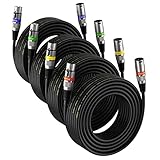
Four 20-foot balanced cables, listed for microphone and DMX duty. This is the pack for the person running both audio and lighting on a small stage, or for anyone who wants a slightly shorter length than 25 feet because their stage box sits closer than they thought. Twenty feet is also the length that best fits a rehearsal room or a home setup where the interface is on a shelf and the mic stands are across the room.
Key specs
- Quantity and length: 4 cables × 20 ft = 80 ft total
- Connectors: 3-pin XLR male to female
- Wiring: balanced
- Listed use: microphone cable and DMX cable
- Jacket: flexible PVC class for repeated coiling
Strengths
Four cables at 20 feet is a genuinely useful quantity: it covers a four-microphone drum kit, a four-piece vocal group, or a small setup of two mics plus two DI channels. It is also the pack that gives you enough cables to keep two permanently installed and two in the bag, which is a better arrangement than owning six cables that all migrate to the same place.
The DMX mention deserves an honest explanation, because it is the most misunderstood part of the XLR world. Three-pin XLR connectors are commonly used on budget lighting fixtures, and DMX is a digital signal that runs at 250 kbit/s over a nominally 120-ohm characteristic impedance line. Microphone cable is not specified for that impedance, and it is not rated for digital data. In practice, short DMX runs on mic cable usually work, and long runs sometimes produce flickering or unresponsive fixtures. The safe approach is to use cable sold and rated as DMX for permanent lighting runs, and to treat a mic cable as a short-term substitute only when the run is a few feet and the alternative is no lighting at all.
That caveat aside, this pack’s audio performance is straightforward: balanced, shielded, four channels, and a length that keeps cable off the floor in most small rooms.
Pros
- Four cables covers a drum kit or a vocal group
- 20 ft keeps runs short and tidy in small rooms
- Balanced construction for noise rejection
- Dual-listed for mic and DMX use, which is convenient on mixed stages
Cons
- Not impedance-rated DMX cable — use proper DMX for permanent lighting runs
- 20 ft may fall short if the stage box is upstage
- No color coding or gold plating at this tier
How it compares
Against the EBXYA 25 ft 6-Pack, this is a quantity-versus-length trade: four 20-foot cables or six 25-foot cables, with the six-pack giving 70 more feet and two more channels for a higher outlay. Against the Gearlux 25 ft pair, this gives you twice the channel count for a shorter reach at a similar tier. Against the EBXYA 50 ft pair, this is the right buy if your longest run is under about 20 feet and you would otherwise be coiling 30 feet of slack at every position. If you run lighting and audio on the same stage, buy dedicated DMX cable for the lighting runs and keep these for audio — the cost of a proper DMX cable is small next to the cost of a fixture that drops out mid-show.
10. Amazon Basics 2-Pack Shielded XLR – Best Budget Matched Pair
Two matched shielded XLR cables at the budget tier — the sweet spot for a home recordist running two microphones at once. It suits stereo pair work such as drum overheads or a spaced pair on an acoustic guitar, dual-mic podcast and interview setups, and any small rig where matched length and matched construction remove a variable from your troubleshooting.
Key specs
- Quantity: 2 matched cables
- Connectors: XLR male to female, balanced
- Conductors: all-copper
- Shielding: shielded construction for interference rejection
- Intended use: recording studio, speaker or PA system, as stated on the listing
- Lengths: offered in multiple lengths within the family
Strengths
Matched cables matter more than people expect when recording in stereo. If one cable in a pair has meaningfully different capacitance from the other, the high-frequency response of the two channels differs slightly, and on a spaced pair of overheads that can shift the perceived image. In practice, budget cables from the same production run are close enough that this is theoretical rather than audible — but buying a matched pair removes the question entirely, which is worth something when you are chasing a problem at 1 a.m.
The other argument for a two-pack at the budget tier is that it makes redundancy cheap. Two cables for the price of roughly one mid-range cable means you can keep both in service and still be able to identify a failure by substitution: swap the cables, and if the problem moves, you have found it. That diagnostic method — substitution rather than measurement — is what most home engineers actually use, and it only works if you have a spare.
These are all-copper, shielded, balanced cables. In a quiet home studio with runs under fifteen feet, that specification is sufficient. The limitations show up in handling, not audio: molded connectors, no published capacitance figures, and no plating specification.
Pros
- Two matched cables at the lowest price tier
- Shielded and balanced for clean noise rejection
- Multiple lengths available within the family
- Affordable enough to keep a spare pair
Cons
- Molded connectors cannot be repaired
- No published gauge, capacitance or plating spec
- Not built for the mating cycles of a weekly gigging rig
How it compares
Against the Cable Matters 2-Pack, this is the budget-tier version of the same idea: two cables, balanced, shielded, at a lower cost and a lower build class. If your cables stay behind a desk, the difference is unlikely to show up. If they travel, Cable Matters is the better long-term buy. Against the two Amazon Basics single-cable listings, this two-pack is almost always the better value per cable, and it is the one to choose unless you specifically need a single cable in a length the two-pack does not offer. Against the VANDESAIL 3 ft pair, this pair’s longer available lengths make it the more versatile purchase for anything except rack patching.
11. EBXYA XLR 25 ft 6-Pack – Best for Permanent Studio and Venue Wiring

Six 25-foot balanced cables at the premium tier, and the strongest argument for this particular pack is not the cables themselves — it is that the same brand covers 20-foot and 50-foot lengths, so you can wire an entire room with one consistent stock. It suits a project studio with a live room and a control room, a small venue with a fixed stage, a rehearsal space, and any installation where cables are run once and left in place for years.
Key specs
- Quantity and length: 6 cables × 25 ft = 150 ft total
- Connectors: 3-pin XLR male to female
- Wiring: balanced, shielded
- Jacket: flexible PVC class for coiling and routing
- Ecosystem: available alongside 20 ft and 50 ft packs in the same family
Strengths
For a permanent install, the priority order of cable attributes changes. Flexibility matters less, because the cable is not moving. Plating matters less, because the connectors are mated once. What matters most is consistency and the ability to replace a cable with an identical one years later. A single-brand stock across multiple lengths solves that: when a cable fails in 2029, you are not hunting for a discontinued model in a specific color and length.
Consistency also simplifies the electrical picture. Cables of the same construction have the same capacitance per foot, so a 25-foot run and a 50-foot run from the same family behave predictably relative to each other. In a studio with a patchbay, that predictability is worth more than any individual cable’s specification, because it means the sound of a channel does not change depending on which cable got patched into it.
Installation practice matters as much as the cable