Key takeaways
- Best all-round weekend duffel: Patagonia Black Hole Duffel 40L. It offers a useful carry-on-sized capacity, backpack straps, weather-resistant recycled fabric, and a wide opening that makes packing easier.
- Best for rugged, wet, or dirty gear: The North Face Base Camp Duffel M, with approximately 71 liters of capacity. Its tough laminate construction, large opening, and removable backpack straps suit camping, climbing, and team sports.
- Best for frequent travelers who want organization: Osprey Transporter Duffel 40 or 65. Multiple handles, a structured opening, and padded backpack straps make it easier to carry and access than a basic cylindrical bag.
- Best for adaptable luggage space: Eagle Creek Cargo Hauler XT Duffel 60L. It combines backpack carry, compression features, and a broad opening that works well when the contents vary from trip to trip.
- Best for urban travel and camera or tech packing: Peak Design Travel Duffel 35L. Its separate access points and compatible packing accessories are useful when you need to divide clothing, shoes, and electronics.
- Best low-cost format: A simple 35–45L polyester duffel with a padded shoulder strap and a U-shaped zipper. It can cost roughly $30–$80, but usually has less comfortable backpack carry and weaker weather protection.
The best duffel bags are the ones whose capacity, opening style, and carry system match the trip: choose 30–45 liters for a weekend, 50–70 liters for bulky sports equipment or checked travel, and a backpack-convertible design when you will walk more than a few minutes with the load.
Our top picks


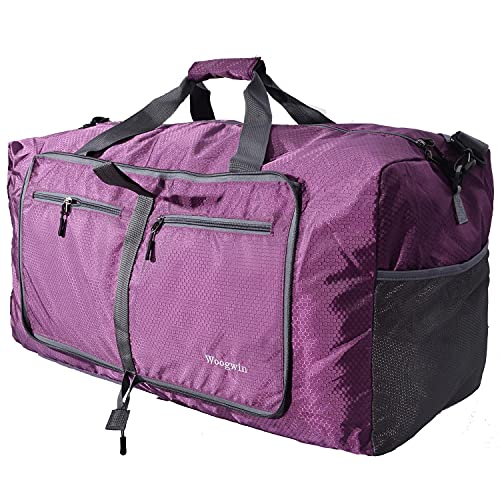
As an Amazon Associate we earn from qualifying purchases at no extra cost to you. Ratings are shown as listed on Amazon.
Quick picks by travel situation
- Best all-round weekend duffel: Patagonia Black Hole Duffel 40L. It offers a useful carry-on-sized capacity, backpack straps, weather-resistant recycled fabric, and a wide opening that makes packing easier.
- Best for rugged, wet, or dirty gear: The North Face Base Camp Duffel M, with approximately 71 liters of capacity. Its tough laminate construction, large opening, and removable backpack straps suit camping, climbing, and team sports.
- Best for frequent travelers who want organization: Osprey Transporter Duffel 40 or 65. Multiple handles, a structured opening, and padded backpack straps make it easier to carry and access than a basic cylindrical bag.
- Best for adaptable luggage space: Eagle Creek Cargo Hauler XT Duffel 60L. It combines backpack carry, compression features, and a broad opening that works well when the contents vary from trip to trip.
- Best for urban travel and camera or tech packing: Peak Design Travel Duffel 35L. Its separate access points and compatible packing accessories are useful when you need to divide clothing, shoes, and electronics.
- Best low-cost format: A simple 35–45L polyester duffel with a padded shoulder strap and a U-shaped zipper. It can cost roughly $30–$80, but usually has less comfortable backpack carry and weaker weather protection.
How to choose the right duffel size
Capacity matters more than the bag’s stated dimensions because soft luggage can expand, compress, or become awkwardly overfilled. Use the following ranges as a starting point:
| Capacity | Typical contents | Best use | Likely loaded weight |
|---|---|---|---|
| 25–35L | One change of clothes, toiletries, light shoes, laptop | Gym, overnight stay, personal-item-style travel where permitted | 5–8 kg |
| 40–45L | Two or three outfits, shoes, jacket, toiletries, small electronics | Two- to four-day weekend | 7–11 kg |
| 50–70L | Several outfits, larger shoes, towels, protective equipment | Long weekends, sports, camping, checked travel | 10–17 kg |
| 80–100L | Bulky clothing, boots, sleeping gear, team equipment | Extended trips or shared gear | 15–25 kg |
For air travel, do not assume a 40L duffel automatically qualifies as a carry-on. Airlines usually enforce an external size limit rather than a volume rating, and a soft bag can exceed that limit when stuffed. Measure the packed bag, including handles and wheels if present. A 35–45L model is the safer range for overhead travel, but the airline’s current dimensions control.
Head-to-head: backpack duffels versus traditional duffels
Backpack-convertible duffels
These are the better choice when you will use public transportation, walk between hotels, or carry the bag across uneven ground. Look for padded shoulder straps, a sternum strap, a breathable back panel, and attachment points that keep loose straps from catching. Patagonia Black Hole and Osprey Transporter models are strong examples of this format.
The compromise is weight and complexity. Backpack harnesses, padding, and extra zippers may add several hundred grams, and many straps are less comfortable than a purpose-built hiking backpack once the load becomes heavy. A backpack duffel is most comfortable when kept below roughly 10–12 kg.
Traditional shoulder duffels
A conventional duffel is lighter, cheaper, and often has a larger uninterrupted main compartment. That makes it effective for football boots, climbing helmets, boxing gloves, or clothing that does not need careful organization. The North Face Base Camp range is built around this durable, equipment-oriented approach.
The weakness is load comfort. A shoulder strap concentrates weight on one side, while short handles encourage carrying the bag in one hand. For a 60L bag loaded with 15 kg, this becomes tiring quickly. Choose this style when the bag will be carried from car to locker room, not hauled through a station.
Materials and construction that matter
- Recycled polyester: Common in modern travel duffels, with good abrasion resistance and lower weight. Patagonia’s Black Hole line uses recycled fabric with a weather-resistant laminate and finish.
- Ballistic or ripstop nylon: Often lighter than heavy laminate fabrics and useful when the bag will be carried frequently. Ripstop patterns help limit the spread of small tears, but they do not make the fabric puncture-proof.
- Tarpaulin-style laminate: Highly resistant to dirt and moisture and easy to wipe clean. It is useful for wet sports equipment, but stiff panels can crease and may become less flexible in cold conditions.
- Water-resistant zippers: Helpful in rain, but they do not make a duffel waterproof. Seams, zipper ends, and unprotected fabric panels can still admit water.
- Reinforced base: One of the most valuable durability features. A coated bottom with stitched webbing protects against concrete, vehicle floors, and wet changing-room surfaces.
In practice, the zipper, shoulder-strap anchors, and bottom corners usually show wear before the central fabric. A bag with a slightly lighter fabric but reinforced stress points can outlast a heavier bag with weak stitching.
Decision matrix: match the bag to your priorities
| Your situation | Recommended format | Useful capacity | What to prioritize |
|---|---|---|---|
| Occasional weekend traveler on a budget | Basic polyester duffel | 35–45L | U-shaped opening, padded strap, replaceable zipper pulls |
| Monthly rail or city traveler | Backpack duffel | 35–50L | Padded harness, sternum strap, laptop sleeve, luggage pass-through |
| Regular athlete with bulky equipment | Wide-mouth gear duffel | 50–70L | Ventilated pocket, wipe-clean base, separate shoe compartment |
| Frequent checked-bag traveler | Structured large duffel | 60–90L | Heavy-duty base, compression straps, lockable zipper pulls, ID panel |
| Minimalist one-bag traveler | Structured travel duffel | 30–40L | Clamshell opening, internal dividers, restrained depth, comfortable carry |
Features worth paying for
A wide opening is more valuable than many small pockets. A U-shaped or clamshell zipper lets you see the bottom of the bag and prevents the familiar problem of unpacking everything to find one shirt.
A separate shoe or wet compartment earns its space for sports and outdoor use. For ordinary travel, it may reduce the usable main compartment and add weight. A washable shoe sack can be a better solution if you only need this separation occasionally.
Compression straps keep a partly filled duffel stable and stop clothing from shifting. They are especially helpful in 60L-plus bags. External straps should be tucked away or secured so they do not snag on conveyor belts or door handles.
Multiple carry points make a bag easier to lift into a car, overhead compartment, or luggage rack. End handles are particularly useful on long duffels, while a padded top handle improves short carries.
A practical packing calculation
Suppose three days of clothing, toiletries, and a pair of compact shoes occupy about 28–32 liters when folded or packed in cubes. Add 20 percent spare capacity for a jacket, laundry, and imperfect packing: 30L × 1.2 equals 36L. That makes a 40L duffel a sensible target. A 25L bag may work for a very light packer, but it leaves little room for bulky shoes or weather layers.
For sports gear, estimate each large item separately instead of relying on clothing capacity. A pair of trainers may use 6–9L, a helmet 8–12L, protective pads 10–20L, and clothing 15–25L. The total can exceed 50L before adding towels or water bottles, which explains why a 60–70L gear duffel is often more practical than a seemingly versatile 40L model.
Care, cleaning, and ownership realities
- Empty the bag after every trip and air it out, especially after carrying shoes, swimwear, or sweaty clothing.
- Remove dirt with lukewarm water and mild soap. Avoid bleach, solvents, and aggressive scrubbing that can damage coatings.
- Dry the duffel fully with every compartment open before storing it. Long-term damp storage can create odor and weaken adhesives.
- Do not overload the zipper by forcing the opening shut. This places stress on the slider and end stops, which are difficult to repair.
- Use a laundry bag or shoe sack instead of placing sharp-edged equipment directly against the lining.
- Inspect strap anchors and bottom corners before a flight or expedition. Small stitching damage is easier to reinforce before it becomes a failure.
For occasional use, spending more on premium weather protection may not pay off. For weekly commuting, frequent sports, or repeated checked travel, reinforced stress points, a comfortable harness, and a washable base can justify a mid-range or premium bag. The best duffel bags are not necessarily the biggest or most feature-heavy; they are the ones that carry your normal load without forcing you to fight the zipper, dig through the compartment, or endure an uncomfortable shoulder strap.
Frequently asked questions
Is a duffel better than a suitcase for weekends?
A duffel is usually lighter and easier to squeeze into a car or crowded luggage rack. A suitcase is easier to roll and often protects contents better. Choose a duffel for flexible packing and short carries; choose a wheeled case when the load will be heavy or you will travel mostly on smooth surfaces.
Can a duffel be used as a personal item?
Only if its packed external dimensions meet the airline’s personal-item allowance. A compact 20–30L bag may qualify, while a 40L duffel often does not, even when it can be compressed.
What is the most versatile duffel size?
For many travelers, 40–45L is the best compromise. It holds a long weekend’s clothing without becoming excessively heavy, and backpack straps make it manageable in transit. Choose 60L or more when equipment or cold-weather layers take priority over portability.