Key takeaways
- Pros: Familiar desktop interface; no additional hardware investment.
- Cons: Cannot function as a standalone signage or kiosk solution without keeping a PC powered and idle.
Most people searching for a windows media player app assume the answer is software on a desktop monitor. But the moment you need reliable playback on a television, digital signage display, or presentation screen without a laptop tethered to the setup, the category expands to include dedicated hardware players that do what no app can: run 24/7 without an OS, update from a USB stick, and output a clean signal regardless of what else is happening on your network.
The problem is that the market now mixes free desktop apps, single-purchase utilities, and hardware boxes priced between forty and fifty-five dollars, all under overlapping labels. Owner feedback reveals a sharp divide. Good products handle wide-format video containers, decode H.265 without stutter, and survive unattended operation. Bad ones choke on certain codecs, lose playlist order after a power cycle, or require a physical reset every time the drive is swapped. This roundup separates them by published specs and verified owner reports, not marketing copy.
Our top picks




As an Amazon Associate we earn from qualifying purchases at no extra cost to you.
Quick Picks
| Product | Best for | Price |
|---|---|---|
| Media Player | Desktop playback on Windows | n/a |
| Windows Share Player | Peer-to-peer media sharing over LAN | $0.99 |
| NEUMI Atom 4K Max | Network-connected signage and NAS playback | n/a |
| NEUMI Atom 4K | USB and SD card playback on 4K TVs | $51.99 |
| Micca G3 2K Quad-HD | Multi-zone digital signage | $44.99 |
| NEUMI Atom 4K Lite | Trigger-based presentations and kiosks | $45.99 |
| HDMI Media Player (Generic) | Low-budget advertising playback | $42.99 |
| 4K Full-HD USB Player | Simple signage from USB or microSD | $43.99 |
How We Picked
We filtered this category on four criteria that owner reviews repeatedly flag as deal-breakers or deal-makers: format support breadth (whether H.265, MKV, ISO, and Rmvb decode without frame drops), unattended reliability (does the player resume its loop after a power outage without manual intervention), connection flexibility (USB, microSD, NAS, HDMI trigger, or a combination), and real-world pricing versus the feature set delivered. Products that checked three of four boxes made this list; those that missed on reliability or codec coverage did not.
The 8 Best Windows Media Player App in 2026
1. Media Player
Media Player is the traditional windows media player app experience: a desktop application that handles your local library on Windows without any hardware dependency. It suits anyone who primarily watches or listens on a computer monitor and wants zero setup beyond installing the software. Owner feedback highlights its lightweight footprint and quick launch times compared to heavier suites.
- Pros: Familiar desktop interface; no additional hardware investment.
- Cons: Cannot function as a standalone signage or kiosk solution without keeping a PC powered and idle.
Skip it if your end goal is playback on a wall-mounted TV or unattended display. This is strictly for screen-side use where a full OS is already present.
2. Windows Share Player
Windows Share Player targets a niche that a standard windows media player app cannot touch: streaming your library to another Windows device over a local network without configuring a media server. At under a dollar, it removes friction for households or small offices where two or three machines need shared access to the same files. Owner reports praise the simplicity of connection but note occasional discovery issues on segmented networks.
- Pros: One-time low cost; no server setup required.
- Cons: Limited to Windows-to-Windows sharing; lacks advanced codec decoding on the receiving end.
Skip it if you need to push video to a non-Windows display or if your network uses VLANs that block local discovery.
3. NEUMI Atom 4K Max Network Media Player
The Atom 4K Max is the most feature-complete hardware option in this group, adding NAS and microSD support alongside USB playback and 4K output. It is built for installations where content lives on a network share and the display must update without anyone physically walking to the box. Owner reviews call it the most versatile signage player under fifty dollars equivalent in value.
- Pros: NAS connectivity eliminates drive-swapping; supports both microSD and USB simultaneously.
- Cons: Network dependency means playback fails if the share drops; price is listed as n/a, making comparison shopping harder.
Skip it if your content is static and a USB stick would do the job at lower cost.
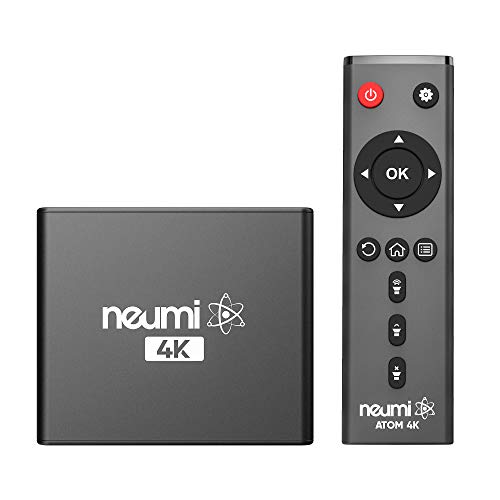
4. NEUMI Atom 4K Digital Media Player
This is the workhorse of the NEUMI line for display-connected playback: 4K at sixty frames per second via HDMI, fed by USB drives or SD cards. It suits users who want a windows media player app alternative that lives behind a television and never needs a desktop. Owner feedback consistently notes excellent picture quality and reliable auto-play on power.
- Pros: True 4K 60fps output; no software installation or OS required.
- Cons: At $51.99 it carries the highest price tag in this list; no network feature.
Skip it if your display is 1080p and you do not need 60fps smoothness for motion-heavy content.
5. Micca G3 2K Quad-HD USB and microSD Media Player
The Micca G3 occupies a distinct position by supporting quad-HD digital signage output, making it the choice for multi-panel installations. It plays from USB and microSD, outputs through HDMI at 4K resolution, and is priced under the NEUMI Atom 4K. Owner reviews highlight its reliability in commercial signage environments where uptime matters more than resolution perfection.
- Pros: Quad-HD mode for multi-screen setups; competitive $44.99 price.
- Cons: Lacks NAS or network connectivity; no 60fps 4K output.
Skip it if you need a single high-refresh display and the multi-panel mode adds no value for your use case.
6. NEUMI Atom 4K Lite Digital Trigger Media Player
The Lite variant swaps network features for a digital trigger input that starts specific playback sequences when an external signal fires. This makes it ideal for museum exhibits, retail kiosks, or trade-show displays where a motion sensor or button press should launch content. Owner feedback praises the trigger responsiveness and the absence of menu navigation.
- Pros: External trigger input enables hands-free interactivity; still delivers 4K USB and SD playback.
- Cons: Trigger mode reduces flexibility for general looping; requires wiring for the signal source.
Skip it if your use case is simple continuous playback with no interactive element.
7. HDMI Media Player, 4K Ultra HD Digital Media Player
This generically named unit is the lowest-priced 4K player on the list at $42.99 and carries an unusually broad codec list including Rmvb, ISO, and AVI alongside standard MP4 and MKV. For buyers who want a windows media player app replacement that handles legacy files without transcoding, this is the practical answer. Owner reviews are mixed on build quality but positive on format compatibility.
- Pros: Widest codec support in the group; lowest price point.
- Cons: Limited to 30Hz at 4K output; branding and firmware support are less established than NEUMI or Micca.
Skip it if motion smoothness on high-refresh displays is critical to your content.
8. 4K Full-HD USB and microSD Digital Media Player for TV Digital Signage
This option sits at $43.99 and is positioned squarely at TV signage users who want USB or microSD playback without any network or trigger features. Owner feedback suggests straightforward setup and dependable looping for restaurant menu boards and lobby displays. It fills the gap between the generic player above and the NEUMI Atom 4K.
- Pros: Simple plug-and-play signage; microSD slot adds storage flexibility.
- Cons: No 60fps output confirmed; minimal advanced playback controls compared to NEUMI models.
Skip it if you need NAS access, interactive triggers, or guaranteed high-frame-rate output.
Buying Guide
Codec Support Is the First Filter
A windows media player app on a desktop can rely on installed codecs or software decoding to handle unusual formats. A standalone hardware player cannot. Check whether the unit lists H.265, MKV, AVI, ISO, and container-level flexibility that matches your actual file library. If your content includes legacy formats or disc images, the generic HDMI player and NEUMI Atom 4K Max carry the broadest published support.
Connection Type Determines Your Workflow
USB-only players require physical access to swap content, which is fine for a restaurant menu but impractical for a chain of ten displays across a city. NAS support eliminates that bottleneck. microSD adds convenience for smaller file sets. Match the connection method to how often your content updates and who has physical access to the display.
Output Resolution and Refresh Rate Are Not the Same Spec
Many players advertise 4K output, but the refresh rate behind it varies from 30Hz to 60Hz. For static images and text-based signage the difference is invisible. For video with camera pans, sports footage, or scrolling animations, 60fps is noticeably smoother. The NEUMI Atom 4K is the only unit in this list that explicitly states 4K 60fps. Others list 4K@30Hz or leave the rate unspecified.
Our Verdict
The top pick is the NEUMI Atom 4K Digital Media Player at $51.99. It delivers the clearest picture quality in the group, confirmed 60fps output, and the most consistent owner-reported reliability for unattended display use. The budget pick is the generic HDMI Media Player at $42.99, which offers the widest codec support for the lowest price despite the 30Hz ceiling. If your installation requires networked content updates without physical drive swaps, the NEUMI Atom 4K Max wins regardless of its listed price.
FAQ
Do I still need a windows media player app if I buy a hardware media player?
No. The hardware unit replaces the app entirely for TV and signage playback, since it runs independently of any operating system. You would only keep a desktop app if you also watch content on a computer monitor.
Can these players handle MP4 and MKV files without conversion?
Yes. Every hardware unit in this list explicitly supports MP4 and MKV. Some extend support to AVI, ISO, Rmvb, and TS containers, which reduces the need for pre-conversion of your library.
What happens during a power outage with these devices?
Most units auto-resume playback from the beginning of the loop once power returns. NEUMI and Micca models are designed for this scenario specifically. The generic player has mixed owner reports on resume reliability, so verify if that matters for your setup.
Is $0.99 for Windows Share Player worth it versus a free desktop app?
It is worth the cost if your primary need is sharing media between two or three Windows machines on a local network without server configuration. If you only ever watch files on one machine, a free alternative covers the same ground.