Key takeaways
- 28L-35L: Best for 2-4 day trips, minimalist packers, or as a personal item plus a small suitcase. Easier to carry all day in cities.
- 40L-45L: The sweet spot for one-bag travel for 5-10 days if you pack efficiently with cubes. Still carry-on compliant when not overpacked.
- 45L+: Needed for longer trips, bulkier clothing, or if you carry photo or work gear. Often requires checking on budget airlines.
The best travel backpack for most travelers is a 35L to 45L panel-loading pack with a padded hip belt, load lifters, and durable water-resistant fabric, with the Osprey Farpoint 40, Peak Design Travel Backpack 45L, Cotopaxi Allpa 35L, and Aer Travel Pack 3 standing out for different trip styles and body types.
Choosing by liter capacity and carry comfort matters more than brand alone. A pack that fits your torso length, distributes weight to your hips, and opens like a suitcase will be far more versatile for both short city breaks and longer one-bag trips than a larger top-loading hiking pack.
Our top picks



As an Amazon Associate we earn from qualifying purchases at no extra cost to you. Ratings are shown as listed on Amazon.
How to Choose by Fit, Capacity, and Comfort
Before comparing models, narrow your choice by these four decision criteria:
1. Capacity vs. Trip Length
Airline carry-on limits are the real constraint. Most airlines cap carry-on at 22 x 14 x 9 inches (56 x 36 x 23 cm). That translates to roughly 35L-45L. Anything larger will likely need to be checked.
- 28L-35L: Best for 2-4 day trips, minimalist packers, or as a personal item plus a small suitcase. Easier to carry all day in cities.
- 40L-45L: The sweet spot for one-bag travel for 5-10 days if you pack efficiently with cubes. Still carry-on compliant when not overpacked.
- 45L+: Needed for longer trips, bulkier clothing, or if you carry photo or work gear. Often requires checking on budget airlines.
2. Fit and Strap System
Torso length determines comfort more than your height. Measure from your C7 vertebra (the bony bump at the base of your neck) to the top of your hip bones. Most travel packs come in one size with adjustable torso, while a few like the Osprey Farpoint/Fairview offer S/M and M/L sizes.
Look for:
- Contoured, breathable shoulder straps with sternum strap and load-lifter straps (the small straps from the top of the pack to the shoulder straps) to pull weight forward
- A stowable hip belt. A padded hip belt transfers 60-80% of weight off your shoulders; a thin webbing belt just stabilizes the pack
- A suspended mesh back panel or padded channels for ventilation if you walk extensively in warm climates
3. Fabric and Durability
Denier (D) measures yarn thickness, not necessarily quality, but it indicates abrasion resistance. Higher denier + ripstop weave = more durable but heavier.
- 210D-400D ripstop nylon with DWR coating: Lightweight, good for urban travel
- 500D-1000D Cordura nylon or polyester: Much more abrasion-resistant for rough handling, heavier
- TPU-coated or recycled polyester with YKK zippers: Better water resistance. No backpack is fully waterproof unless it has a roll-top and welded seams; look for weatherproof zippers and included rain cover if you expect rain
4. Access and Organization
Panel-loading (full U-shaped zipper that opens like a suitcase) is faster to pack and live out of than top-loading. Clamshell designs also let you compress the pack when half-full. Check for a separate padded laptop sleeve, lockable zippers, and external compression straps to reduce volume.
Top Picks Compared: Specs That Matter
These four versatile packs consistently rank for comfort, capacity, and durability across different budgets and travel styles. Weights and dimensions are manufacturer specs for the base model without extra cubes.
| Backpack | Capacity | Weight | Dimensions | Main Fabric | Best For |
|---|---|---|---|---|---|
| Osprey Farpoint 40 / Fairview 40 | 40L (S/M: 38L) | 1.55 kg / 3.43 lbs | 55 x 35 x 23 cm / 21.5 x 13.5 x 9 in | 450D ripstop recycled polyester, DWR | Comfort for long walks, hip belt support |
| Peak Design Travel Backpack 45L | 35L compressed, 45L expanded | 2.05 kg / 4.52 lbs | 56 x 33 x 24 cm / 22 x 13 x 9.5 in | 400D nylon canvas, 100% recycled, DWR + weatherproof zips | Photographers, expandable capacity |
| Cotopaxi Allpa 35L | 35L | 1.46 kg / 3.22 lbs | 51 x 33 x 22 cm / 20 x 13 x 8.5 in | 1000D TPU-coated polyester, YKK zippers | Suitcase-style organization, durability |
| Aer Travel Pack 3 (35L) | 35L (Small: 28L) | 1.87 kg / 4.12 lbs | 52 x 33 x 22 cm / 20.5 x 13 x 8.5 in | 1680D Cordura ballistic nylon, YKK zippers | Work travel, laptop protection, clean look |
Which Pack Fits Your Situation?
Use this matrix to match your priorities to a type, rather than just picking the biggest pack.
| Your Situation | Recommended Capacity & Features | Why It Works |
|---|---|---|
| Budget-conscious, 1-2 trips per year, carry-on only | 35L, panel-loading, simple harness | Lower weight and price, fits all airlines including stricter European low-cost carriers. Example type: Cotopaxi Allpa 35L or similar 35L clamshell. |
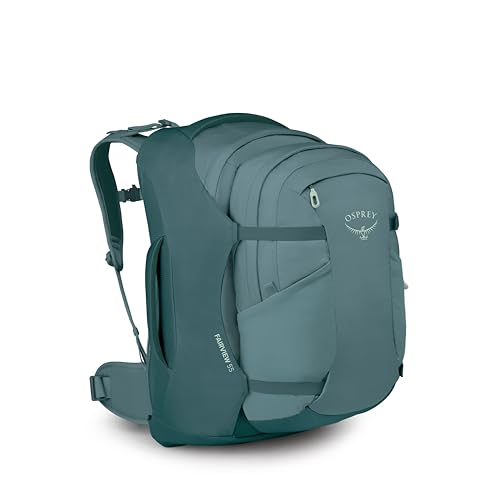
| Frequent one-bag traveler, 7+ days, walks a lot | 40L with adjustable torso + padded hip belt + load lifters | Hip transfer prevents shoulder fatigue over miles. Osprey Farpoint/Fairview excels here. |
| Digital nomad / business travel with laptop + gear | 28L-35L with suspended laptop sleeve, structured back panel | Professional look, protects tech, easier to use on public transit. Aer Travel Pack 3 and Bellroy Transit types fit this need. |
| Photographer or hybrid traveler needing expansion | 35L-45L expandable, modular dividers, side access | Compress for daily use, expand for travel days. Peak Design 45L offers this flexibility. |
| Tall or small frame, sensitive shoulders/back | Sized torso (S/M vs M/L) and women-specific harness | Prevents the hip belt riding too high or shoulder straps gapping. Worth prioritizing fit over extra pockets. |
A Quick Capacity Calculation
To estimate cost-per-use and whether you need 35L or 45L, try this:
1. Audit your baseline kit: Lay out everything you pack for a 5-day trip and stuff it into packing cubes. Measure the cubes: a typical set (1 large + 1 medium + 1 small) holds about 28L-32L including clothes, toiletries, and a 14-inch laptop.
2. Add trip variable: Add 3L for cold-weather layers, 4-6L for camera cube or second pair of shoes.
3. Calculate: If your total is under 33L, a 35L pack leaves 2L buffer and will force disciplined packing. If your total is 36L+, choose a 40L-45L pack rather than overstuffing a 35L, which stresses zippers and makes the pack exceed carry-on depth.
For value: A pack in the $160-$280 range used for 20 trips over 5 years costs $8-$14 per trip – less than a checked bag fee on most airlines. Durability therefore outweighs a small upfront saving.
Durability and Ownership Realities
Travel backpacks fail in predictable places. Knowing what wears first helps you maintain the pack and avoid common mistakes.
- Zippers first: Main U-zippers and bottom corners take the most stress. Overpacking is the #1 cause of blowouts. Always use compression straps before forcing a zipper, and choose packs with #8 or #10 YKK zippers rather than smaller coil zippers.
- DWR coating fades: Durable water repellent wears off in 6-12 months of heavy use. It is not the waterproof membrane itself. Reapply a spray-on DWR and wash with tech wash, never fabric softener, which clogs the coating.
- Back panel foam compresses: Cheaper foam stays compressed after being stored stuffed. Store the pack loosely, unbuckled, and air it out after sweaty use to prevent odor and foam breakdown.
- Hip belt and strap stitching: Check bartack stitching where straps meet the pack body. Padded belts that are stowable last longer if you tuck them away when checking the bag to avoid conveyor snags.
- Cleaning: Empty all pockets, shake out debris, hand wash with lukewarm water and mild soap, air dry completely. Never machine dry with heat; it delaminates coatings.
Common mistakes to avoid: buying by liters alone without checking torso fit, choosing a 45L pack for weekend trips (it will feel bulky half-empty), and ignoring weight – a 2.2 kg empty pack already uses 30% of a 7 kg carry-on allowance on some airlines.
Final Recommendations by Travel Style
Best Overall for One-Bag Travel: Osprey Farpoint 40
Its adjustable LightWire frame, stowable padded hip belt, and 40L panel-loading design balance comfort on long walking days with true carry-on size. The Fairview is the women-specific equivalent with a different harness angle. Trade-off: less structured laptop protection than work-focused packs.
Best for Organization and Rough Handling: Cotopaxi Allpa 35L
Full clamshell opening with subdivided compartments, 1000D TPU-coated shell, and theft-deterring zippers make it excellent for living out of the pack in hostels or varied accommodations. Trade-off: minimal hip support for hikes over a few miles.
Best Expandable and Modular: Peak Design Travel Backpack 45L
Expands from 35L to 45L, offers side, top, and front access, and integrates with camera cubes. Heavier than competitors, but versatile if you alternate between minimal and gear-heavy trips.
Best for Work and City Travel: Aer Travel Pack 3
1680D Cordura ballistic nylon resists abrasion, with a suspended, padded 16-inch laptop compartment and clean, professional silhouette. Less ventilated for hot climates and heavier per liter than ultralight options.
If you only buy one pack in 2026 and want maximum airline compatibility, choose a 35L clamshell. If you want one pack to replace checked luggage for a week or more and prioritize walking comfort, choose a 40L with a real hip belt. Fit and empty weight will determine long-term satisfaction more than extra pockets or marketing claims.