Key takeaways
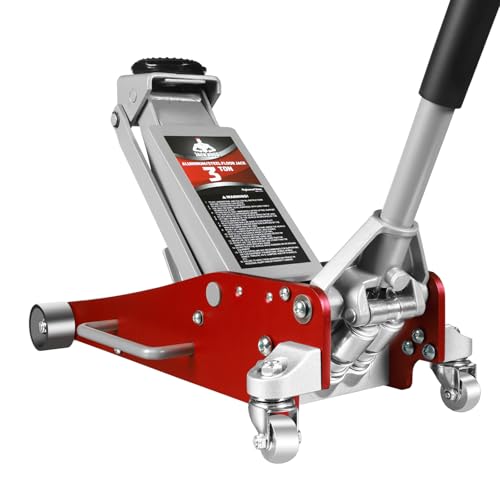
- For a typical sports car or lowered coupe: The Arcan ALJ3T combines a 3-ton rating with an 18-inch maximum lift. Its 3.75-inch entry height suits many cars, but it may not fit a heavily lowered vehicle or one with a deep side skirt.
- For an exceptionally low car: The Ranger RFJ-3000LPF’s roughly 2.75-inch minimum height gives it an advantage when the side lift point sits close to the floor. Its longer lifting range can also help when the jack must reach inward to a central point.
- For a higher lift or longer reach: The ESCO 10498 is worth considering if its entry height fits your car and the jack’s dimensions fit your garage. Check both the saddle height and the distance from the front wheels to the saddle; a low saddle is of little use if the frame cannot roll far enough under the chassis.
- For occasional home maintenance on a budget: A 3-ton long-reach model can be a practical choice, but verify its warranty, replacement parts, and current specifications. Budget models may be heavier or less refined to position than premium jacks.
Best low profile jacks: quick picks for low-clearance cars
The best low profile jacks for most home garages are long-reach, low-entry floor jacks with a minimum saddle height of about 3 inches, a lifting range of at least 18 inches, and a capacity matched to the vehicle and lifting point. For a lightweight sports car, the Arcan ALJ3T is a strong all-around choice; for very low cars, look at the Ranger RFJ-3000LPF or a low-entry model with a removable saddle.
Minimum height determines whether the jack can get under the car; maximum height determines whether it can lift the tire clear. Capacity alone does not guarantee fit: saddle diameter and reach matter too. The figures below are manufacturer-listed specifications where available. Check the current manual before buying, since specifications can vary by version.
Our top picks



As an Amazon Associate we earn from qualifying purchases at no extra cost to you. Ratings are shown as listed on Amazon.
Comparison: low-profile floor jacks
| Jack | Minimum saddle height | Maximum lift height | Capacity | Saddle diameter | Best fit |
|---|---|---|---|---|---|
| Arcan ALJ3T | 3.75 in | 18 in | 3 tons | About 4 in | General-purpose sports-car and garage use |
| Ranger RFJ-3000LPF | About 2.75 in | About 20 in | 3 tons | About 4 in | Cars with especially low side lift points |
| ESCO 10498 low-profile jack | About 3.5 in | About 20 in | 3 tons | About 4 in | Longer reach and higher lift in a professional-style floor jack |
| DAYTONA 3-ton low-profile long-reach floor jack | About 3.1 in | About 19.8 in | 3 tons | About 4 in | Budget-conscious home garage, if available locally |
These are approximate published figures, not a guarantee that a jack will fit every vehicle. Saddle measurements may refer to the pad itself, while a removable rubber puck or adapter adds height. Confirm the exact model and measure your car’s lift points before purchase.
Choose by your clearance, not by the lowest advertised number
- For a typical sports car or lowered coupe: The Arcan ALJ3T combines a 3-ton rating with an 18-inch maximum lift. Its 3.75-inch entry height suits many cars, but it may not fit a heavily lowered vehicle or one with a deep side skirt.
- For an exceptionally low car: The Ranger RFJ-3000LPF’s roughly 2.75-inch minimum height gives it an advantage when the side lift point sits close to the floor. Its longer lifting range can also help when the jack must reach inward to a central point.
- For a higher lift or longer reach: The ESCO 10498 is worth considering if its entry height fits your car and the jack’s dimensions fit your garage. Check both the saddle height and the distance from the front wheels to the saddle; a low saddle is of little use if the frame cannot roll far enough under the chassis.
- For occasional home maintenance on a budget: A 3-ton long-reach model can be a practical choice, but verify its warranty, replacement parts, and current specifications. Budget models may be heavier or less refined to position than premium jacks.
A 3-ton rating is often suitable for passenger cars when the jack is used at an approved lifting point, but it is not a reason to lift any part of the vehicle indiscriminately. Follow the vehicle manual. A floor jack lifts; correctly rated jack stands support the car while you work underneath it.
Check the fit with a simple measurement
Measure the vertical gap from the garage floor to the approved jacking point—not just the rocker panel. Then account for anything that changes the car’s resting height, such as a sloped floor, a flat tire, or a lift-point adapter.
Fit check: If the lift point is 3.4 inches above the floor and the jack’s saddle is 3.1 inches high, the nominal clearance is 0.3 inches. That is a tight margin: floor unevenness, a jack tilted during entry, or a rubber pad may eliminate it. A jack with a 2.75-inch minimum height would provide more room. If using a puck that adds 0.5 inches, the jack must first fit beneath the car without the puck; the puck is added at the saddle after positioning.
Also check maximum height. The required lift is the distance needed to unload and remove the tire, which varies with suspension design and tire size. Leave a margin rather than assuming that the car’s ride height equals the jack’s required lift.
Why saddle size and reach matter
A larger saddle can distribute contact over a broader area, but it may not seat correctly on a narrow pinch weld or a shaped chassis pad. A smaller saddle may fit the point but concentrate force. Use the vehicle maker’s specified lifting location and a compatible grooved adapter where required; never let the saddle press on a plastic side skirt, floor pan, or battery enclosure.
Before buying, compare the jack’s saddle diameter with the usable area at the lift point and check whether a pinch-weld slot, rubber pad, or vehicle-specific puck is needed. Measure the jack’s overall width and length as well. Long-reach models can reach central lifting points, but take more floor space and may be awkward to maneuver in a crowded garage.
Safe setup and ownership
- Park on firm, level ground, select the parking brake, and chock wheels that remain on the floor.
- Use only the vehicle’s approved lifting points. Position the jack so its saddle is centered and stable before raising.
- Raise the car only as high as needed, then support it with appropriately rated jack stands at the specified support points. Never work under a car supported only by a hydraulic jack.
- Lower the jack slowly and keep hands and feet clear. If the car shifts, stop and reset rather than trying to steady it by hand.
Hydraulic seals and wheels are common wear points. A slow leak, sinking saddle, damaged hose, or bent component means the jack should be taken out of service until inspected or repaired. Keep the frame clean, inspect it for damage, and follow the manufacturer’s directions for hydraulic-fluid checks and bleeding. Do not add fluid casually: overfilling or using the wrong type can affect operation.
Floor jacks are heavy, so consider where you will store and roll one before choosing the biggest model. If your car cannot be reached safely with any floor jack that fits, a low-rise lift or professional workshop may be the more suitable solution.
Bottom line
For a broadly useful garage jack, choose a 3-ton long-reach model with a minimum height that clears your measured lift point, a maximum height that clears the tire, and a saddle compatible with the car’s approved lifting pad. The Arcan ALJ3T is a sensible general-purpose pick; the Ranger RFJ-3000LPF is better suited to especially low cars. Verify current specifications and vehicle fit before purchase, and always use jack stands for under-car work.