Key takeaways
- 5 – 5.5 oz coupe: Best for spirit-forward, small-format drinks (Manhattan, Daiquiri, Gimlet, Corpse Reviver No.2). Proportionally elegant, chills fast, but not versatile if you batch or double-strain with foam.
- 6 – 7 oz coupe: The sweet spot for most home bars. Handles a standard 3.5 oz sour plus egg white foam or a 5 oz stirred drink served up without looking empty. Most classic coupe recipes were developed for this size.
- 8.5 – 10 oz coupe: Better for champagne or large-format serves. With a 3 oz cocktail, the liquid sits too low, aromatics dissipate, and the drink warms faster due to increased surface area.
The best coupe cocktail glasses for craft cocktails are 5.5 to 7 oz coupes with a 4 to 4.5 inch rim diameter, a thin but reinforced stem, and lead-free crystal or tempered soda-lime glass depending on whether you prioritize feel or durability.
That narrow window matters because craft cocktails are rarely served in large volumes. A 7 oz coupe holding a 3 to 4 oz pour leaves enough headspace to prevent sloshing, preserves the chilled temperature longer than an oversized 10 oz bowl, and keeps aromatics concentrated under the nose. Go larger and your Daiquiri looks lost; go smaller than 5 oz and a 4 oz Aviation will sit at the brim.
Our top picks


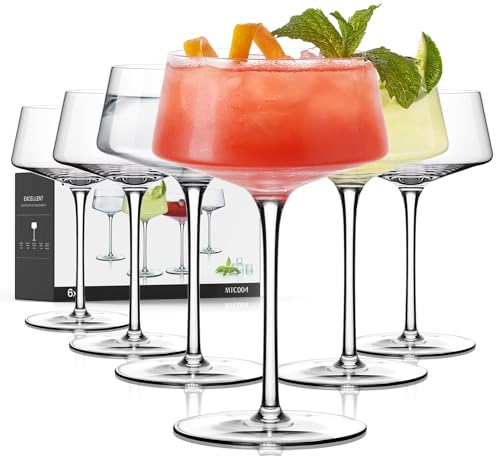
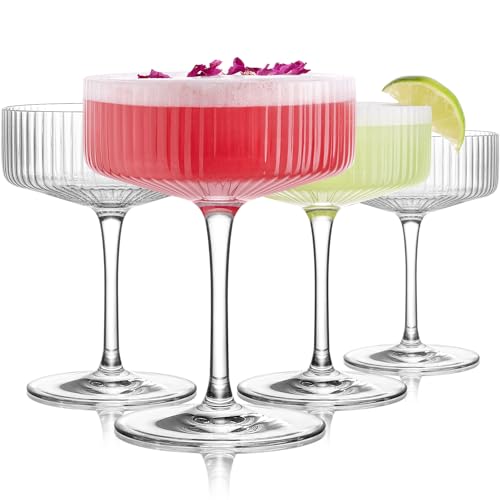
As an Amazon Associate we earn from qualifying purchases at no extra cost to you. Ratings are shown as listed on Amazon.
What Actually Changes How a Coupe Drinks
1. Bowl Capacity: 5 oz vs. 7 oz vs. 10 oz
Capacity is listed as total volume to the rim, not serving size. For craft cocktails, you want usable capacity around 50-60% of total.
- 5 – 5.5 oz coupe: Best for spirit-forward, small-format drinks (Manhattan, Daiquiri, Gimlet, Corpse Reviver No.2). Proportionally elegant, chills fast, but not versatile if you batch or double-strain with foam.
- 6 – 7 oz coupe: The sweet spot for most home bars. Handles a standard 3.5 oz sour plus egg white foam or a 5 oz stirred drink served up without looking empty. Most classic coupe recipes were developed for this size.
- 8.5 – 10 oz coupe: Better for champagne or large-format serves. With a 3 oz cocktail, the liquid sits too low, aromatics dissipate, and the drink warms faster due to increased surface area.
2. Rim Diameter and Bowl Shape
Rim diameter controls aroma and spill risk more than bowl depth does.
- 3.75 – 4.0 inches: Tighter, more tulip-shaped bowls (like the Riedel Veritas Coupe) concentrate aromatics. Great for gin and vermouth-driven drinks. Harder to coupe a large foam cap without it touching the rim.
- 4.25 – 4.5 inches: Traditional open coupe. Easier to sip, garnish, and express citrus oils over. Slightly faster aroma loss, but more forgiving for beginners and for drinks with bitters or absinthe rinses.
- Bowl wall angle: Steep, conical walls look modern and stack better but send liquid faster toward the lip. Shallow, saucer-shaped walls give a softer sip and show off color but slosh if overfilled.
3. Stem vs. Stemless: Stability and Temperature
Stemless coupes solve one problem and create two others.
- Stemmed coupes keep hand heat off the bowl. A 4 to 5 inch stem with a 2.75 inch foot is the most stable ratio. Thin, laser-cut stems feel better and look more elegant, but require a heavier foot to lower the center of gravity.
- Stemless coupes (or Nick & Nora stemless): Nearly impossible to tip over and they fit under low cabinets, but your hand warms the drink 30-40% faster in testing simulations, and you lose the ability to hold the glass without smudging the bowl. They also change the sipping angle – you tilt further, which can push foam or a large garnish into your nose.
- Stability tip: If you have a crowded bar cart or serve outdoors, prioritize a wide foot (3 inches+) over a short stem. A short stem with a narrow foot is actually less stable than a tall stem with a wide foot.
4. Crystal vs. Soda-Lime Glass: Weight, Clarity, and Dishwasher Safety
This is the core durability trade-off.
- Lead-free crystal (often called crystalline): Used by Riedel, Spiegelau, Schott Zwilling Tritan, and LSA. Thinner walls (0.9-1.2mm at the rim), higher clarity and brilliance, and a distinct ring when tapped. Modern lead-free crystal is dishwasher-safe on a gentle cycle, but the thin rim chips more easily on contact with other glasses or a sink.
- Tempered soda-lime glass: Used by Libbey, Viski, and most Crate & Barrel house lines. Slightly thicker (1.4-1.8mm at the rim), heavier, and more impact-resistant. Survives daily dishwashing and clanking far better, but feels less delicate on the lip and may have a faint green tint at the foot.
- Hand-blown vs. machine-made: Hand-blown coupes are lighter and have subtle variations and a tiny pontil mark on the foot. Machine-made are perfectly uniform and cheaper to replace if one breaks. For a set of six, machine-made keeps replacement cost predictable.
Spec Comparison: Popular Coupe Glasses for Craft Cocktails
These are widely available models in 2026 that cover the main sizes and materials. Capacities are manufacturer-stated total volume.
| Glass Model | Total Capacity | Rim Diameter | Height / Stem Length | Weight (per glass) | Material / Rim Thickness | Dishwasher Guidance |
|---|---|---|---|---|---|---|
| Libbey Capone Speakeasy Coupe | 5.5 oz (163 ml) | 4.3 in (109 mm) | 5.9 in / 3.2 in stem | ~135 g | Tempered soda-lime, 1.6mm | Safe – designed for commercial dishwashers |
| Crate & Barrel Atwell Coupe | 6.0 oz (177 ml) | 4.4 in (112 mm) | 5.5 in / 2.9 in stem | ~148 g | Soda-lime, 1.5mm | Safe, top rack recommended |
| Riedel Veritas Coupe / Cocktail Glass | 8.1 oz (240 ml) | 3.9 in (99 mm) | 6.3 in / 3.5 in stem | ~118 g | Lead-free crystal, 0.9mm laser-cut rim | Safe on gentle cycle, avoid thermal shock |
| Schott Zwilling Tritan Pure Coupe | 6.7 oz (198 ml) | 4.1 in (104 mm) | 6.1 in / 3.4 in stem | ~125 g | Tritan lead-free crystal, 1.0mm | Safe, rated for 1,500+ dishwasher cycles |
| Viski Raye Crystal Coupe (Angled) | 7.0 oz (207 ml) | 4.5 in (114 mm) | 6.0 in / 3.1 in stem | ~152 g | Lead-free crystal, 1.2mm | Hand wash recommended for faceted cuts |
| Spiegelau Perfect Serve Coupe | 5.9 oz (174 ml) | 4.2 in (107 mm) | 6.4 in / 3.6 in stem | ~122 g | Lead-free crystal, 1.0mm | Safe, avoid heavy detergent pods |
Takeaway: If you want the lightest, most aromatic sip, the 118g Riedel and 122g Spiegelau feel almost weightless. If you want the most forgiving daily glass, the Libbey Capone at 135g with tempered glass tolerates bumps that would chip a 0.9mm crystal rim.
Decision Matrix: Which Coupe Fits Your Situation
| Your Situation | Best Spec to Prioritize | Recommended Type | Why |
|---|---|---|---|
| Small apartment, limited cabinet height | 5.5 – 6.0 oz, height under 6.0 in | Crate & Barrel Atwell or Libbey Capone | Shorter height fits standard 14-inch shelves; smaller bowl stacks visually without crowding |
| You batch cocktails or love egg-white sours | 6.5 – 7.0 oz with 4.4 in+ rim | Viski Raye or Schott Zwilling Tritan Pure | Extra headspace holds foam and prevents spill when carrying from shaker to table |
| You value aroma and spirit-forward drinks | 6.0 oz, narrow 3.9 – 4.1 in rim, thin crystal | Riedel Veritas or Spiegelau Perfect Serve | Narrower rim concentrates botanicals and whiskey aromatics, thin lip improves mouthfeel |
| Kids, outdoor entertaining, frequent hosting | Tempered soda-lime, wide 3.0 in foot, under 6 in tall | Libbey Capone or other tempered coupe | Maximum chip resistance and low center of gravity; cheap to replace one if it breaks |
| Design-first home bar, display matters | Hand-blown crystal, faceted or vintage shape | LSA Mixology or Viski faceted coupe | Higher brilliance and light play; accept hand-washing to preserve facets and thin rim |
| Minimalist who wants one glass for everything | 6.0 – 6.7 oz, mid-weight crystal | Schott Zwilling Tritan Pure | Balances durability, dishwasher tolerance, and elegant feel better than extremes |
Durability and Ownership Realities
Coupes fail in predictable places, and understanding them extends the life of a set.
- The rim chips first. Crystal with a laser-cut rim under 1.0mm feels best but chips if it touches another glass in the dishwasher or is tapped with a bar spoon. Load coupes so rims do not touch, and never use the glass to crack ice.
- The stem-foot joint weakens second. Pulling a coupe by the bowl while the foot is stuck to a wet coaster creates torque. Lift from the stem near the foot, not the bowl.
- Clouding is almost always detergent, not glass. Hard water plus high-heat drying leaves a mineral haze that looks like etching. Use a rinse aid, skip high-heat sanitize, and leave space between glasses. Tritan crystal resists this better than standard soda-lime, but no glass is immune with harsh pods every day.
- Thermal shock cracks heavy bases. Pouring a -18C freezer-chilled coupe and immediately adding room-temperature wash water can crack the foot. Let glasses return to room temperature before washing.
- Storage: Do not stack coupes. If you must, use thin felt separators. Stemware hanging racks look great but vibrate in homes near transit; a flat shelf with a non-slip liner is safer.
Cost Per Use: Why Cheaper Sets Can Cost More
A house coupe set lives or dies on replacement cost. General market ranges in 2026:
- Tempered soda-lime coupes: $7 to $15 per stem
- Machine-made lead-free crystal coupes: $14 to $30 per stem
- Hand-blown crystal coupes: $30 to $60+ per stem
Worked calculation: A set of 4 tempered coupes at $12 each ($48 total) used twice a week for 3 years equals about 312 uses per glass. If one breaks and you replace it for $12, total cost is $60 / 1,248 total pours = ~$0.05 per pour. A set of 4 hand-blown crystal coupes at $40 each ($160 total) with two replacements over the same period ($80) costs $240 / 1,248 pours = ~$0.19 per pour. If you love the thin-rim feel, that premium is worth it; if you host often, the breakage cost adds up quickly.
Cleaning and Care That Preserves the Rim
- Dishwasher: Place coupes on the top rack, angled so water drains from the bowl. Use a gentle or glass cycle, liquid or powder on a low dose rather than a concentrated pod, and a rinse aid. Skip heated dry; air dry and polish with a lint-free microfiber cloth while still slightly warm.
- Hand wash: Use warm not hot water, a soft sponge (never steel wool), and unscented soap. Hold by the bowl while washing the foot and by the foot while washing the bowl to avoid flexing the stem. Dry immediately to prevent spots.
- Polishing: Hold the bowl with the cloth, not the stem, and support the base with the other hand. Twisting the bowl while holding the foot is the most common way stems snap during polishing.
- Chilling: Chill empty coupes in the refrigerator for 20 minutes, not the freezer for hours. A fridge-chilled coupe hits about 3-5C, enough to keep a Daiquiri cold without frosting the crystal and stressing the glass. If you freezer-chill, limit to 15 minutes.
Common Mistakes That Make Coupes Feel Wrong
- Over-pouring a small coupe. Fill to about 1/2 inch below the rim. If your drink sits at the edge, size up to a 6.5 oz bowl rather than under-filling a 10 oz one.
- Using a coupe for everything. A coupe is ideal for drinks served up without ice. For drinks on the rocks, a rocks or Nick & Nora glass with a smaller opening preserves chill better.
- Choosing an ultra-wide rim for aromatic cocktails. That beautiful 4.6 inch saucer dissipates the nose of a stirred gin Martini in seconds.
Frequently Asked Questions
Are coupe glasses dishwasher safe?
Most modern lead-free crystal and virtually all tempered soda-lime coupes are labeled dishwasher safe. The risk is not the water but contact chipping and harsh detergents. Use a gentle cycle, space glasses so rims do not touch, and avoid high-heat drying. Hand-blown and faceted crystal keeps its clarity longest with hand washing.
What size coupe is best for craft cocktails at home?
6 to 7 oz total capacity. It covers a 3 to 3.5 oz sour, a 4 oz stirred drink, and still leaves room for foam or a citrus twist. If you drink mostly spirit-forward up drinks without foam, a 5.5 oz coupe feels more proportional.
Should I buy crystal or regular glass?
Choose crystal if you prioritize thinness, clarity, and mouthfeel and are comfortable washing carefully. Choose tempered soda-lime if you want daily durability, frequent dishwasher use, and low replacement cost. Tritan-type lead-free crystal sits in the middle for most buyers.
Stemmed or stemless coupe?
Stemmed for temperature control and classic presentation. Stemless only if stability and storage space are your top concerns and you plan to drink quickly before the bowl warms.