Key takeaways
- Slat spacing: Gaps of about 2.5–3 inches are common. Follow the mattress maker’s maximum permitted gap, particularly with foam mattresses.
- Center support: A queen or king frame should normally have a longitudinal center rail and multiple legs reaching the floor. Without them, the slats may bow and the mattress may sag in the middle.
- Slat construction: Closely spaced solid or laminated slats generally provide more continuous support than widely spaced, thin strips.
Best Canopy Bed Frames for Every Bedroom Style
The best canopy bed frame for most bedrooms is a slatted metal frame with at least 7 inches of under-mattress support, but a solid wood frame is the better choice when you want warmer styling, quieter movement, and furniture that can anchor a room for years.
Canopy beds differ less by their decorative curtains than by four practical details: the clearance between the top rails and ceiling, the way the mattress is supported, the frame’s weight limit, and how precisely the posts and crossbars must be assembled. Use those factors—not appearance alone—to choose among the following frame types.
Our top picks


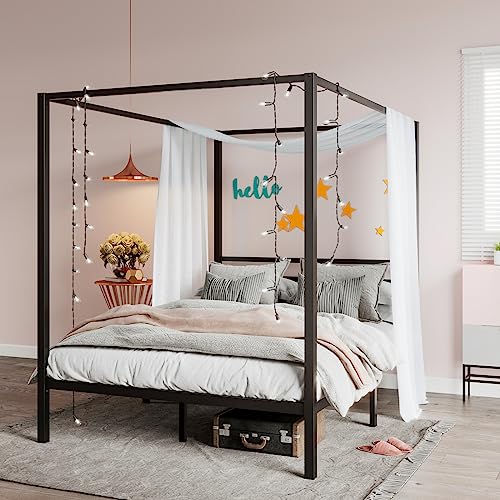
As an Amazon Associate we earn from qualifying purchases at no extra cost to you. Ratings are shown as listed on Amazon.
Quick picks by bedroom situation
| Bedroom situation | Best frame type | Why it fits | Typical price range |
|---|---|---|---|
| Low ceiling or compact room | Low-profile metal canopy | Usually offers the greatest usable ceiling clearance and a lighter visual footprint | $150–$350 |
| Warm, traditional, or cottage style | Solid wood canopy | Natural grain and thicker posts make the bed look like substantial furniture | $400–$1,200+ |
| Frequent moving or renting | Knock-down metal frame | Lower weight and simpler disassembly reduce transport problems | $150–$450 |
| Heavy mattress, two adults, or frequent lounging | Reinforced steel or hardwood frame | Higher central support and stronger joints help limit flexing | $300–$1,200+ |
| Four-poster look without curtains | Minimalist open-frame canopy | Preserves the architectural outline without making the room feel enclosed | $200–$700 |
Metal vs. wood canopy bed frames
Metal: practical clearance and easier assembly
Metal canopy frames are commonly made from powder-coated steel tubing. Their posts can be slim, which helps in smaller rooms, and their lighter components are easier for one person to position before the final bolts are tightened. A typical queen metal canopy may weigh roughly 70–120 pounds, although reinforced models can be substantially heavier.
The main limitation is joint movement. Thin tubing, loose bolts, and poorly aligned corner fittings can create squeaks or side-to-side sway. Metal also transfers vibration readily, so a frame with strong center legs and rubber feet is preferable if either sleeper moves often.
Metal is usually the better choice when ceiling height is uncertain. Many designs are about 75–85 inches high, while taller decorative models can approach 90 inches. Because the posts are narrow, the room may also feel less crowded than it would with thick wooden columns.
Wood: quieter, heavier, and more visually dominant
Wood canopy frames are usually made from solid pine, rubberwood, acacia, oak, or another hardwood, with plywood or engineered panels sometimes used in less visible components. Solid wood posts absorb some vibration and can feel quieter, but the frame’s stability depends heavily on the quality of its joinery and center support.
Wood frames frequently weigh 150–300 pounds or more. That weight improves stability after assembly but makes delivery, moving, and bedroom rearrangement harder. Wood also occupies more visual space: posts around 3–5 inches square can make a modest bedroom feel significantly fuller than one furnished with slim steel tubing.
Choose wood if the canopy is intended to function as a long-term centerpiece and you prefer traditional, farmhouse, coastal, or upholstered bedroom styling. Check every exposed surface for a sealed finish, especially near the floor, where unsealed wood can absorb cleaning liquid and develop swelling or discoloration.
Ceiling-height clearance: measure the real space
Do not compare a frame’s advertised height with your ceiling height and assume the fit is safe. Measure from the finished floor to the lowest obstruction above the bed, such as a ceiling fan, pendant light, beam, sprinkler, or crown molding.
A useful target is at least 4–6 inches of empty space above the canopy’s highest point. For example, if your ceiling is 96 inches high and a ceiling light hangs 8 inches below it, the available height is:
96 inches − 8 inches = 88 inches of usable clearance.
A frame advertised at 84 inches would leave only 4 inches, which may technically fit but could look cramped and make bedding or curtain installation awkward. If you plan to hang fabric, allow additional room for the curtain track, rings, or ties. In a room with an 8-foot ceiling, a frame between 76 and 82 inches is usually easier to live with than a near-ceiling model.
Slat systems that can skip the box spring
Many canopy beds are designed for a mattress to rest directly on slats, eliminating the need for a box spring or foundation. That can reduce both cost and mattress height, but “slatted” does not automatically mean “foundation-free.” Look for three details:
- Slat spacing: Gaps of about 2.5–3 inches are common. Follow the mattress maker’s maximum permitted gap, particularly with foam mattresses.
- Center support: A queen or king frame should normally have a longitudinal center rail and multiple legs reaching the floor. Without them, the slats may bow and the mattress may sag in the middle.
- Slat construction: Closely spaced solid or laminated slats generally provide more continuous support than widely spaced, thin strips.
If a frame requires a separate foundation, adding one can raise the mattress by 5–9 inches and reduce headroom beneath the canopy. It can also make getting into bed more difficult and may cause the top of a thick mattress to sit close to the canopy rails. Confirm the intended mattress-plus-foundation height before buying.
| Specification | Light-duty metal | Reinforced metal | Solid wood |
|---|---|---|---|
| Common queen-frame weight | 70–100 lb | 100–160 lb | 150–300+ lb |
| Typical stated weight capacity | 500–800 lb | 800–1,200 lb | 600–1,000 lb |
| Typical height range | 75–85 in | 78–90 in | 78–96 in |
| Common slat gap | 2.5–5 in | 2.5–3.5 in | 2.5–4 in |
| Assembly difficulty | Low to moderate | Moderate | Moderate to high |
| Useful service expectation | Several years with retightening | Long-term with stable joints | Long-term if finish and joints are maintained |
Weight capacities are manufacturer-stated limits, not a guarantee that every frame will feel equally rigid at that load. Include the weight of both sleepers, the mattress, the foundation if used, bedding, and anyone who regularly sits on the edge. A pair weighing 360 pounds, plus a 120-pound mattress and 40 pounds of bedding, already creates a 520-pound working load before occasional sitting or movement is considered. A frame rated at 600 pounds may fit that calculation, but a higher-rated option leaves a more sensible margin.
Assembly complexity is a buying criterion
A canopy frame has more connections than a conventional platform bed because each corner often joins a vertical post, side rail, headboard or footboard rail, and upper canopy rail. The simplest designs use numbered parts and bolts that remain accessible after assembly. More demanding designs may require aligning dowels, holding long rails overhead, or fitting decorative panels between posts.
- Choose low-complexity construction if you move frequently, assemble furniture alone, or rent. Look for fewer than 20 major components, tool-free cam fittings, and a design that separates into side rails and posts.
- Choose reinforced construction if the bed will stay in one room. Additional center legs, corner brackets, and crossbars add time but usually improve rigidity.
- Plan for two people when upper rails are long or the frame weighs more than about 100 pounds. Holding a rail in position while starting bolts is awkward and increases the risk of stripped threads.
After assembly, leave bolts slightly loose until all rails are aligned, then tighten them in stages. Tightening one corner completely before fitting the opposite side can pull the frame out of square and cause later squeaking.
Ownership realities: what wears first
On metal frames, the first trouble is often a loosening bolt or a compressed plastic foot rather than a broken rail. Check the fasteners after two to four weeks of use and again every few months. Felt or rubber feet protect hard flooring, but they may need replacement if they flatten or slide.
On wood frames, joints and finish deserve the most attention. Dust with a dry or barely damp cloth, avoid soaking the lower posts, and use coasters or protective pads if you attach accessories to the rails. Never drag a heavy wood canopy across the floor; lift it or use furniture sliders designed for its flooring type.
Do not hang heavy shelves, swings, or exercise equipment from the canopy rails unless the manufacturer specifically rates the structure for that load. Decorative fabric is usually light, but concentrated loads can twist a corner joint. Also avoid covering ventilation paths around the mattress if curtains are used, since enclosed fabric can trap heat and moisture.
Bottom line
Select a low-profile metal canopy for limited ceiling height, frequent moving, or a contemporary bedroom. Select reinforced steel when load capacity and economical maintenance matter most. Choose solid wood when you want a quieter, heavier centerpiece and can accommodate its larger footprint and more demanding assembly. In every case, verify the actual height, mattress support requirements, slat spacing, and total weight capacity before choosing a style.