Key takeaways
- For daily commutes: Start with a wired adapter if your phone has a headphone output or you already use a compatible audio player. It avoids adding a charging task and is often the lower-cost option, typically around $10–$25.
- For a phone without a headphone jack: A Bluetooth model avoids a dangling cable and can stream from modern phones. Expect roughly $20–$40 for common models, and check whether the adapter can reconnect automatically after the car starts.
- For occasional drives: Either type can work. A wired model is ready when you are; a rechargeable Bluetooth model may need charging before a trip if it has been sitting unused.
- For a fussy or aging tape deck: Prioritize a return policy and a compact, smooth shell over extra Bluetooth controls. A deck that struggles with ordinary tapes may also struggle with an adapter.
Best Cassette Adapters for Your Car Stereo
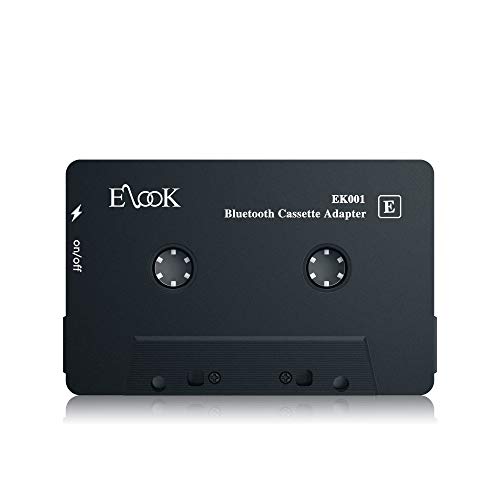
The best cassette adapter for most older cars is a low-noise wired model if you want steady playback without charging; choose a Bluetooth cassette adapter if you need wireless streaming and will keep up with its battery. Before buying, check your deck’s auto-reverse behavior: some transports eject or flip adapters that work in a single direction.
A cassette adapter sends audio through the tape head, so it can add a little hiss and may sound less clear than a direct auxiliary input. The right choice depends less on a long feature list than on how your stereo handles tapes, how often you drive, and whether you want to charge another device.
Our top picks



As an Amazon Associate we earn from qualifying purchases at no extra cost to you. Ratings are shown as listed on Amazon.
Wired vs. Bluetooth: the decision that matters
| Adapter type | Power and runtime | Auto-reverse considerations | Hiss and sound | Best fit |
|---|---|---|---|---|
| Wired, 3.5 mm plug | No adapter battery; powered by the connected audio device | Usually the simpler choice, but cassette shells and transport mechanisms vary | Can be quiet when the cable and plug are in good condition; hiss may come from the deck | Frequent use, minimal charging, and phones or players with a headphone output |
| Bluetooth, rechargeable | Commonly about 6–10 hours per charge; charging time and capacity vary by model | Same mechanical fit concerns as wired models; wireless operation does not make a deck auto-reverse compatible | May have a faint noise floor or connection artifacts; volume matching matters | Wireless streaming from a phone without a headphone jack |
| Bluetooth, replaceable-battery design | Runtime depends on the battery type and use; replaceable cells avoid waiting for a recharge | Check shell shape and directional behavior just as you would with a rechargeable model | Varies by electronics and deck condition | Drivers who prefer swapping batteries over charging, if a suitable model is available |
Runtime figures for Bluetooth adapters are manufacturer-dependent, not a guarantee: battery age, temperature, call use, and volume can change them. A wired adapter has no adapter battery to run down, though it does rely on the phone or music player and its output connection.
Choose by your car and listening habits
- For daily commutes: Start with a wired adapter if your phone has a headphone output or you already use a compatible audio player. It avoids adding a charging task and is often the lower-cost option, typically around $10–$25.
- For a phone without a headphone jack: A Bluetooth model avoids a dangling cable and can stream from modern phones. Expect roughly $20–$40 for common models, and check whether the adapter can reconnect automatically after the car starts.
- For occasional drives: Either type can work. A wired model is ready when you are; a rechargeable Bluetooth model may need charging before a trip if it has been sitting unused.
- For a fussy or aging tape deck: Prioritize a return policy and a compact, smooth shell over extra Bluetooth controls. A deck that struggles with ordinary tapes may also struggle with an adapter.
These are broad market ranges, not fixed prices. Features and availability vary, and a higher price does not guarantee lower hiss or better compatibility.
Auto-reverse: check the transport before the feature list
Auto-reverse decks change tape direction automatically, either at the end of a side or when the mechanism senses resistance. Cassette adapters do not contain music tape in the usual way, so their moving parts and shell design may behave differently from a normal cassette. One deck may play an adapter smoothly while another repeatedly flips, stops, or ejects it.
If your stereo has auto-reverse, look for a model explicitly described as compatible with auto-reverse, but treat that claim as a starting point rather than a guarantee for every deck. If the adapter plays only in one direction, try the deck’s manual direction control if it has one. Don’t repeatedly force a cassette that the mechanism is rejecting; that can strain an already worn transport.
When your stereo has a removable faceplate or a narrow cassette opening, check the adapter’s shell dimensions and cable exit direction. A cable that bends sharply against the dash can pull the shell out of alignment or wear at the plug.
How to reduce hiss and uneven volume
Some hiss is normal: the adapter’s signal passes through a tape head and the stereo’s tape circuitry. A clean adapter cannot fix noise from a worn head, failing belts, or an aging amplifier, but a few adjustments can help identify the source.
- Set a sensible volume balance. Start with the phone around 70–80% volume, then raise the car stereo to a comfortable level. If the phone is too quiet, the stereo may amplify its own background noise; if it is too loud, the signal can distort.
- Compare sources at the same listening level. A radio station that sounds louder can seem clearer simply because it is louder. Match volumes before judging hiss or bass.
- Inspect the plug and cable on a wired model. A loose or dirty connection can cause crackling that is easy to mistake for tape hiss. Keep the cable from being pinched in the console or door.
- Check Bluetooth distance and battery state. Keep the phone in the cabin and the adapter charged. A weak connection or low battery can cause dropouts that are different from steady tape-deck hiss.
- Clean the tape head if the deck’s sound is dull or inconsistent. Use a cassette-deck cleaning method appropriate for the stereo, following the manufacturer’s guidance. Avoid inserting sharp objects or household liquids into the slot.
If the radio itself is noisy, distorted, or inconsistent, the problem may be the stereo rather than the adapter. An adapter is a budget workaround, not a repair for a failing tape mechanism.
Ownership costs and what tends to wear first
For a Bluetooth model, the built-in battery is the main long-term consumable. Rechargeable cells lose capacity over time, and a sealed adapter may need replacement when its runtime becomes too short. Avoid leaving it in a hot parked car: heat is hard on small batteries and electronics.
For a wired adapter, the cable and plug are common weak points. Pull the plug by its housing rather than the wire, and store the cable without tight knots. On either type, the shell can collect dust and the cassette transport can wear or jam. If the adapter starts clicking, dragging, or triggering repeated reversals, stop playback and remove it carefully rather than letting the deck keep cycling.
For example, suppose a Bluetooth adapter costs $30 and is used for a 30-minute commute on five days each week. That is about 130 hours of listening per year. If it provides eight hours per charge, you would recharge roughly 16 times a year (130 ÷ 8), before allowing for battery aging or shorter real-world runtime. A wired model avoids those adapter charges, but may be less convenient if your phone needs a separate headphone-jack dongle.
Bottom line
Pick a wired cassette adapter for simple, frequent listening when a cable is acceptable and you want to avoid charging another device. Pick Bluetooth for a phone without a headphone output or for a cleaner wireless setup, provided you are comfortable charging it and its controls suit your car. For either type, auto-reverse compatibility and a well-fitting shell matter more than a promise of “premium sound”—and a healthy tape deck is the best starting point for keeping hiss and playback problems down.