Key takeaways
- Throat depth: select at least 1 inch more than the widest cut you normally make. A 9-inch-class saw commonly offers about 9 inches of nominal throat, but the practical capacity is lower once your hands, fence, and blade drift are considered.
- Cutting height: choose a machine whose stated capacity exceeds your stock thickness by at least 1/2 inch. This leaves room for a flat workpiece, a properly tensioned blade, and a controlled feed.
- Motor power: compact machines in the roughly 2.8- to 3.5-amp range suit general hobby work. A 1/3-horsepower machine offers better reserve, especially with hardwood and resaw blades, but it still requires a slow, steady feed.
- Table size: a larger table supports wide stock, but it also increases the bench footprint. Do not buy extra capacity that prevents you from safely supporting the work.
The best benchtop bandsaws for small workshops are the Rikon 10-305 for frequent woodworking, the WEN BA3962 for the strongest low-cost specification, and the WEN BA3959 for occasional cuts where limited bench space matters most.
Choosing between them is less about the advertised wheel diameter than about three measurements: throat depth, cutting height, and motor power. Throat depth determines how wide a board can be guided past the blade; cutting height determines how thick the workpiece can be; and motor power indicates how confidently the saw can maintain blade speed in hardwood or during resawing.
Our top picks
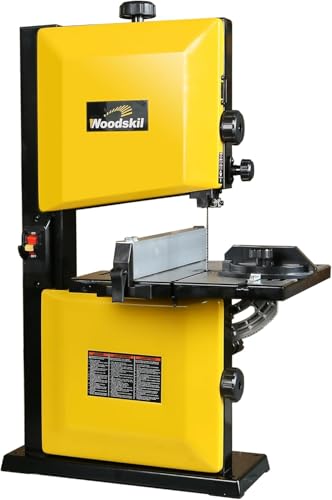


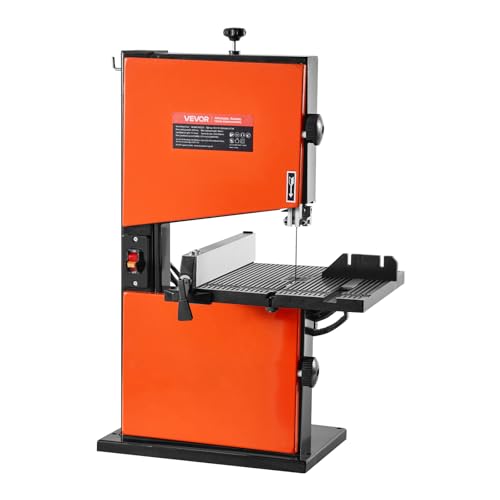
As an Amazon Associate we earn from qualifying purchases at no extra cost to you. Ratings are shown as listed on Amazon.
Best benchtop bandsaws by workshop situation
| Workshop need | Best fit | Why it fits | Main limitation |
|---|---|---|---|
| Lowest-cost occasional use | WEN BA3959 | Compact 9-inch format, 2.8-amp motor, and approximately 3-1/2-inch cutting height | Limited resaw capacity and less reserve for dense hardwood |
| Small shop needing more capacity | WEN BA3962 | 3.5-amp motor, 9.75-inch wheels, and approximately 6-inch cutting height | Still a benchtop saw; large stock needs careful feeding |
| Frequent woodworking and better construction | Rikon 10-305 | 1/3-horsepower motor, roughly 4-5/8-inch throat and resaw capacity, plus a heavier steel build | Costs more and occupies more bench space |
| Curves, small blanks, and model work | Any 9-inch benchtop model with a narrow blade | Small wheels and a compact table are easy to use for controlled curved cuts | Small wheels are less suitable for tall resawing |
Our picks, compared directly
Rikon 10-305: best for regular woodworking
The Rikon 10-305 is the strongest choice when a benchtop bandsaw will be used every week rather than stored for occasional projects. Its 10-inch wheel size, 1/3-horsepower motor, and approximately 4-5/8-inch throat and resaw capacity provide a useful middle ground: enough room for furniture components and bowl blanks without moving to a large floor-standing machine.
Its steel construction and heavier overall design help reduce vibration compared with very light entry-level saws. That matters when following a curve, cutting joinery-sized stock, or making a resaw cut where wandering wastes valuable wood. It is also a sensible platform for upgrading to a better blade.
Choose it if you can dedicate a permanent bench position and expect to cut hardwood, blanks, or thicker stock regularly. Choose something smaller if your normal work consists of thin plywood, craft parts, and occasional curves.
WEN BA3962: best capacity per dollar
The WEN BA3962 is appealing when cutting height is the priority. Its 9.75-inch wheels, 3.5-amp motor, and approximately 6-inch maximum cutting height give it more vertical capacity than many compact 9-inch saws. That makes it useful for thicker stock, small logs, and occasional resawing.
The extra height does not make it a production resaw machine. The supplied blade, fence alignment, wheel tracking, and feed rate all affect results. Nevertheless, the specification is unusually useful for a small workshop: it can handle work that would simply exceed the opening of a smaller saw.
Buy the BA3962 when you need maximum versatility within a modest budget and have enough bench depth for its larger footprint. It is less attractive for a cramped apartment-style workspace or for users who rarely cut material thicker than 1-1/2 inches.
WEN BA3959: best compact budget option
The WEN BA3959 keeps the footprint and cost down with a 9-inch wheel format, a 2.8-amp motor, and approximately 3-1/2 inches of cutting height. It is well suited to small projects, curved cuts, thin hardwood, plywood, and hobby work.
Its limitation is not the ability to cut; it is the amount of material it can cut comfortably. A 3-inch hardwood resaw cut is a demanding job for a compact saw with limited motor reserve. If you expect to process thick boards, a larger saw usually saves time and produces straighter results.
How to match throat depth and cutting height to your work
- Throat depth: select at least 1 inch more than the widest cut you normally make. A 9-inch-class saw commonly offers about 9 inches of nominal throat, but the practical capacity is lower once your hands, fence, and blade drift are considered.
- Cutting height: choose a machine whose stated capacity exceeds your stock thickness by at least 1/2 inch. This leaves room for a flat workpiece, a properly tensioned blade, and a controlled feed.
- Motor power: compact machines in the roughly 2.8- to 3.5-amp range suit general hobby work. A 1/3-horsepower machine offers better reserve, especially with hardwood and resaw blades, but it still requires a slow, steady feed.
- Table size: a larger table supports wide stock, but it also increases the bench footprint. Do not buy extra capacity that prevents you from safely supporting the work.
A practical sizing calculation
Suppose your projects use boards up to 4 inches thick and 8 inches wide. A 3-1/2-inch-capacity saw is immediately disqualified, regardless of its attractive price. A machine rated around 4-5/8 inches technically fits, but leaves only 5/8 inch of vertical margin. A 6-inch-capacity model leaves 2 inches of margin and will be easier to set up for repeated cuts.
For the same project, an advertised 9-inch throat may be adequate for an 8-inch-wide board, but only just. If you routinely cut panels or wide curves, look for more throat capacity or plan to use a jigsaw or track saw for those operations. A bandsaw should not be forced to perform every type of stock breakdown.
Blade choice matters more than a small motor difference
A narrow blade, such as 1/8 inch, turns more readily for tight curves. A 1/4-inch blade is a useful general-purpose choice for many small-shop cuts. For resawing, use a wider blade with fewer teeth per inch, provided the saw’s guides and wheel capacity support it.
More teeth are not automatically better. A fine-tooth blade can clog in thick wood because the gullets do not clear chips quickly. A coarse blade cuts faster and stays cooler in resawing, while a fine blade leaves a cleaner edge in thin material. Match the blade to the stock rather than leaving the supplied blade installed for every task.
Ownership realities and setup mistakes
The first parts likely to need attention are the blade, tires, guide bearings, and drive belt. Blades dull or develop tooth damage; rubber tires collect resin and can lose grip; bearings may become noisy or rough; and belts can glaze or stretch. Replacement blades are a normal consumable cost, not evidence that the machine has failed.
Before making a demanding cut, carry out this setup sequence:
- Unplug the saw and check that the blade is seated on the wheel crowns rather than riding against a flange.
- Set blade tension according to the manufacturer’s guidance, then check tracking by turning the wheels by hand.
- Position the upper and lower guides close to the workpiece without touching the teeth.
- Align the fence to the actual blade drift; do not assume the fence should be perfectly parallel with the table slot.
- Make a test cut in scrap before cutting expensive stock.
Clean sawdust from the lower wheel housing and table after use. Dust buildup can interfere with tracking and conceal a damaged tire. A shop vacuum helps, but avoid directing compressed air into bearings or electrical controls because it can drive fine dust deeper into the machine.
What should you spend?
Compact benchtop bandsaws generally occupy the lower general-purpose tool price range, while heavier steel models and better-guided machines move into the mid-range. Budget for a quality replacement blade, dust collection hose, push stick, and a stable stand or reinforced bench. A cheap saw on a flexible table often performs worse than a modest saw on a rigid, level surface.
For occasional hobby cuts, the WEN BA3959 is the economical choice. For the best combination of capacity and price, choose the WEN BA3962. For regular woodworking where reduced vibration and sturdier construction justify additional cost, the Rikon 10-305 is the better long-term choice. Whichever model you select, buy according to your largest recurring cut—not the largest cut you might make once—and leave enough space to feed stock safely.