Key takeaways
- Five solar chargers for off-grid travel, from a pocket-size 5-watt panel to folding 100-watt panels, with wattage, weight, and port guidance.
- Top Pick: Jackery SolarSaga 100W Bifacial Solar Panel
- Runner-up: Anker SOLIX PS100 Bifacial Solar Panel
- Also consider: BigBlue 28W Solar Panel Charger
When the trail leaves the last outlet behind, a solar charger turns daylight into phone calls, maps, photos, and light. The best travel solar chargers are foldable panels that pack flat, plug straight into a phone or a power bank, and keep working outdoors.
Solar power has one honest limit: a panel only makes power while the sun hits it, and clouds, shade, and a poor angle all cut output. That is why the strongest setups pair a panel with a power bank.
As an Amazon Associate, we earn from qualifying purchases.
Quick Answer
For off-grid travel, a 100-watt folding panel suits base camps and power stations, while a 20 to 28-watt panel fits daypacks and phone charging. Panels charge only in direct sun, so pair one with a power bank for cloudy hours and night use. The Jackery SolarSaga 100W leads for power, the BigBlue 28W leads for pack weight, and the BioLite 5+ leads for ultralight trips.
Jackery SolarSaga 100W Bifacial Solar Panel
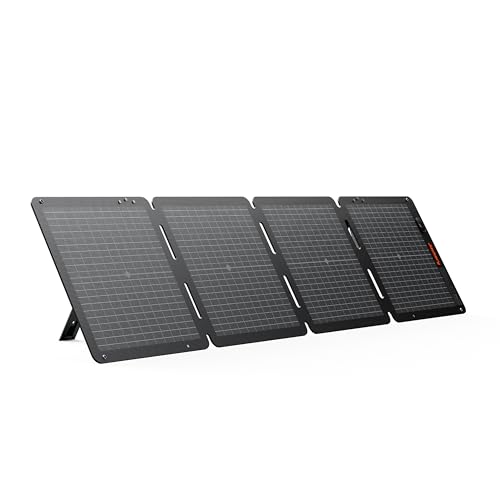
The Jackery SolarSaga 100W Bifacial is the strongest panel in this roundup, and the right pick when the trip has a base camp. It is a 100-watt folding panel with bifacial cells, so the rear side also catches reflected light. The maker rates cell efficiency at 25 percent.
USB-A at 5 volts and 2.4 amps and USB-C at 5 volts and 3 amps charge two devices at once. The panel is built mainly to feed a portable power station, and it pairs with Jackery Explorer 240, 300, 500, 1000, and 1500 stations. One listing field reads 23.6 pounds for item weight, which conflicts with the panel’s folded size, so this article does not repeat that figure. The dimensions field reads 10 by 10 by 10 inches, which is clearly a placeholder. Confirm the weight at checkout; this panel suits a shared power source at camp.
Specs
| Feature | Detail |
|---|---|
| Rated power | 100 watts |
| Cell efficiency | 25 percent |
| USB outputs | USB-A 5 volts, 2.4 amps; USB-C 5 volts, 3 amps |
| Unfolded size | 48 x 21 x 0.79 inches |
| Folded size | 24 x 21 x 1.4 inches |
| Model number | JS-100F |
Anker SOLIX PS100 Bifacial Solar Panel

The Anker SOLIX PS100 is the lightest 100-watt panel in this roundup, and the best match for a traveler who wants full-size solar power without full-size bulk. It is a bifacial folding panel with N-type cells and a fixed 35-degree stand. The maker rates conversion efficiency above 25 percent, with a PV output of 21.6 volts at 4.63 amps.
It folds to 20.1 by 23.6 by 2.5 inches and weighs 6.2 pounds. Two 8.2-foot solar cables and one 1.6-foot XT60i cable are included, and Anker covers the panel with a 5-year warranty. It pairs cleanly with Anker SOLIX C300-class power stations. The Amazon listing disagrees with the maker: the listing title says IP67 and 23 percent efficiency, while the maker and retailers say IP68 and above 25 percent efficiency, and the listing’s weight field reads 10.5 pounds against the maker’s 6.2 pounds. This article follows the maker figures. In real use, expect output well below the rated 100 watts.
Specs
| Feature | Detail |
|---|---|
| Rated power | 100 watts |
| Conversion efficiency | Above 25 percent (maker); listing reads 23 percent |
| PV output | 21.6 volts, 4.63 amps |
| Unfolded size | 40.6 x 23.6 x 0.7 inches |
| Folded size | 20.1 x 23.6 x 2.5 inches |
| Weight | 6.2 pounds (about 7 pounds with stand) |
BigBlue 28W Solar Panel Charger

The BigBlue 28W is the best all-round travel panel in this roundup: light enough for a daypack, strong enough to charge a phone at a useful speed, and built around three USB ports instead of the usual two. It folds to 11.1 by 6.3 by 1.34 inches and weighs 1.48 pounds, so it rides flat in a pack.
Two USB-C ports and one USB-A port deliver up to 5 volts and 3 amps each, with a combined maximum of 5 volts and 4.8 amps, N-type cells rated at 25.4 percent efficiency feed the ports, and the panels carry an IP44 rating. A recent mirror showed only 10 left in stock, fulfilled by Amazon. The panel has no built-in battery and cannot store electricity, so it only works in direct sunlight while a device is connected. That suits travelers who already carry a power bank: the panel fills the bank by day, and the bank does the night shift. The model number reads B401DD in the Amazon listing and B401D in the Canadian listing, so confirm the 28-watt triple-port listing at checkout.
Specs
| Feature | Detail |
|---|---|
| Rated power | 28 watts |
| Conversion efficiency | 25.4 percent |
| USB outputs | 2 x USB-C, 1 x USB-A |
| Combined output | 5 volts, 4.8 amps maximum |
| Folded size | 11.1 x 6.3 x 1.34 inches |
| Weight | 1.48 pounds |
| Water resistance | IP44 panels; USB junction box not waterproof |
| Built-in battery | None |
| Model number | B401DD (Canadian listing reads B401D) |
Goal Zero Nomad 20 Solar Panel
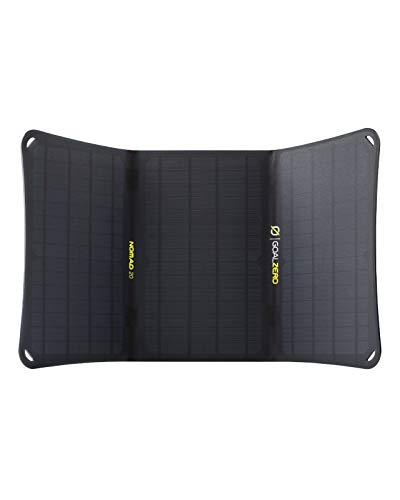
The Goal Zero Nomad 20 is the most refined small panel in this roundup, and the right pick for travelers who want a panel that feels made for a backpack rather than bolted onto one. It is a 20-watt folding panel with three monocrystalline sections, a built-in kickstand that clicks into place at several angles, integrated cable storage, and a Flip dock. It weighs 2.28 pounds, folds to 11.5 by 7.4 by 1.25 inches,
A USB port at 5 volts and up to 2.1 amps and an 8-millimeter solar port at 14 to 22 volts and up to 1.3 amps serve Goal Zero power packs and solar generators. It is chainable, and Goal Zero covers it with a 2-year warranty. The model number is 11910, and that number matters: an older Nomad 20, model 12004, is listed as no longer available at one major retailer, and it is a different, older panel with different dimensions. The code comes from the Canadian Amazon listing, so confirm it on the United States listing before posting. The USB port tops out at 2.1 amps, so a tablet charges slowly and a laptop does not charge from this panel.
Specs
| Feature | Detail |
|---|---|
| Rated power | 20 watts |
| USB output | 5 volts, up to 2.1 amps |
| Solar port | 8-millimeter, 14 to 22 volts, up to 1.3 amps |
| Unfolded size | 11.5 x 21.75 x 0.75 inches |
| Folded size | 11.5 x 7.4 x 1.25 inches |
| Weight | 2.28 pounds |
| Kickstand | Built-in, adjustable angles |
| Warranty | 2 years |
| Model number | 11910 |
BioLite SolarPanel 5+

The BioLite SolarPanel 5+, model SPA0200, is the ultralight pick in this roundup, and the only panel here with a battery of its own. It is a 5-watt monocrystalline panel with a 3,200 milliamp-hour onboard battery that stores what the panel collects during the day, so a phone can charge after sunset or under cloud. The panel measures 10.12 by 8.19 by 0.94 inches and weighs 13.76 ounces, and it carries a single USB-A output.
The Optimal Sun System uses an analog sundial to align the panel to direct sun, and a 360-degree kickstand holds the angle on uneven ground. The panel is IPX4 rated against splashing water, and an Auto Reconnect feature resumes charging after a passing cloud interrupts it. Two details need a flag. First, the battery size: current sources say 3,200 milliamp-hours, while older sources say 2,200. This article uses 3,200. Second, stock: one outdoor retailer shows the panel out of stock, but that is that retailer’s stock, not Amazon’s, and the maker’s own store shows it in stock. Confirm the Amazon listing at checkout. The buffer holds roughly a quarter of a typical large phone’s charge, so think of it as a top-up reserve.
Specs
| Feature | Detail |
|---|---|
| Rated power | 5 watts |
| Onboard battery | 3,200 milliamp-hours (older sources read 2,200) |
| USB output | 1 x USB-A |
| Size | 10.12 x 8.19 x 0.94 inches |
| Weight | 13.76 ounces |
| Water resistance | IPX4, splash resistant |
| Sun alignment | Analog sundial (Optimal Sun System) |
| Kickstand | 360 degrees |
| Model number | SPA0200 |
How to choose
Match the wattage to the job, not to the biggest number on the page. A 5-watt panel keeps a phone alive on a trail. A 20 to 28-watt panel charges a phone at a useful speed and fills a power bank over a day. A 100-watt panel feeds a power station at a base camp. No panel works at night, so plan the power bank as part of the kit.
A 100-watt panel is base-camp gear, while a 28-watt panel disappears into a daypack and a 5-watt panel disappears into a jacket pocket. Check the ports: USB-C and USB-A cover phones, cameras, and power banks, while a power station needs the right solar cable and connector.
Who should skip
Skip a solar panel entirely if the trip stays near outlets, because a wall charger and a power bank weigh less. Skip the 100-watt panels if the trip is on foot with no base camp, because their size and weight punish every mile. Skip the 5-watt BioLite if the job is a tablet or a camera battery that needs real current, because 5 watts is a trickle.
Travelers who need power on a schedule should also skip solar as the only source. A panel cannot promise a full phone by morning, and a cloudy day can leave a bank half full. In that case, carry a fully charged power bank as the main source and treat the panel as a way to stretch it, not replace it. Skip any listing whose code cannot be confirmed.
Frequently Asked Questions
Do solar chargers work on cloudy days?
They work, but output drops sharply. A panel makes its rated power only in direct sun at the right angle, and cloud cover can cut output to a small fraction of that figure. Treat a cloudy day as a slow top-up day.
Can a solar panel charge a phone directly?
Yes, if the panel has a USB port and the sun is direct. Plug the phone in, angle the panel at the sun, and leave it alone. The BigBlue 28W and the BioLite 5+ both charge phones directly.
Do I need a power bank with a solar panel?
For most trips, yes. A panel without a battery stops when the sun goes down or a cloud passes. A power bank collects the panel’s output steadily by day and charges gear reliably after dark.
How do I keep a solar panel working on a trail?
Keep the panel clean, keep it angled at the sun, and keep shade off every cell. Strap it to the outside of the pack while walking and prop it on its kickstand at camp.
Final verdict
For most off-grid travelers, the BigBlue 28W balances weight, output, and ports, and it fits the widest range of trips. The Jackery SolarSaga 100W Bifacial leads for base camps and power stations, while the Anker SOLIX PS100 leads for travelers who want 100 watts at the lowest carry weight. The Goal Zero Nomad 20 suits backpacks, and the BioLite 5+ suits ultralight trips.
More from Amazon
Programs that pair well with the guide above. Offers and eligibility are set by Amazon and may change.
Free shipping on eligible items, Prime Video and more. Eligible new members can start with a free trial.
Start a Prime free trialA Prime membership for ages 18-24 with a trial period. Eligibility is set by Amazon.
See Prime for Young AdultsAudiobooks and podcasts to listen to on the go. Eligible new members can start with a free trial.
Try Audible freeAd-free music streaming. Eligible new subscribers can start with a free trial.
Try Music Unlimited freeAs an Amazon Associate we earn from qualifying purchases.